Impression LANCIA Ypsilon LX Elettrica by DrivOlution
Test report

✨ La dolce vita goes electric ⚡ — Lancia revives, courtesy of Stellantis
After years in the shadows, Lancia returns as a full member of the Stellantis family. The iconic Italian brand is getting a second wind, with a sharp focus on electrification, refined design, and an ambitious European relaunch.
The new all-electric Ypsilon leads the way. A compact city car with pure Italian flair and a rear end that playfully nods to the legendary Lancia Stratos. Thanks to Gent Motors, we spent two days behind the wheel of the Ypsilon LX Elettrica, discovering how quiet refinement has taken the place of squealing tyres and rally dust.
With 117 years of history, Lancia stands for timeless elegance, making the world dream with icons such as the graceful Flaminia and Aurelia B24 Spider, the high-performance Delta, Stratos and 037, the characterful Fulvia, and the versatile Beta HPE. Today, staying true to its principles of innovation and timeless design, the brand now also embraces sustainability, customer focus, and social responsibility.
Lancia’s renaissance is backed by a bold 10-year plan — ready to win hearts all over again, this time powered by electricity.
General information
- Hatchback 5D
- Number of seats 5
- Mass in running order 1.733 kg
- LxWxH (mm) 4.080 x 1.760 x 1.440
- Price test vehicle (VTAi) 49.995, - euro (op basis van configuratie)
- Boot capacity 309 L / 1.118 L (max)
- Front trunk (frunk) load volume 0 L
Driveline
- BEV (Battery Electric Vehicle)
- Battery type Lithium-ion (NMC)
- 54 kWh battery capacity (51 kWh usable)
- Power 115 kW (156 pk)
- Torque 260 Nm
- Front-wheel drive (FWD)
- Architecture 400 V
- Ev-platform e-CMP2
Consumption/driving range (WLTP)
- Combined consumption 14,3 kWh/100 km
- Combined driving range 403 km
- Driving range city --- km
Charging information
- Internal on-board charger 11 kW
- Charging port at rear left
- Charge Power AC 11 kW
- Charge Power DC 100 kW max.
- AC : 1 charge
- DC : 0 charges
Test track (103 km)
- Non-urban (40 km) 9,7 kWh/100 km
- Motorway (42 km) 12,9 kWh/100 km
- City (21 km) 8,2 kWh/100 km
- Combined 10,3 kWh/100 km
Test results (294 km)
- Non-urban 9,3 kWh/100 km
- Motorway 12,2 kWh/100 km
- City 8,2 kWh/100 km
- Combined 10,3 kWh/100 km
Test data
Test drivers
Johan Stevens
294 Testkilometers
Drivetrain
Ypsilon - Two drives, one Italian soul.
The new Lancia Ypsilon embodies Italian elegance in two guises.
- The Ypsilon Elettrica, the all-electric variant, drives completely emission-free, with a 54 kWh battery (51 kWh usable) and up to 425 km WLTP range.
- The Ypsilon Ibrida uses a 1.2-litre three-cylinder petrol engine, coupled with a mild-hybrid system with 48V technology and a compact electric motor. The result: smooth starts, quieter driving at low speeds, and lower consumption - without the need to charge. Ideal for those who want to make the switch to electric without sacrificing freedom.
Platform - eCMP
The entire Lancia Ypsilon range (electric) is on the e-CMP2 platform and features front-wheel drive. This is the same platform used by other compact electric cars within the Stellantis group, such as the Peugeot e-208, Opel/Vauxhall Corsa-e, Fiat 600e, Jeep Avenger, and DS 3 E-Tense.
The Ypsilon, Ypsilon LX and Ypsilon HF-Line share the same electric motor of 115 kW (156 hp) and 260 Nm torque, powered by a 54 kWh battery (51 kWh usable). This gives a WLTP driving range of 403 to 425 km in the standard versions.
The top version, the Ypsilon HF with 280 hp (207 kW) and 345 Nm, stays true to the same battery pack, but pairs it with extra performance. Here, the WLTP range drops to around 370 km.
Versions
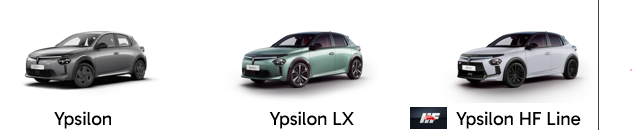
Version | Key extras |
|---|---|
Ypsilon (basic) | 16″ Aero wheels, full-LED lighting, 2× 10.25″ screens (digital+ infotainment), wireless Apple CarPlay/Android Auto, automatic air conditioning, rear parking sensor, driving assistance systems such as lane assist & traffic sign recognition |
Ypsilon LX | 17″ diamond-cut wheels, privacy glass, premium velour seats, ambient lighting, front+rear camera, adaptive cruise control with Stop&Go, blind spot detection, induction charger and additional USB-C ports |
HF‑Line (electric) | Sporty variant (available later in 2025), HF logos, lowered sports suspension, dark 17″ wheels, specific HF styling, drive mode selector with Level-2 autonomy, adaptive cruise, keyless entry, armrest, aluminium pedals and sporty interior trim. |
More information on the Ypsilon's range can be found at Ypsilon.
Driving modes: 3
Driving mode | Character | Situation of use |
|---|---|---|
Eco | Low power, limited top speed, maximum efficiency | City, traffic jam, preserve battery capacity as long as possible |
Normal | Full power, balanced performance | Standard daily use |
Sport | Acceleration sharper, steering feel heavier | Smoother motorway journeys or winding roads |
Regenerative braking (standard for all versions)
The Ypsilon offers limited adjustment options via the classic D/B mode:
- In D the car brakes slightly on throttle release, coasting is hardly possible.
- In B recovery is significantly stronger, which is comfortable in city traffic.
A true one-pedal driving experience is lacking.
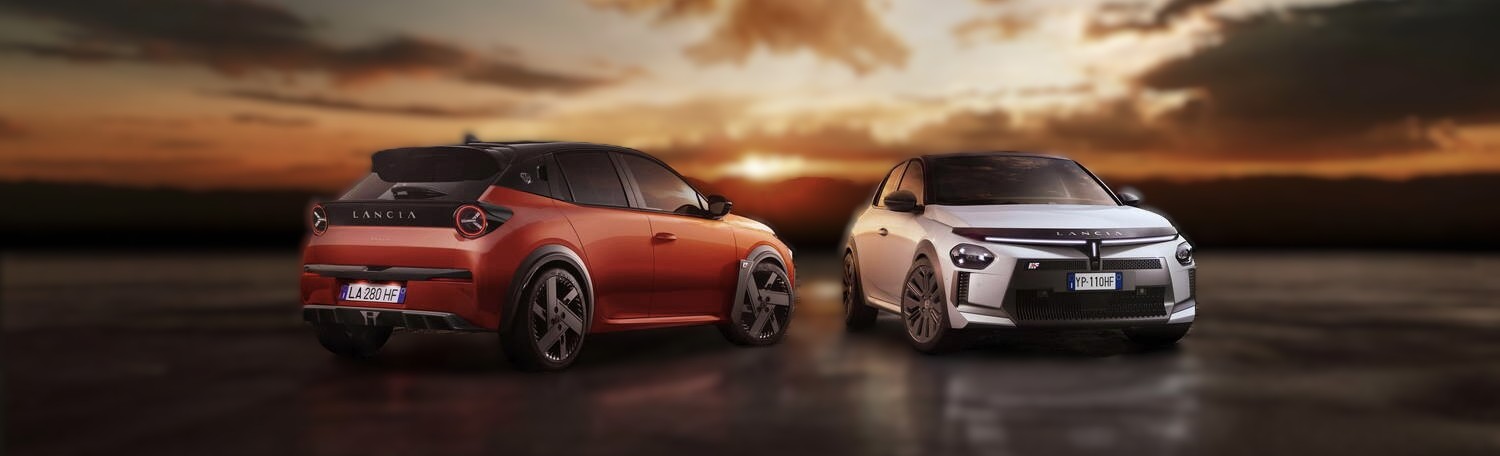
The Lancia Ypsilon HF - the sporty
Since 1951, the running elephant (Elefantino) has been more than a symbol.
Personally chosen by Gianni Lancia, the Elefantino represents strength, courage and victory.
Today it returns on the Ypsilon HF and HF Line: a tribute to legendary racing and unstoppable passion.
HF - High Fidelity - means pure performance, precision and emotion.
From Delta HF to Ypsilon HF: heritage in motion.
Technical data Ypsilon HF 280 CV (Lancia) - the most performant (subject to change)
- Power: 280 hp / 345 Nm
- CO₂ emissions: 0 g/km
- Top speed: 180 km/h
- 0-100 km/h in 5.6 seconds
- Range up to 370 km (WLTP combined)
Consumption
During the short two-day test with the Lancia Ypsilon LX, a total of 294 kilometres were covered, spread over seven trips. According to the on-board computer, the average consumption 10.4 kWh per 100 kilometres. Taking into account the usable battery capacity of 51 kWh, that results in a theoretical driving range of some 490 kilometres - an anything but unkind figure for this compact EV.
Looking at the different parts:
- Consumption by road type
Road type | Number of trips | Percentage (%) | Average consumption (kWh/100 km) |
|---|---|---|---|
Non-urban | 3 | 43 | 9,3 |
Motorway | 3 | 43 | 12,2 |
City | 1 | 14 | 8,2 |
- Consumption by driving mode
Driving mode | Number of trips | Percentage(%) | Average consumption (kWh/100 km) |
|---|---|---|---|
Eco | 5 | 71 | 10,4 |
Normal | 2 | 29 | 10,5 |
Test track
? Always curious to see how the test car performs on our regular test track. This time it was the Lancia Ypsilon LX's turn.
Over the three sections - out of town, motorway and city traffic - we recorded a combined consumption of 10.3 kWh/100 km. Taking into account the usable battery capacity of 51 kWh, this equates to a theoretical driving range of 495 km*.
1. Out of town (Rural roads)
Distance (40.0 km) we arrive at a consumption of 9.7 kWh/100 km.
Start driving range: 340 km - End driving range: 296 km
Consumption: 9.7 kWh/100 km
2. Highway
Distance: 42.0 km yields a consumption of 12.9 kWh/100 km.
Start driving range: 296 km - End driving range: 254 km
Consumption: 12.9 kWh/100 km
3. City
Distance: 21.0 km
Start driving range: 254 km - End driving range: 238 km
Consumption: 8.2 kWh/100 km
Overview
Road type | Consumption (kWh/100 km) | Driving range end of trip |
|---|---|---|
Non-urban | 9,7 | 296 km |
Motorway | 12,9 | 254 km |
City | 8,2 | 238 km |
Average | 10,3 |
? 2. SoC (State of Charge) – Daling per rit
Road type | Start-SoC | Eind-SoC | SoC loss | % Consumption |
|---|---|---|---|---|
Non-urban | 87% | 79% | -8% | 8% |
Motorway | 79% | 68% | -11% | 11% |
City | 68% | 65% | -3% | 3% |
? Total drop SoC over test course (103 km): 22%
? 3. Driving range - Drop per trip
Road type | Driving range start | Driving range end | Loss in km | % Loss (vs. start) |
|---|---|---|---|---|
Non-urban | 340 km | 296 km | -44 km | 13% |
Motorway | 296 km | 254 km | -42 km | 12% |
City | 254 km | 238 km | -16 km | 5% |
? Total decrease driving range: 102 km (which is very close to the effectively driven distance of 103 km → indicates good accuracy)
Calculation of theoretical driving range
Based on the usable battery capacity of 51 kWh and the measured trip consumption in kWh/100 km, we arrive at the following theoretical driving ranges per road type:
Road type | Consumption (kWh/100 km) | Theoretical driving range (km) |
|---|---|---|
Non-urban | 9,7 | 526 |
Motorway | 12,9 | 395 |
City | 8,2 | 622 |
Combined | 10,3 | 495 |
*The stated driving range is a theoretical calculation based on the usable battery capacity. This is always a snapshot. All kinds of factors such as weather conditions, use of air conditioning, topography, traffic density and your own driving style can influence this.
We strive to drive as efficiently as possible by making maximum use of cruise control (constant speed) and by anticipating traffic situations as much as possible. The speed on motorways is 110 km/h. Energy consumers (such as air conditioning) are switched off when weather conditions permit. In addition, we choose the most efficient driving mode (Eco), if available.
Charging and driving range
General
All versions charge via AC with 7.4 kW as standard, with an optional upgrade to 11 kW - standard on the Ypsilon HF. DC fast charging is done with up to 100 kW, good for 10 to 80% in around 24 minutes. Average WLTP consumption ranges from 14.8 to 15.5 kWh/100 km for regular models, to around 15.8 to 16.2 kWh/100 km for the HF-Line.
The loading connector is located at the back on the right side.
Only one charge
During our short test session, one charge sufficed. Via AC, the battery was filled to 100%, good for a promised driving range of 400 km - a remarkably strong result for such a compact BEV.
Unfortunately, the MYLANCIA App remained untested this time - a missed opportunity to discover the digital side of the Ypsilon as well.
Drive and comfort
A piece of Italian flair
With the Ypsilon LX Lancia redefines comfort. The quiet drive, refined sound insulation and smoothly tuned suspension combine to create a driving experience more akin to coming home than being on the road. The interior trim also contributes greatly to this: ergonomically shaped seats upholstered in soft, high-quality materials instantly create a warm and familiar atmosphere. Thanks to automatic climate control, the temperature always remains pleasant and consistent - as if you were sitting in your own living room, but on wheels.
S.A.L.A. platform: your virtual butler
The innovative S.A.L.A. platform (Sound, Air, Light, Augmentation) further enhances that feeling of home. Via the dual 10.25-inch displays, you effortlessly control navigation, infotainment, climate and vehicle settings. The system automatically adjusts brightness and sound to your preferences and conditions. In doing so, S.A.L.A. behaves like a digital butler that doesn't just react, but thinks ahead. Thus, the interior of the Ypsilon LX becomes a place where you not only travel, but you actually feel at home.
Ambient lighting and the 'charming 'coffee table' in the middle bring a touch of Italian homeliness, while the surprisingly spacious boot offers enough space for daily shopping or a weekend trip.
Driver assistance systems (ADAS)
Below is an overview of the main ADAS features of the Lancia Ypsilon LX:
Adaptive cruise control: Automatically adjusts speed based on traffic for a relaxed driving experience .
Parking sensors front and rear: Help with manoeuvring in tight spaces .
Back-up camera: Improves visibility when reversing .
Dead Angle Detection: Warns of vehicles in the blind spot .
Lane Departure Warning (LDW): signals unintended lane departure .
Automatic lighting: Ensures optimal visibility in different lighting conditions .
10.25-inch digital dashboard: Provides clear display of driving information .
These advanced systems contribute to increased levels of safety and relaxation while driving.
Driving range simulation (km) based on trip consumption (kWh/100 km), trip length (km), road type and usuable battery capacity
Theoretical driving range: what does consumption really say?
Based on the measured trip consumption during our two-day trip and the usable battery capacity (51 kWh net), we can simulate the theoretical driving range. Although this always remains a snapshot, it does give a clear picture of how far you could drive in ideal conditions for a given average consumption.
Of course, numerous external factors - such as driving style, temperature, wind, topography and use of heating or air conditioning - affect this result in practice. Nevertheless, this calculation remains a relevant indicator of the car's efficiency in different driving conditions.