Test review DrivOlution BMW iX3 50 xDrive
Test report
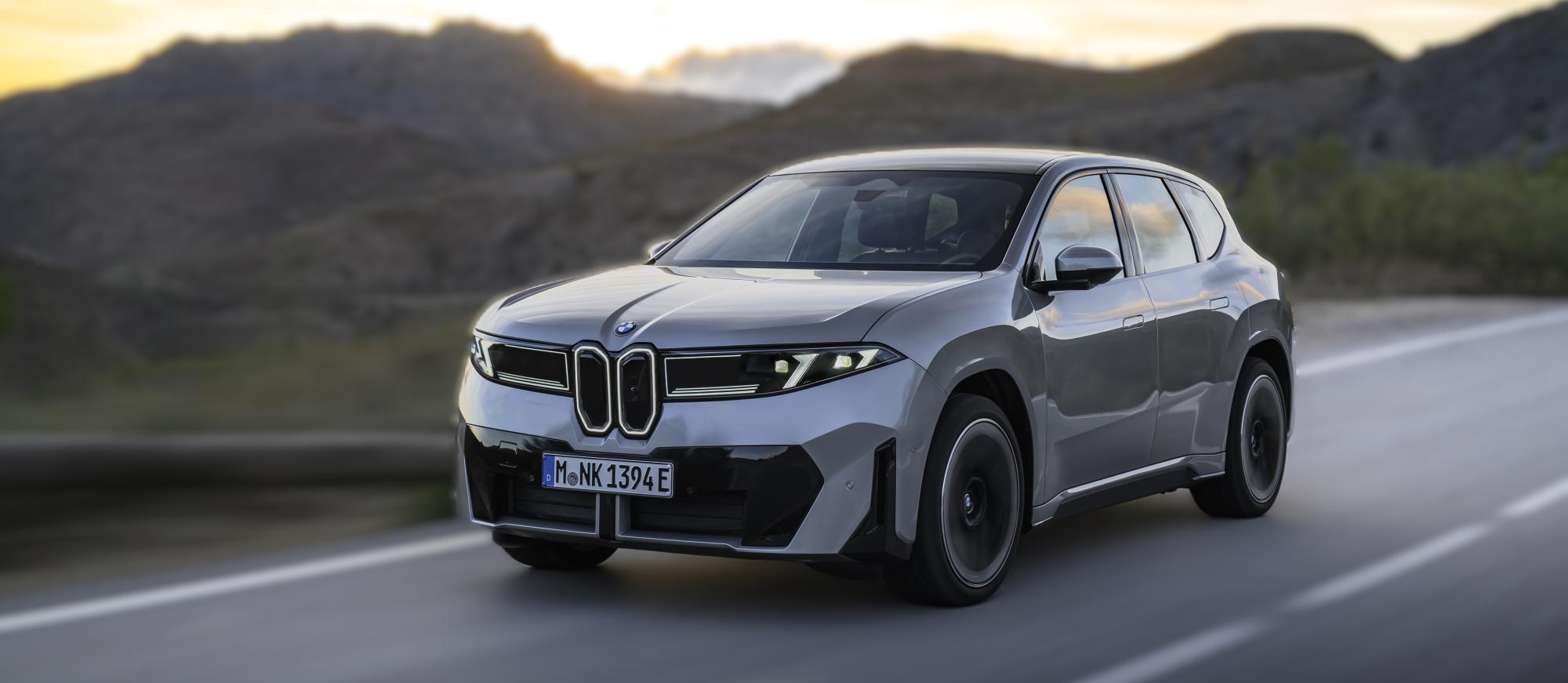
BMW iX3 50 xDrive: a new generation, but what does that mean on the road?
With the new BMW iX3 50 xDrive, BMW is taking a significant step towards its electric future. The iX3 is not simply the successor to an existing model, but the first production model of the Neue Klasse. A new vehicle architecture, an 800V electrical system, a new generation of battery technology and extensive digitalisation are designed above all to deliver greater efficiency, a longer driving range and faster charging.
On paper, expectations are therefore high. But as always with DrivOlution, we are primarily interested in how well these hold up in everyday use.
That’s why we put the iX3 50 xDrive through its paces extensively during our test period. In total, we covered 1,030 kilometres, across a variety of road types and driving conditions. We also drove our standard DrivOlution test route, comprising out-of-town roads, motorways and city traffic.
Our focus was not on pushing the car to its limits, but on the questions that are far more relevant to a driver or fleet manager: how efficient is this new iX3 in practice, what is a realistic driving range, how does the road surface affect performance, and how impressive are the new 800V technology and charging performance?
And, of course, we looked beyond the figures alone. Comfort, controls, driving modes, regeneration and driver-assistance systems are also part of everyday use.
So it’s time to find out how many of the Neue Klasse’s promises the BMW iX3 50 xDrive can deliver in practice.
General information
- SAV (Sport Activity Vehicle)
- Number of seats 5
- Mass in running order 2.360 kg
- LxWxH (mm) 4.782 x 2.093 x 1.635
- Price test vehicle (VTAi) 87.365,0- euro
- Cargo volume 520 L / 1.750 L (max)
- Cargo volume frunk 58 L
- Tow bar possible (2.000 kg braked - 750 kg unbraked)
- Warranty : 3 years without kilometre limit
Drivetrain
- BEV (Battery Electric Vehicle)
- Battery type Lithium-ion (NMC)
- 115 kWh battery capacity (108,7 kWh usable)
- Power 345 kW (469 hp)
- Torque 645 Nm
- AWD
- Architecture 800 V
- EV-platform BMW Neue Klasse
- Bidirectional Charging (V2X / BPT) – yes
- Vehicle-to-load (V2L) yes (3,7 kW AC)
Consumption/driving range (WLTP) (CoC)
- Combined consumption 16,7 kWh/100 km
- Combined driving range 734 km
- Driving range city 923 km
Recharging information
- Internal onboard charger 11 kW
- Charging port rear right
- Charge Power AC 11 kW
- Charge Power DC 400 kW max.
- AC : 1 charge
- DC : 1 charge
- Battery preheating possible yes
Test track
- Non-urban (44,6 km) 10,9 kWh/100 km
- Motorway (40,0 km) 15,5 kWh/100 km
- City (21,0 km) 10,1 kWh/100 km
- Combined 12,2 kWh/100 km
Test results
- Non-urban 11,9 kWh/100 km
- Motorway 14,8 kWh/100 km
- City 10,1 kWh/100 km
- Mix 16,4 kWh/100 km
- Combined 14,2 kWh/100 km
Test data
Test drivers
Johan Stevens
1030 Testkilometers
Drivetrain
Neue Klasse: more than just a new EV platform
The iX3’s bodywork conceals what is perhaps its most significant innovation. As the first production model in BMW’s Neue Klasse range, it introduces a completely new electrical and electronic architecture.
At the heart of the system is the sixth-generation BMW eDrive technology (Gen6), featuring an 800V electrical system, new electric motors and cylindrical battery cells. These cells are integrated directly into the battery pack, whilst the battery itself forms part of the vehicle’s structure. The result is expected to deliver lower weight, higher efficiency, greater driving range and, above all, significantly faster charging speeds.
But Neue Klasse goes beyond the battery and powertrain. With four powerful central computers – the so-called ‘superbrains’ – BMW is replacing a large number of individual control units. The best known of these is the Heart of Joy, which coordinates the powertrain, energy recovery, braking and driving dynamics at lightning speed.
The iX3 is therefore not only a new electric SUV, but above all the first tangible result of BMW’s new technological platform for the next generation of models.
Two batteries, two characters
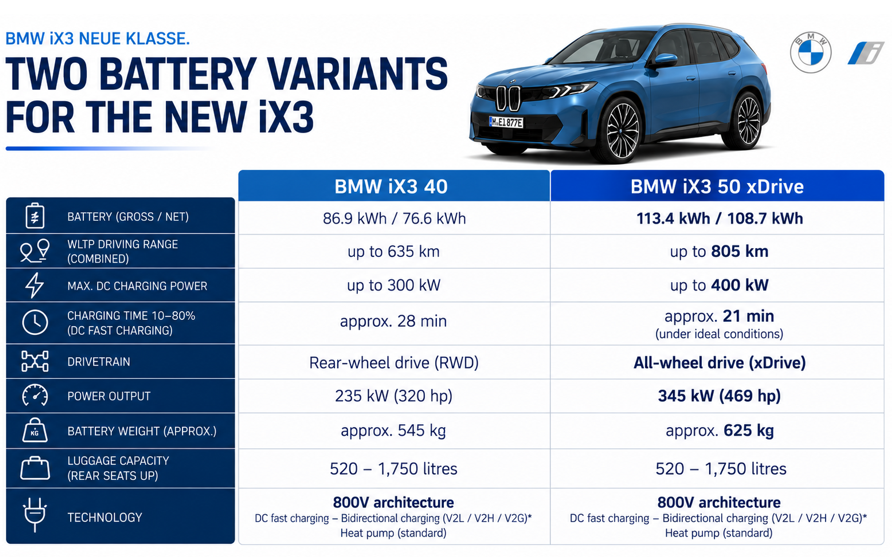
BMW is offering the new iX3 with two different battery configurations. The iX3 40 combines a battery with a capacity of 86.9 kWh gross (76.6 kWh net) with rear-wheel drive and 235 kW (320 PS). With this, BMW promises a WLTP range of up to 635 kilometres and a DC charging capacity of up to 300 kW.
The iX3 50 xDrive, which we’re taking for a spin, takes things a step further. Its larger battery, with a capacity of 113.7 kWh gross (108.4 kWh net), powers two electric motors, delivering all-wheel drive and 345 kW (469 pk). The WLTP range extends to 805 kilometres, whilst the 800V architecture enables DC charging at up to 400 kW.
BMW Experience Modes
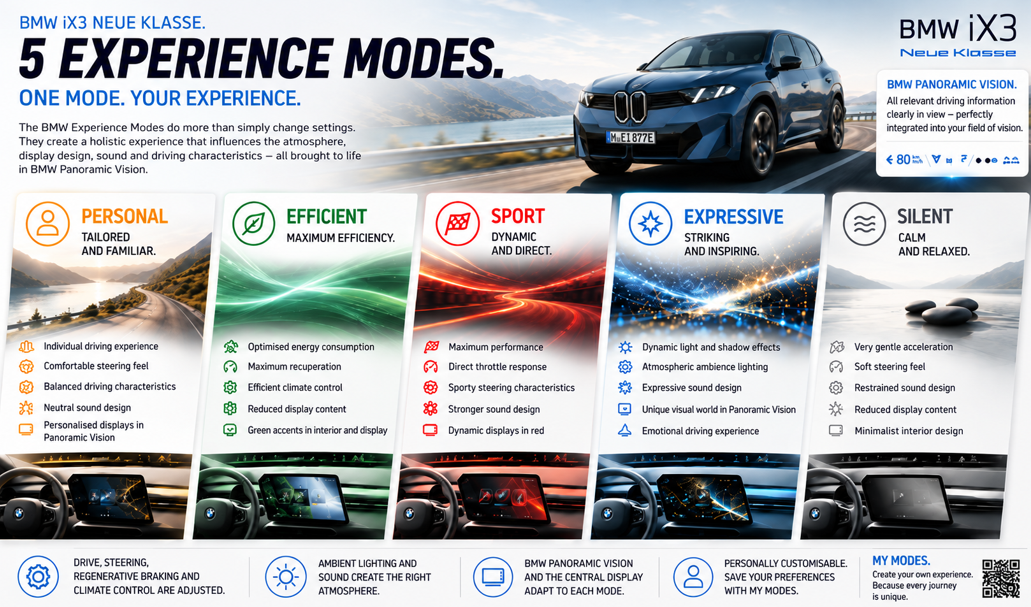
The BMW iX3 Neue Klasse features the updated BMW Experience Modes. These go beyond the traditional driving modes and affect not only the powertrain, but also the power steering, throttle response, energy recovery, ambient lighting, sound and the display on BMW Panoramic Vision.
Driving mode | Features |
|---|---|
Personal | The standard mode for everyday use. Offers a balanced combination of comfort, performance and efficiency. |
Efficient | Maximises the range by optimising the powertrain, climate control and energy recovery to ensure the lowest possible energy consumption. |
Sport | Faster throttle response, heavier power steering and maximum performance from the electric motor(s). |
Silent
Expressive | Creates a dynamic atmosphere with customised lighting, sound and displays for a more emotional driving experience. |
Brake energy recovery
Recover or coast?
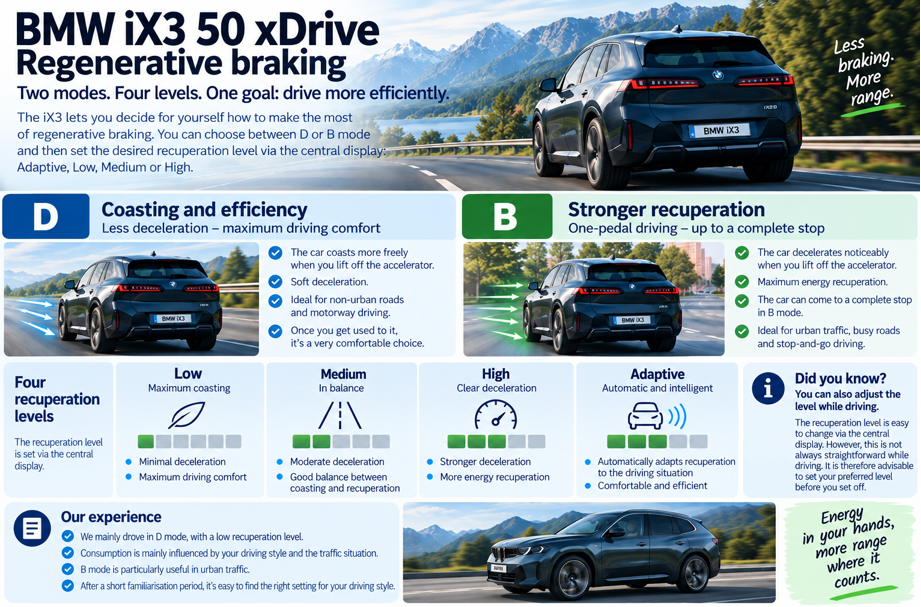
During our test drives in the BMW iX3 50 xDrive, we mainly used the D/B mode, and when in D we usually opted for low regenerative braking.
In doing so, we deliberately opted for a driving style in which the iX3 can coast relatively freely when the accelerator pedal is released, rather than braking sharply straight away using the electric motors. This is in line with our anticipatory and efficient driving style: as long as deceleration is not necessary, we try to retain as much of the available kinetic energy as possible.
When deceleration is required, the iX3 can recover braking energy and store it back in the high-voltage battery. The B mode significantly enhances this energy recovery. When you release the accelerator pedal, the iX3 decelerates powerfully and can come to a complete stop, allowing you to drive almost entirely using just one pedal in many traffic situations.
What we do find lacking here, however, are paddles on the steering wheel. These would allow you to adjust the level of regenerative braking whilst driving even more quickly and intuitively to suit the traffic situation: coasting freely when possible and temporarily increasing regenerative braking when approaching, for example, a bend, a roundabout or a slower vehicle ahead. With the iX3, you have to rely on choosing between D and B for this.
For most of our test, we preferred low energy recovery in D. The low fuel consumption was therefore achieved mainly by anticipating, maintaining speed and coasting as much as possible, rather than by constantly recovering the maximum amount of energy.
Consumption
Efficient throughout the entire test period
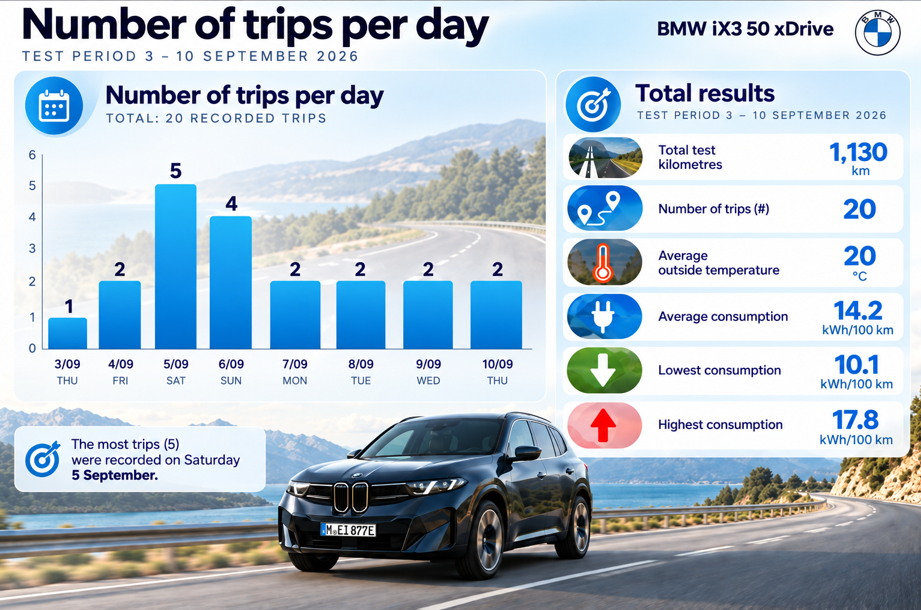
During our test period, we covered a total of 1,130 km in the BMW iX3 50 xDrive. Across all recorded journeys, we recorded an average test consumption of 14.2 kWh/100 km.
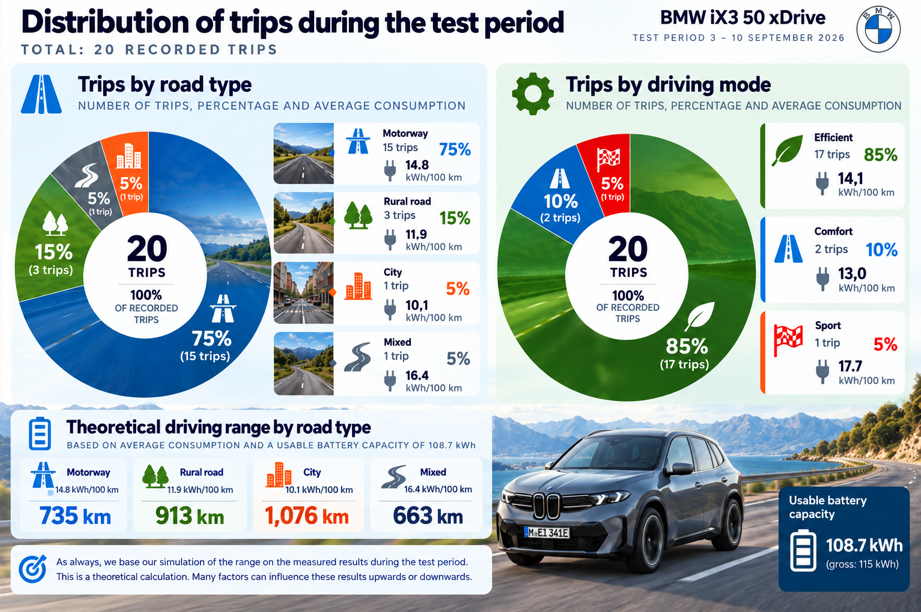
When we compare this consumption with the usable battery capacity of 108.7 kWh, we arrive at a theoretical range of approximately 765 km. That is a particularly impressive result in itself and is even slightly higher than the official combined WLTP range of 734 km.
Of course, this remains a theoretical simulation. Temperature, weather conditions, speed, traffic volume, road type, topography, driving style and the use of climate control can all affect actual fuel consumption and driving range.
To put the results into context, we show below how our 20 recorded journeys were broken down by road type and driving mode, along with the average fuel consumption for each journey and the theoretical driving range calculated from this.
Test track
Efficiency in practice
As always, we put our test car through the standard DrivOlution test route. This consists of three clearly distinct sections – out of town, motorway and in town – and, with the BMW iX3 50 xDrive, covered a total of 105.6 km.
The conditions were favourable, with an average outside temperature of around 22 °C. We drove in Efficient driving mode, without using the air conditioning. Over the entire route, the on-board computer recorded an average consumption of just 12.2 kWh/100 km. That is 27.1% lower than the official combined WLTP consumption of 16.7 kWh/100 km.
The iX3 proves to be particularly efficient, especially outside the city and in urban traffic. We recorded 10.9 and 10.1 kWh/100 km respectively. On the motorway, as expected, consumption rose to 15.5 kWh/100 km, but even there the iX3 remained below the official combined WLTP figure.
We made a particularly interesting observation during the first part of the journey. We set off from the city with 81% SoC and a displayed range of 576 km. After driving 44.6 km, the battery status had, as expected, dropped to 76%, but at the same time the indicated range had increased to 598 km. So, although we had driven 44.6 km, the car still indicated 22 km more remaining range than at the start.
That is not a fault in the on-board computer, but it perfectly illustrates how an electric car’s range indicator works. SoC and range are two different things. The SoC indicates how much energy is still available in the battery, whilst the displayed range is a dynamic estimate of the distance that can be travelled with that remaining energy. This estimate is adjusted whilst driving, taking into account factors such as recent energy consumption and driving conditions.
With a driving consumption of just 10.9 kWh/100 km, the iX3 proved to be considerably more efficient on out-of-town journeys than the original forecast had anticipated. The car therefore adjusted its calculation upwards. This is a good real-world example that demonstrates why the driving range displayed on the dashboard should never be regarded as a static figure: it changes in line with actual consumption.
Based on our test results, we also carry out, as always, a theoretical simulation of the driving range. With a usable battery capacity of 108.7 kWh and an average test consumption of 12.2 kWh/100 km, we arrive at a theoretical range of approximately 891 km. Depending on the driving scenario, this calculation varies from approximately 701 km on the motorway to more than 1,000 km based on the measured urban consumption.
These figures must, of course, be viewed in their proper context. They represent a theoretical calculation based on the measured results and are not a prediction of the actual achievable driving range. Our test route remains a snapshot in time. Temperature, wind, traffic, topography, speed, tyre pressure, load, use of the HVAC system and, above all, personal driving style can significantly influence fuel consumption and, consequently, the final driving range.
The key conclusion from the test drive: the combination of the large usable battery capacity and the exceptionally low real-world energy consumption gives the BMW iX3 50 xDrive an impressive potential driving range. At the same time, our first test drive clearly demonstrates that it is not just the amount of energy in the battery that counts, but above all how efficiently you use that energy.
Charging and driving range
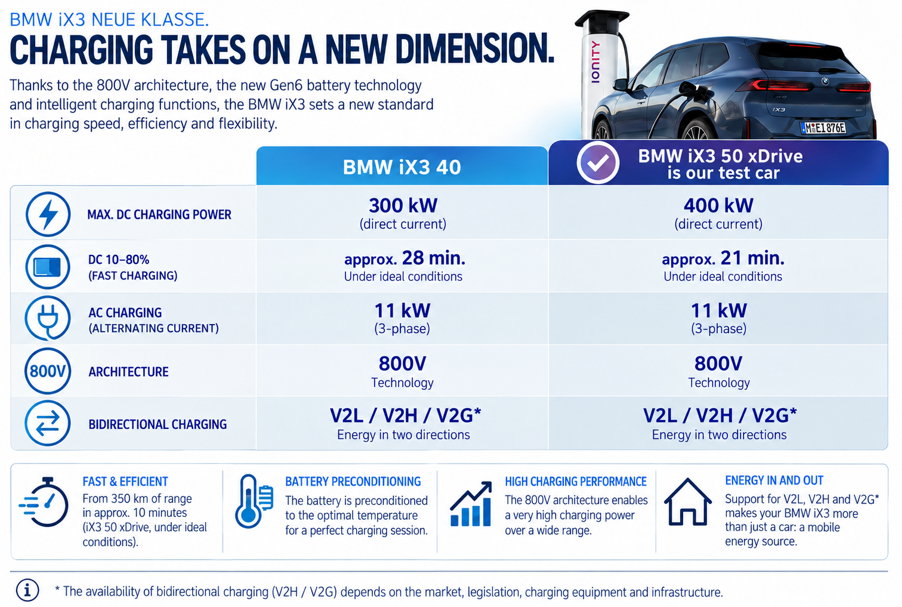
Charging: 400 kW thanks to 800V
One of the major strengths of the Neue Klasse is the new 800V architecture.
- The iX3 50 xDrive boasts a maximum DC charging power of 400 kW, placing BMW straight among the fastest-charging electric models on the market. Under ideal conditions, up to 350 kilometres of driving range can be recharged in around ten minutes.
- The smaller iX3 40 delivers a maximum of 300 kW. However, just as important as these peak figures is the charging curve: how quickly is the maximum power reached, and for how long can the battery sustain a high charging rate?
That is precisely where our real-world test will have to show just how much time the new 800V technology actually saves on the road.
Charging: particularly keen to find out more about the 800V technology
During our test week with the BMW iX3 Neue Klasse, we carried out a total of two charging sessions: one DC fast-charging session and one AC charging session. We were particularly keen to see how the DC session would go. After all, the new iX3 uses an 800V architecture, which should enable high charging power and short charging stops.
The real-world performance certainly didn’t disappoint. During our DC test, the battery went from 30 to 80 per cent SoC in just 18 minutes. According to the BMW app, 56.46 kWh was charged during this process. The average charging power was 179 kW, with a recorded peak of 201 kW. The displayed driving range increased during that short period from 224 to 599 km, or an extra 375 km.
The charging curve from the BMW app is also interesting. The charging power remains at around 200 kW for much of the session. After a brief dip, this high level is maintained once again. It is only from around 65% SoC that the charging power begins to decrease noticeably towards 80%. It is not just the peak, but above all the sustained high charging power that explains the short charging time.
Our AC charging session was, of course, much more leisurely. It took 5 hours and 30 minutes to go from 30 to 80 per cent SoC, at an average of 11 kW. We were also able to compare the readings here: the BMW app showed 57.00 kWh, whilst the charging provider recorded 59.92 kWh of energy supplied. A difference of 2.92 kWh, or approximately 4.9% of the energy supplied by the charging point.
We deliberately do not automatically label this difference as a charging loss. After all, the charging provider and BMW measure the energy at different points in the energy chain and may also use different measurement and rounding methods. For our practical test, it is particularly interesting to record both values side by side.
This first charging experience therefore confirms, above all, what we set out to investigate about 800V technology: not just high peak power, but a high charging rate that is maintained for a significant portion of the DC charging session. As a result, a relatively short charging stop can once again deliver hundreds of kilometres of range.
Drive and comfort
The Life Inside
The BMW iX3 50 xDrive is a pleasant place to be. The interior feels spacious, light and modern, and makes it immediately clear that the Neue Klasse is also taking a new direction on the inside. The undisputed highlight is undoubtedly BMW Panoramic Vision, which, together with the large central display, gives the classic cockpit a whole new look.
It is therefore hardly surprising that the majority of the controls are operated via the central screen. Heating and climate control, seat adjustments (including the memory function), the choice of driving mode, energy recovery settings and numerous other vehicle functions are all brought together here. The result looks sleek and minimalist, although this approach does take a little getting used to at first. Some functions are simply less readily accessible whilst driving than they would be with a traditional physical button.
The steering wheel is also anything but traditional. The spokes do not run horizontally but, strikingly, vertically. This not only gives the steering wheel a distinctive and futuristic look, but also ensures that the view through Panoramic Vision is obstructed as little as possible.
And it is precisely this Panoramic Vision that largely defines the driving experience. Instead of a traditional instrument panel behind the steering wheel, the most important driving information is displayed across a wide area at the bottom of the windscreen. Speed, navigation and other relevant information are therefore positioned high up and clearly within the driver’s natural field of vision. At first, you’ll find yourself looking behind the steering wheel for a traditional instrument cluster, but you get used to the new layout quite quickly. The combination of Panoramic Vision and the central display creates, above all, a calm, open cockpit in which information is laid out differently from what we’ve been used to from BMW until now.
The iX3 also has a lot to offer in terms of practicality. The boot capacity is 520 litres and can be expanded to a maximum of 1,750 litres with the rear seats folded down. At the front, there’s also a 58-litre frunk. This is a particularly handy place to store items such as the charging cable safely and quickly, without having to sacrifice space in the main boot.
The new iX3 thus combines a distinctive digital experience with space, comfort and everyday practicality. The Life Inside is clearly more than just a new dashboard in this Neue Klasse.
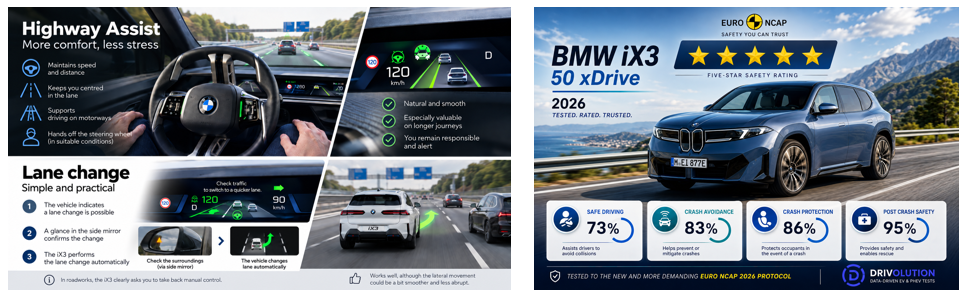
Driver assistance systems (ADAS)
Advanced Driver Assistance Systems (ADAS)
Driving range simulation (km) based on trip consumption (kWh/100 km), trip length (km), road type and usuable battery capacity
Driving range simulation
As always, we calculate the driving range based on the results measured during our test drives. This involves comparing the driving consumption with the usable battery capacity of 108.7 kWh. This is therefore always a theoretical calculation and not a prediction or guarantee of the actual driving range achievable.
With the BMW iX3 50 xDrive, we can see just how much that theoretical range can vary depending on the driving profile. During the most efficient journeys, with energy consumption of around 10 to 11 kWh/100 km, the simulation puts the range at over 1,000 km. For journeys with energy consumption of around 18 kWh/100 km, this drops to approximately 600 km.
Over the entire test period, we drove 1,130 km, spread over 20 journeys, with an average consumption of 14.2 kWh/100 km. Based on this, the theoretical simulation puts the driving range at approximately 765 km, compared with 734 km according to the WLTP combined cycle.
These figures must always be viewed in context. Outside temperature, weather conditions, traffic volume, average speed, road type, topography, driving style, driving mode, use of the heating, ventilation and air conditioning (HVAC) system, and tyre pressure can significantly affect fuel consumption – and therefore the potential driving range.
The simulation is therefore particularly useful for demonstrating how the usage profile affects efficiency and potential driving range. The battery remains the same, but the circumstances in which, and the way in which, the available energy is used ultimately determine how many kilometres you can get out of it.
Comparison WLTP/test results Drivolution
WLTP versus praktijk: hoe efficiënt is de iX3 echt?
Official WLTP figures are a useful reference, but ultimately we’re most interested in how an electric car performs in real-world conditions. That’s why we’re comparing the results from our BMW iX3 50 xDrive with the WLTP figures.
During all our test drives, as is always the case at DrivOlution, we try to drive as efficiently as possible. We do not set out to test how much power or performance we can extract from the car. The iX3 50 xDrive has more than enough to offer in that respect. We deliberately focus on other aspects: fuel consumption, efficiency, driving range and everyday practicality.
Nor does that mean we are trying to achieve the lowest possible fuel consumption or the maximum driving range at any cost. We drive in a proactive and efficient manner, but always in a way that remains realistic and practical in everyday traffic.
Over the entire test period, we covered 1,030 km and recorded an average energy consumption of 14.2 kWh/100 km. This means the iX3 remains approximately 15 per cent below our WLTP reference figure of 16.7 kWh/100 km.
Taking into account the usable battery capacity of 108.7 kWh, this real-world consumption theoretically corresponds to a driving range of approximately 765 km. This is close to the maximum official WLTP driving range of 805 km.
On our standard DrivOlution test route, we recorded an even lower average consumption of 12.2 kWh/100 km over 105.6 km. Based on the usable battery capacity, this would theoretically correspond to approximately 891 km.
That figure of 891 km should primarily be regarded as a theoretical simulation rather than a claim regarding the actual driving range. Temperature, traffic, speed, wind, topography, tyres and climate control can all have a significant impact on the final result.
For us, therefore, it is the result over the full 1,030 km that is particularly relevant. With an average of 14.2 kWh/100 km, the BMW iX3 50 xDrive demonstrates just how efficient it can be during normal, mindful everyday use.
At DrivOlution, we don’t test how fast a car can go or how much power we can extract from it. Above all, we want to know how efficiently it covers its distance and what driving range is achievable in real-world conditions.