Test review DrivOlution Farizon SV L2H3
Test report

The market for electric vans is still lagging behind that of passenger cars. However, that does not mean that manufacturers are sitting still. In addition to the well-known players, more and more Chinese brands are venturing onto the European stage. One of these newcomers is Farizon. Does that name ring a bell? Understandable. The brand is still unknown in our market, but don't be fooled: Farizon is no pushover.
Farizon is part of the Geely Group, the same automotive group that owns brands such as Volvo, Polestar, Lotus, and smart. Since its establishment in 2016, Farizon has focused on sustainable commercial vehicles – from light vans to trucks and buses – all built on modular platforms with advanced battery and drive-by-wire technology.
With the introduction of the Farizon SuperVan (SV), the brand is now setting foot on European soil, including in Belgium via the Beherman Group. With this move, Farizon aims to prove that Chinese brands will play a significant role not only in the passenger car sector, but also in the field of electric commercial vehicles.
So it's time to find out whether the Farizon SV L2H3 is as impressive in practice as it is on paper.
General information
- VAN
- Mass in running order 2.470 kg (according to identification report)
- Number of seats in the front 3
- LxWxH (mm): view the variants further down
- Warranty: battery pack 8 years / 200.000 km
- Laadvolume koffer 326 L / 1.000 L (max)
Driveline
- BEV (Battery Electric Vehicle)
- LFP (Lithium Iron Phosphate)
- 83 kWh
- Power 170 kW (231 hp)
- Torque --- Nm
- EV-platform GMA GXA-M
Consumption/Driving Range (WLTP) (CoC)
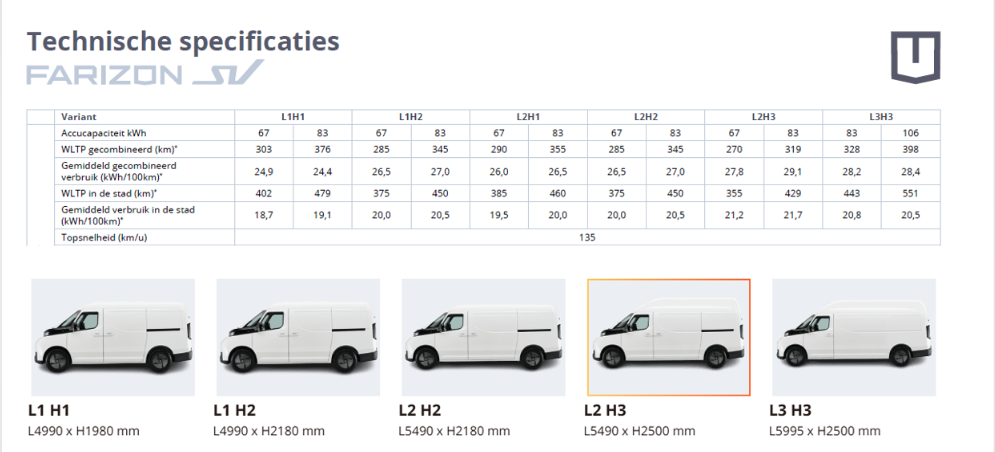
- Combined consumption 29,1 kWh/100 km (CoC)
- Combined driving range 319 km (CoC)
- Driving range city 429 km (CoC)
- Average consumption in the city: 21.7 kWh/100 km (data from Farizon)
Charging information
- Internal onboard charger 11 kW
- Charging port right front
- Charge Power AC 11 kW
- Charge Power DC 100 kW max.
- AC : 0 charges
- DC : 1 charge
Test track
- Non-urban (40,8 km) 21,0 kWh/100 km
- Motorway (42,1 km) 24,6 kWh/100 km
- City (21 km) 18,0 kWh/100 km
- Combined 21,2 kWh/100 km
Test results
- Non-urban 20,4 kWh/100 km
- Motorway 22,4 kWh/100km
- City 18,0 kWh/100 km
- Combined 21,6 kWh/100 km
Test data
Test drivers
Johan Stevens
490 Testkilometers
Driveline
EV platform
The Farizon SV is built on the GMA GXA-M platform, an electric foundation designed specifically for delivery vans. It offers a low loading floor and optimal interior space, which facilitates loading and unloading. The advanced drive-by-wire technology ensures direct steering response and increased safety, while the low centre of gravity and smart weight distribution ensure a stable ride. In addition, the platform supports different battery sizes and future technologies, making the SV flexible and future-proof.
Available battery options and features
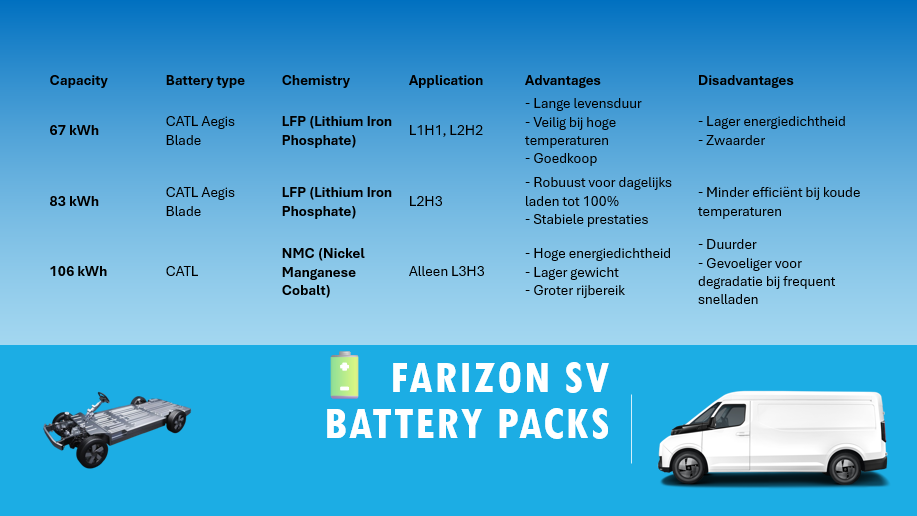
67 kWh LFP (Lithium-Iron-Phosphate): available on L1H1 and L2H2 models.
83 kWh LFP: available on L1H1, L2H2, L2H3 and L3H3 models.
106 kWh NMC (Nickel-Manganese-Cobalt): only available on L3H3 models.
Available versions
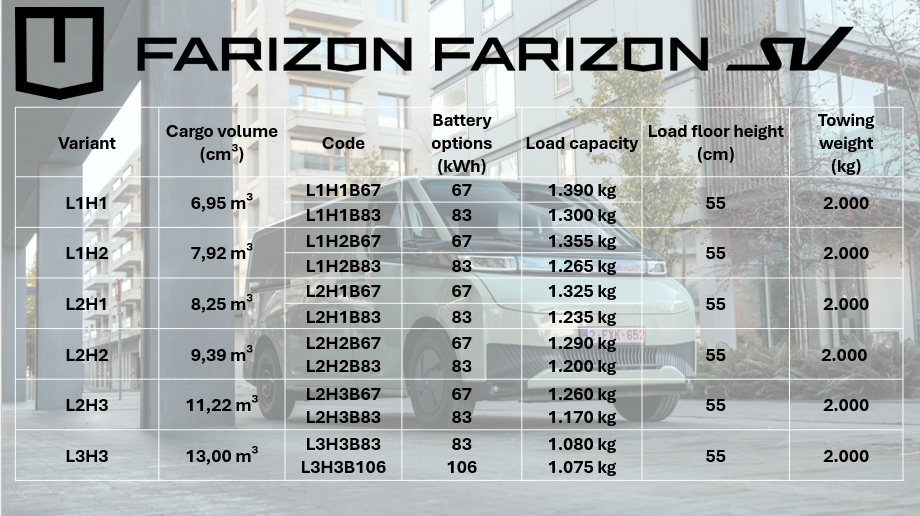
- Below is an overview of the available variants
Technical details
The target audience for the Farizon SV is primarily business customers who need a spacious, safe and efficient electric van. The SV is designed for a wide range of applications, including urban logistics, courier services, taxi and combi transport, and as a commercial vehicle for small to medium-sized enterprises.
More information about the implementation can be found at Home - Farizon BE.
Driving modes - Eco, Comfort and Sport
? Eco mode
- In Eco mode, the power response is limited and the maximum speed is significantly reduced in order to maintain maximum efficiency.
- Objective: to minimise consumption, suitable for longer journeys with a calm driving style.
- Wordt expliciet omschreven als “manages power response and limits the maximum speed to achieve optimal driving efficiency”.
- Please note: no exact value is given for how much slower the acceleration is or how much less range loss there is, but it clearly implies a conscious trade-off between performance and range
? Comfort mode (default)
- This is the standard driving mode that offers a balance between efficiency and performance.
- Acceleration is less restricted than in Eco mode, but not as maximalist as in Sport mode.
- Suitable for general use when you are not explicitly choosing to drive economically or for maximum performance.
? Sport-modus - not used during the test
- Sport mode delivers the highest performance: rapid acceleration, sharper throttle response, maximum power available.
- Omschreven op de officiële site als “Delivers maximum performance and quicker accelerator responses.”
- Volgens een review: met “power mode engaged” (equivalent van Sport) “the SV doesn’t hang about”.
- Disadvantage: likely higher fuel consumption/faster range loss when driving frequently in this mode.
✅ Summary & tip
- Select Eco if you primarily want to drive economically, extend your range, and are not in a hurry.
- Select Comfort for a good all-round mode where you don't want to compromise or go to extremes.
- Select Sport when you want extra performance — for example, when overtaking or when you want to get going quickly — but be aware of the impact on fuel consumption/range.
Regenerative recovery - 3 stages
The three settings for regenerative braking are:
Light regeneration – for a natural riding experience without much resistance.
Average regeneration – for a balance between energy recovery and driving comfort.
Strong regeneration – for maximum energy recovery, with almost one-pedal driving. Handy in city traffic.
Consumption
? Farizon SV consumption analysis
During our test period with the Farizon SV, we covered a total of 490 kilometres, spread over 14 journeys. The on-board computer recorded an average consumption of 21.6 kWh/100 km. Based on the battery capacity of 83 kWh, this results in a theoretical range of 384 kilometres*. We had a load on board of around 300 kg.
The test took place at an average outside temperature of 15°C, under realistic driving conditions.
On average, Eco mode is more than 1 kWh/100 km more economical than Comfort mode. That difference may seem small, but over a full battery charge it adds around 20 to 25 km of extra driving range.
At the start of the journey and after resetting the on-board computer, the display shows 20.0 kWh/100 km. Consumption will decrease or increase as the journey progresses.
? 1️⃣ Consumption by road type
Road type | Number of trips | Consumption (kWh/100 km) | Relative share | Approximate contribution |
|---|---|---|---|---|
City | 1 | 18,0 | 7 % | 1,3 |
Non-urban | 3 | 20,4 | 21 % | 4,3 |
Motorway | 10 | 22,4 | 72 % | 16,1 |
The lowest consumption was recorded in the city (18.0 kWh/100 km) — typical for electric vehicles due to braking energy recovery.
Outside the city, it rises slightly to 20.4 kWh/100 km, which is a good average figure.
On motorways, we see a clear increase to 22.4 kWh/100 km, which is logical due to higher speeds and air resistance.
2️⃣ Consumption per driving mode
Driving Mode | Number of trips | Consumption (kWh/100 km) | Relative share | Approximate contribution |
|---|---|---|---|---|
Eco | 10 | 21,3 | 71 % | 15,1 |
Comfort | 4 | 22,4 | 29 % | 6,5 |
Analyse:
Eco mode delivers noticeably lower fuel consumption: a difference of –1.1 kWh/100 km compared to Comfort mode.
That is a saving of approximately 5%.
General conclusion
Over 14 journeys and 490 kilometres, the average test consumption was approximately 21.6–21.7 kWh/100 kilometres.
That figure fits nicely with what we saw for each type of journey and driving mode.
It also confirms that Eco mode delivers effective efficiency gains, especially on urban and mixed routes.
Motorway kilometres clearly determine total consumption (more than 70% of the distance).
It is clear that the Farizon SV is primarily focused on last mile deliveries. The city is its preferred environment: at low speeds and frequent braking, it achieves its best efficiency, with consumption of just 18 kWh/100 km.
Although consumption is slightly higher on the motorway, the overall picture remains positive. With an average test consumption of 21.6 kWh/100 km and a realistic driving range of approximately 380 km, the Farizon SV proves itself to be a well-designed electric workhorse — ideal for daily distribution tasks in and around urban areas.
The results shown provide a snapshot of how the car performs during this specific test week, but they do not tell the whole story. In practice, factors such as driving profile (city, out of town, motorway), load, temperature, frequency of stop-and-go traffic and the driver's right foot have a significant impact on fuel consumption. WLTP figures remain useful for comparison, but actual usage values may vary significantly, both positively and negatively, depending on circumstances.
Test track
In keeping with tradition, we always complete a test route. The advantage of this is that we always follow the same route and aim to drive as efficiently as possible. The route consists of three parts: outside the city, motorway and city traffic. We covered a total of 103.9 km. The combined consumption is 21.2 kWh/100 km. Below you will find the details of each part.
Fuel consumption and evolution of driving range and SoC per component
Testparcours | Distance travelled (km) | Trip speed (km/h) | Trip consumption (kWh/100 km) | Rijbereik start (km) | Driving range finish (km) | SoC start (%) | SoC finish (%) |
|---|---|---|---|---|---|---|---|
Non-urban | 40,8 | – | 21,0 | 250 | 215 | 72 | 62 |
Motorway | 42,1 | – | 24,6 | 215 | 169 | 62 | 49 |
City | 21,0 | – | 18,0 | 169 | 152 | 49 | 44 |
The graph above clearly shows that city traffic is the ideal environment for the Farizon SV.
Overview of the decrease in driving range (km) and SoC (%) and efficiency per journey.
Testparcours | Distance travelled(km) | Decrease in driving range (km) | Ratio of driving range decrease/distance | Decrease (%) | Ratio SoC decrease/distance (%/km) |
|---|---|---|---|---|---|
Non-urban | 40,8 | 35 | 0,86 | 10 | 0,25 |
Motorway | 42,1 | 46 | 1,09 | 13 | 0,31 |
City | 21,0 | 17 | 0,81 | 5 | 0,24 |
Theoretical driving range based on actual consumption per component:
Road type | Distance (km) | Consumption (kWh/100 km) | Theoretical driving range (km) |
|---|---|---|---|
Non-urban | 40,8 | 21,0 | 395 |
Motorway | 42,1 | 24,6 | 337 |
City | 21,0 | 18,0 | 461 |
On average | 103,9 | 21,85 | 380 |
*The specified driving range is a theoretical calculation based on the usable battery capacity. This is always a snapshot. All kinds of factors such as weather conditions, use of climate control, topography, traffic congestion and your own driving style can influence this.
We strive to drive as efficiently as possible by making maximum use of cruise control (constant speed) and by anticipating traffic situations as much as possible. The speed on motorways is 100 km/h. Energy consumers (such as air conditioning) are switched off if weather conditions permit. In addition, we select the most efficient driving mode (Eco), if available.
Comfort
Driving
The Farizon SV is a pleasure to drive. It is quiet on board and the only thing you can hear is the rolling noise of the tyres. The Farizon SV is the first electric van in the world to use independent double wishbone suspension systems at the front. This provides exceptional driving comfort and handling that you would normally only find in passenger cars.
Interior
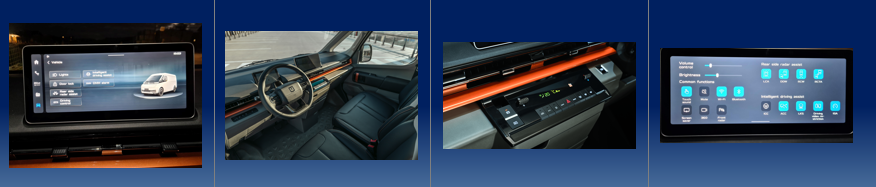
The interior of the Farizon SV is beautifully finished. It is equipped with a 12.3-inch touchscreen, Apple CarPlay (Android to follow), a heated steering wheel and a heated and ventilated driver's seat. These features contribute to a comfortable driving experience, especially in cold weather. Most of the functions are controlled via the central screen, as is increasingly common today. What is striking is that the steering wheel is only adjustable in height.
Praktische laad- en instapmogelijkheden
Wat onmiddellijk opvalt is dat de Farizon SV geen B-stijl heeft, wat resulteert in een zijdeuropening van 1,0 tot 1,2 meter breed, gemakkelijk om bijvoorbeeld een europallet in te laden. In combinatie mDriving
The Farizon SV is a pleasure to drive. It is quiet on board and the only thing you can hear is the rolling noise of the tyres. The Farizon SV is the first electric van in the world to use independent double wishbone suspension systems at the front. This provides exceptional driving comfort and handling that you would normally only find in passenger cars.
Interior
The interior of the Farizon SV is beautifully finished. It is equipped with a 12.3-inch touchscreen, Apple CarPlay (Android to follow), a heated steering wheel and a heated and ventilated driver's seat. These features contribute to a comfortable driving experience, especially in cold weather. Most of the functions are controlled via the central screen, as is increasingly common today. What is striking is that the steering wheel is only adjustable in height.
Practical loading and entry options
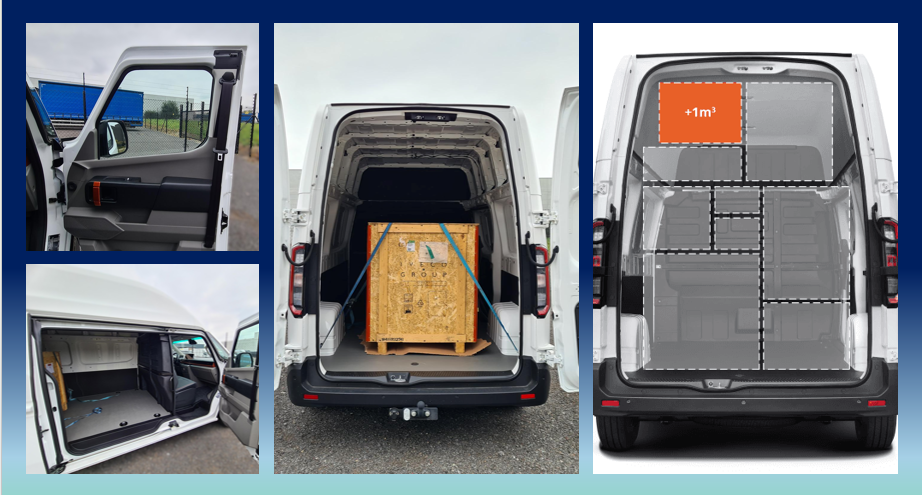
What immediately stands out is that the Farizon SV has no B-pillar, resulting in a side door opening of 1.0 to 1.2 metres wide, making it easy to load a Euro pallet, for example. Combined with a loading floor height of only 55 cm, this makes loading and unloading easier than with many competitors. The skateboard platform also offers extra space. The seat belts are integrated into the doors.
In addition, you have various configurations in terms of length and height, with a load volume of up to 13 m³. This offers flexibility for various business needs.
Charging and driving range
General charging information
Type charging | Battery capacity (kWh) | Max. load capacity | Charging time 20 → 80 % | Remarques |
|---|---|---|---|---|
AC (alternating current) | 67 / 83 / 106 | 11 kW (driefasig) | ± 8 h (67 kWh) / ± 9,5 h (83 kWh) / ± 11 u (106 kWh) | Ideal for home or storage drawers; Type 2 connection |
DC (direct current) | 67 kWh | max. 120 kW | ± 36 min (20–80 %) | Snelladen via CCS; laadsnelheid daalt boven 80 % |
DC (direct current) | 83 kWh | max. 140 kW | ± 36 min (20–80 %) | Highest DC power, most balanced version |
DC (direct current) | 106 kWh | max. 120 kW | ± 40 min (20–80 %) | Larger battery, slightly longer charging time |
Charging sessions
We visited a fast charger only once with the Farizon SV. The attached image provides an overview of the charging session.
Driver assistance systems (ADAS)
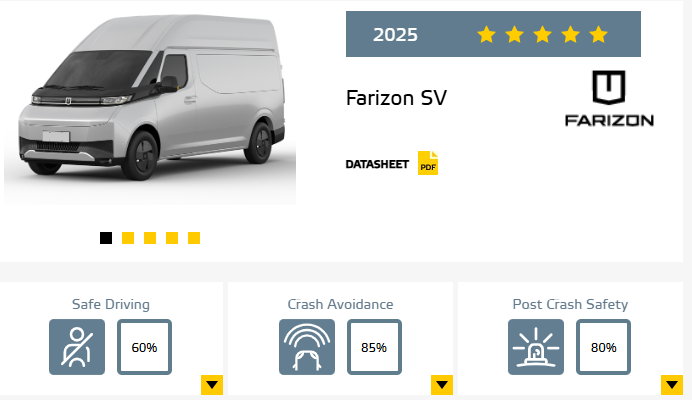
The Farizon SV (2025) achieves a five-star safety rating, positioning it as one of the safest electric vans in its segment. With an 85% score for crash avoidance, it performs particularly well in preventing accidents thanks to advanced driver assistance systems. In terms of post-crash safety (80%), protection after an impact is also well taken care of. The score of 60% for safe driving shows that there is still room for further refinement in driver assistance functions.
The Farizon SV is equipped with the latest driver assistance systems, many of which have become mandatory since the introduction of the General Safety Regulation (GSR) 2024. This European regulation aims to achieve a higher level of safety and paves the way for partially autonomous driving.
Since July 2024, systems such as Intelligent Speed Assistance (ISA), Driver Attention Warning, Advanced Emergency Braking (AEB) and Emergency Lane Keeping Assist (ELKA) have been mandatory. Features such as reversing detection, an Event Data Recorder (EDR), alcohol interlock interface, TPMS and seat belt reminders for all seats are also standard equipment.
One small caveat, however: some of these systems, particularly attention monitoring, are quite sensitive and sometimes issue warnings too quickly. Over time, this can become annoying, causing drivers to switch them off — which is obviously not the intention. Sophisticated calibration therefore remains crucial to maintaining the balance between safety and comfort.
With this safety equipment, the Farizon SV complies with the strictest European standards and presents itself as a technologically advanced van that combines safety and professional ease of use.
Driving range simulation (km) based on trip consumption (kWh/100 km), trip length (km), road type and usuable battery capacity
Simulation of driving range per journey
It is always interesting to have an overview of the results achieved per journey. This provides a clear picture of the various driving parameters (driving mode) and the influence of the journey profile (city, outside city, motorway).
Over a total of 14 trips and 490 test kilometres, the Farizon SV recorded an average consumption of 21.6 kWh/100 km, good for a theoretical driving range of 384 kilometres.
The Eco mode proved to be on average more than 1 kWh/100 km more efficient than Comfort, which translates into extra driving range without any noticeable loss of performance.
The road type had a clear influence: the city is the most efficient environment with a consumption of only 18.0 kWh/100 km, while the motorway visibly increases energy consumption with 22.4 kWh/100 km.
The results confirm that the Farizon SV is ideally suited to last mile deliveries and urban distribution, where it can fully exploit its efficiency and electric flexibility.
We would like to emphasise once again that these are snapshots, which remain dependent on factors such as load, driving style, outside temperature and traffic conditions.