Test review DrivOlution Mercedes-Benz CLA 250+ Sport Edition
Test report
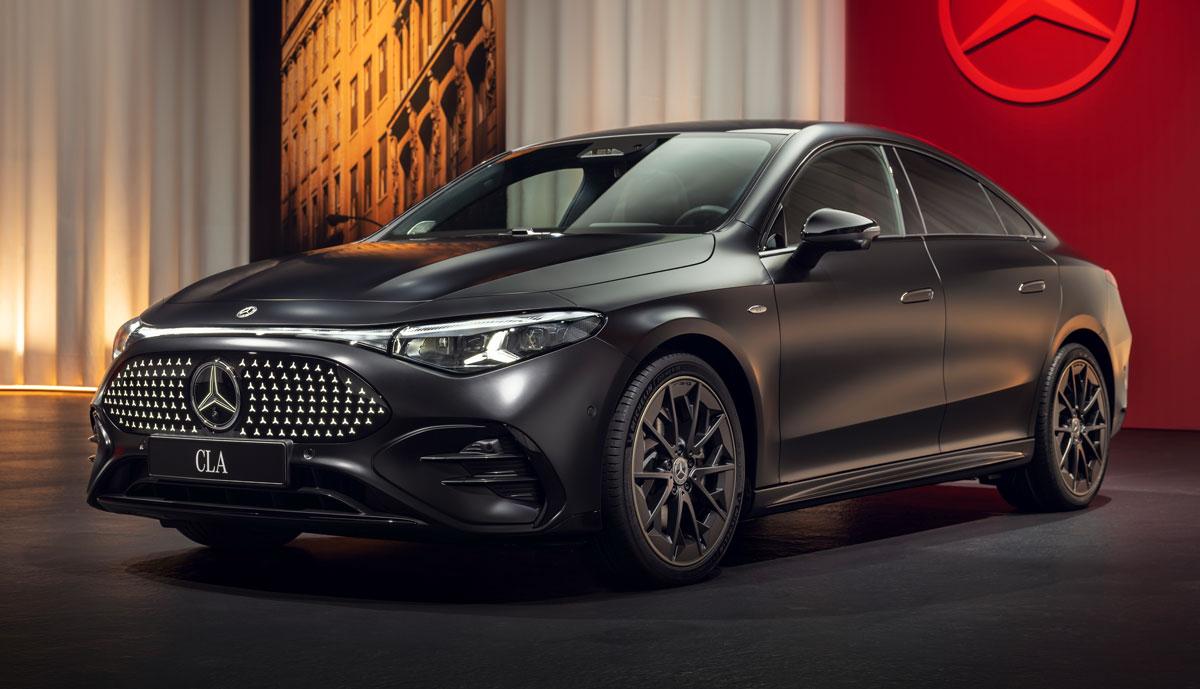
With the Mercedes-Benz CLA with EQ technology, Mercedes is heralding a new chapter for its compact four-door coupé. What began in 2013 as a bold design statement has now evolved into a fully electric, EV-first model that focuses on efficiency. The CLA with EQ technology is built on the new MMA platform and uses an 800-V electric architecture, with a clear ambition: to combine maximum energy efficiency with an attractive driving range in practice.
For this new generation, the CLA was not simply electrified, but designed as an electric car from the outset. Aerodynamics, energy management and powertrain efficiency played a decisive role, inspired by insights from the Vision EQXX programme. With a usable battery capacity of approximately 85 kWh and WLTP driving ranges of up to around 740 km, Mercedes is positioning the CLA EQ as one of the most efficient models in its segment.
For a whole week, we had the opportunity to put this promise to the test in practice with the CLA 250+ Sport Edition with EQ technology. As usual at DrivOlution, we subject every test car to a data-driven practical analysis, looking beyond the WLTP values and focusing on actual energy consumption and driving range in relation to road type, driving mode, journey length and outside temperature. This test report shows how the sporty CLA 250+ Sport Edition translates its efficiency promise into everyday driving conditions.
The CLA with EQ technology is not only available as a four-door coupé, but also as a Shooting Break. Mercedes combines the same electrical efficiency and technology with extra practicality and cargo space, without compromising on the sporty CLA design.
General information
- Sedan
- Number of seats 5
- Mass in running order 2.055 kg
- LxWxH (mm) 4.843 x 1.859 x 1.466
- Price test vehicle (VATi) 60.197,5 - euro
- Boot capacity 405 L / L (max)
- Load volume frunk (front) 101 L
- Tow bar possible (1.500 kg braked - 750 kg unbraked)
- Warranty : 8 jaar/160.000 km (battery)
Drivetrain
- BEV (Battery Electric Vehicle)
- Battery type Lithium-ion (NMC)
- 90 kWh battery capacity (85 kWh usable)
- Power 200 kW (272 pk)
- Torque 335 Nm
- Rear wheel drive (RWD)
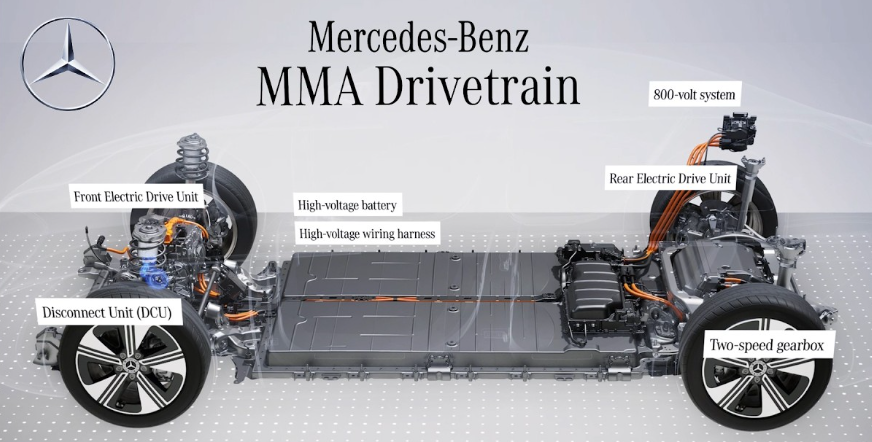
- Architecture 800 V
- Ev-platform MB MMA
- Heat pump standard
- V2L : no
Consumption/driving range (WLTP) (CoC)
- Combined consumption 13,2 kWh/100 km
- Combined driving range 742 km
- Driving range city 863 km
Charging information
- Internal onboard charger 11 kW
- Charging port rear right
- Charge Power AC 11 kW
- Charge Power DC 353 kW max.
- AC : 1 charge
- DC : 0 charge
- Battery preheating possible yes
Test track
- Non-urban (43 km) 12,8 kWh/100 km
- Motorway (40 km) 15,7 kWh/100 km
- City (21 km) 13,2 kWh/100 km
- Combined 13,9 kWh/100 km
Test results
- Non-urban 16,0 kWh/100 km
- Motorway 14,9 kWh/100km
- City 13,2 kWh/100 km
- Mix 13,8 kWh/100 km
- Combined 15,0 kWh/100 km
Test data
Test drivers
Johan Stevens
703 Testkilometers
Drivetrain
EV platform of the Mercedes-Benz CLA with EQ technology
The MMA platform (Mercedes-Benz Modular Architecture) forms the technological basis of the electric CLA and was developed as an EV-first architecture. This means that the platform has been optimised primarily for electric drive, with efficiency and energy management as core values.
Versions Mercedes-Benz CLA with EQ technology Drive system & battery capacity
Model | Drive | Power (indicative) | Battery gross | Battery net (usable) |
|---|---|---|---|---|
CLA 200 with EQ-technology | Rear-wheel drive (RWD) | 165 kW / 224 hp | 60 kWh | 58 kWh |
CLA 250+ with EQ-technology | Rear-wheel drive (RWD) | 200 kW / 272 hp | 90 kWh | 85 kWh |
CLA 350 4MATIC with EQ-technology | All-wheel drive (AWD) | 260 kW / 354 hp | 90 kWh | 85 kWh |
CLA 250+ Shooting Break with EQ technology | Rear-wheel drive (RWD) | 200 kW / 272 hp | 90 kWh | 85 kWh |
CLA 350 4MATIC Shooting Break with EQ technology | All-wheel drive (AWD) | 260 kW / 354 hp | 90 kWh | 85 kWh |
Driving modes
The Mercedes-Benz CLA EQ (the fully electric CLA with EQ technology) uses the DYNAMIC SELECT system to select driving modes — this allows you to adjust the character of the car in terms of engine response, steering, regeneration and often also the climate control/emission settings.

Standard driving modes in the CLA EQ
According to the specifications and available information, the electric Mercedes CLA typically offers the following driving modes via DYNAMIC SELECT.
ECO – maximum efficiency and energy savings
Comfort – balanced, comfortable tuning for everyday driving
Sport – more direct accelerator and steering response for a sportier feel
Individual – self-configurable mode (e.g. sporty driving behaviour + comfortable suspension)
Brake energy recovery – Mercedes-Benz CLA with EQ technology

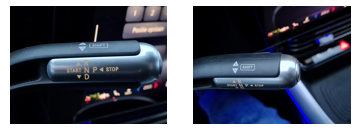
The Mercedes-Benz CLA with EQ technology no longer has paddles on the steering wheel. Braking energy recovery is controlled via the DYNAMIC SELECT lever on the steering column.
Pushing away from the steering wheel → less recuperation (reducing)
Pull towards the steering wheel → more recuperation (increase)
Recovery mode | Character | Braking feel when releasing the accelerator | Typical use | Efficiency impact |
|---|---|---|---|---|
D AUTO | Adaptive | Variable, context-dependent | Mixed journeys, daily use | ✔✔ Stable and predictable |
D+ | Rolling/coasting | No recovery, rolling | Country road, motorway, constant speed | ✔✔ Low fuel consumption when cruising |
D | Normal | Normal recuperation | Allround | ✔ Balanced |
D− | Stong recuperation | Significant delay during deceleration | Town, crossroads, roundabouts | ✔✔ Efficient in stop-and-go traffic |
The CLA with EQ technology is a real glider.
During testing, it is striking how well the brake energy recovery system of the Mercedes-Benz CLA EQ is tuned to efficient driving. The CLA EQ excels particularly in D+ mode: when the accelerator pedal is released, the speed remains virtually unchanged, allowing the car to coast or sail exceptionally well. D+ turns the CLA EQ into a real glider — efficient, quiet and surprisingly stable in terms of speed.
The minimal recuperation ensures very low resistance and exceptionally smooth handling, making this mode particularly suitable for country roads and motorways at constant speeds. This enhances the feeling of calm and smoothness while driving. What's more, this translates directly into favourable practical consumption (kWh/100 km) and underlines the efficiency-oriented character of the CLA EQ.
In D− mode, the Mercedes-Benz CLA EQ goes one step further in brake energy recovery. When the accelerator pedal is released, the car slows down progressively to a complete stop, which in practice can be considered a form of one-pedal driving. The driver uses the accelerator pedal to both accelerate and decelerate, while the use of the traditional brake pedal is reduced to a minimum.
It is important to note that during strong recuperation, the brake lights are also activated automatically, which ensures visibility and safety for traffic behind. In urban environments and stop-and-go traffic, D− not only increases driving comfort, but also energy efficiency, by making maximum use of recovered braking energy.
Consumption
During our test week, we spent a total of 703 kilometres on board the CLA 250+ Sport Edition with EQ technology, spread over 17 registered journeys. Over the entire test route, the on-board computer recorded an average energy consumption of 15.0 kWh/100 kilometres. Based on the usable battery capacity of 85 kWh, this corresponds to a theoretical driving range of approximately 567 kilometres. The average outside temperature during the test period was 8°C, which makes the results particularly relevant for everyday, realistic conditions of use.
Below is an overview of the results achieved per road type and per driving mode, which allow for further refinement of the practical consumption and the driving range derived from it.
?Overview of trip consumption per road type
Road type | Number of trips (#) | Average trip consumption (kWh/100 km) |
|---|---|---|
Non-urban | 7 | 16,0 |
Motorway | 7 | 14,9 |
City | 1 | 13,2 |
Mix | 2 | 13,8 |
?Overview of fuel consumption per driving mode
Driving mode | Number of trips (#) | Average trip consumption (kWh/100 km) |
|---|---|---|
Eco | 13 | 15,1 |
Comfort | 4 | 14,7 |
Sport | 0 | – |
? Range per road type
(85 kWh usable)
Road type | Average consumption (kWh/100 km) | Theoretical range (km) |
|---|---|---|
Non-urban | 16,0 | ≈ 531 km |
Motorway | 14,9 | ≈ 570 km |
City | 13,2 | ≈ 644 km |
Mix | 13,8 | ≈ 616 km |
? Range per driving mode
(85 kWh usable)
Driving mode | Average consumption (kWh/100 km) | Theoretical range (km) |
|---|---|---|
Eco | 15,1 | ≈ 563 km |
Comfort | 14,7 | ≈ 578 km |
Sport | – |
? This is a simulation based on measured average fuel consumption. Actual results may vary depending on temperature, speed, driving style and use of assistance systems.
Joint conclusion – road type & driving mode
When we look at the results by road type and by driving mode together, one clear trend emerges: it is not the selected driving programme, but rather the driving profile and driving style that determine the final energy consumption. The differences between Eco and Comfort remain limited, confirming that the technical efficiency of the powertrain and the way in which the vehicle is used are more decisive than the software settings alone.
By road type, we see that the CLA 250+ with EQ technology performs particularly well at constant speeds. Both on motorways and in mixed driving conditions, fuel consumption figures remain remarkably low, indicating efficient aerodynamics and a powertrain that performs optimally at a steady pace. The best figures are recorded in urban conditions, although this result remains indicative due to the limited number of journeys. Outside the city, fuel consumption is slightly higher, mainly due to variations in speed and acceleration.
?In summary: the CLA 250+ Sport Edition with EQ technology is not a car that relies on one specific driving mode to be efficient. It particularly rewards anticipatory driving behaviour, a constant speed and the smart use of recuperation and coasting, regardless of the type of road. This makes its practical fuel consumption predictable, reproducible and perfectly suitable for everyday and professional use.
Test track
? DrivOlution Test Track
In keeping with tradition, we subject every test vehicle to the DrivOlution test track, which consists of urban traffic, suburban roads and motorway use. This fixed and reproducible track allows vehicles to be analysed under comparable and realistic conditions.
During this test, the average outside temperature was 9 °C. To limit the impact of peripheral consumers, the climate control was set manually, without using air conditioning. The car was driven in Eco mode throughout the entire journey, with a focus on efficient energy management and consistent driving style.
Based on the entire test route, we arrive at an average energy consumption of 13.9 kWh/100 km, which confirms the high efficiency and consistent energy management of this test vehicle under realistic driving conditions.
The tables below provide a detailed overview per trip segment, focusing on energy consumption, efficiency, SoC evolution and (theoretical) driving range.
DrivOlution Test Track – key parameters per driving segment
Trip segment | Trip length (km) | Average speed (km/h) | Trip consumption (kWh/100 km) |
|---|---|---|---|
Non-urban | 43 | 43 | 12,8 |
Motorway | 40 | 90 | 15,7 |
City | 21 | 25 | 13,2 |
Total / average | 104 | 52,7 | 13,9 |
? Note – influence of driving profile and recuperation strategy
It can generally be expected that energy consumption in urban traffic is lower than outside the city, mainly due to lower speeds and frequent regeneration. In this test, however, consumption outside the city is slightly more favourable.
This difference is largely attributable to the use of D+, which focuses on maximum coasting/sailing. This driving programme can be used to its full potential on secondary roads, with a smooth speed progression and limited stopping moments. The car maintains its speed for long periods without drive or recuperation losses, resulting in very low actual energy consumption.
In urban traffic, on the other hand, the advantage of regeneration remains, but this is partly offset by frequent acceleration, lower average speeds and more dynamic recalculations of energy management.
This effect was clearly demonstrated during our test route, and underlines that road type and driving strategy are at least as important for efficiency as the classic distinction between urban and extra-urban driving.
Based on fuel consumption, this would correspond to the following driving range:
? Theoretical driving range per trip segment
(based on 85 kWh usable battery capacity)
Trip segment | Consumption (kWh/100 km) | Theoretical driving range (km) |
|---|---|---|
Non-urban | 12,8 | ≈ 664 km |
Motorway | 15,7 | ≈ 541 km |
City | 13,2 | ≈ 644 km |
Average (test track) | 13,9 | ≈ 612 km |
? Evolution of SoC & driving range per trip segment
(during driving vs. after stopping)
Trip segment | SoC start (%) | SoC end (%) | Δ SoC (%) | Driving range start – during trip (km) | Driving range end – during trip (km) | Δ driving range during journey (km) | Driving range after stopping (km)* |
|---|---|---|---|---|---|---|---|
Non-urban | 90 | 83 | −7 | 586 | 570 | −16 | 613 |
Motorway | 83 | 76 | −7 | 570 | 523 | −47 | 554 |
City | 76 | 73 | −3 | 523 | 484 | −39 | 524 |
Total | — | — | −17 | — | — | −102 | — |
* After switching off the system
⚡ Efficiency per journey component (km/kWh)
Trip segment | Trip consumption (kWh/100 km) | Efficiency (km/kWh) |
|---|---|---|
Non-urban | 12,8 | 7,81 km/kWh |
Motorway | 15,7 | 6,37 km/kWh |
City | 13,2 | 7,58 km/kWh |
Average (test track) | 13,9 | 7,19 km/kWh |
Driving range when restarting - clear difference
Trip segment | SoC start (%) | SoC end (%) | Decrease in SoC (%) | Driving range after last stop (km) | Driving range after stopping (km)* | Δ driving range(km) |
|---|---|---|---|---|---|---|
Non-urban | 90 | 83 | −7 | 586 | 613 | +27 |
Motorway | 83 | 76 | −7 | 613 | 554 | −59 |
City | 76 | 73 | −3 | 554 | 524 | −30 |
Total | — | — | −17 | — | — | −62 |
*After switching off the system
The displayed driving range is not a fixed value, but a dynamic prediction. When stationary, the system recalculates the driving range based on recent consumption, which explains why the driving range may increase or decrease while the SoC decreases linearly. This results in a different driving range figure. The displayed driving range (GOM – Guess-O-Meter) is a dynamic, algorithmically calculated estimate and not a direct reflection of the remaining battery capacity. For analysis, we therefore primarily use the measured consumption and the SoC evolution.
Charging and driving range
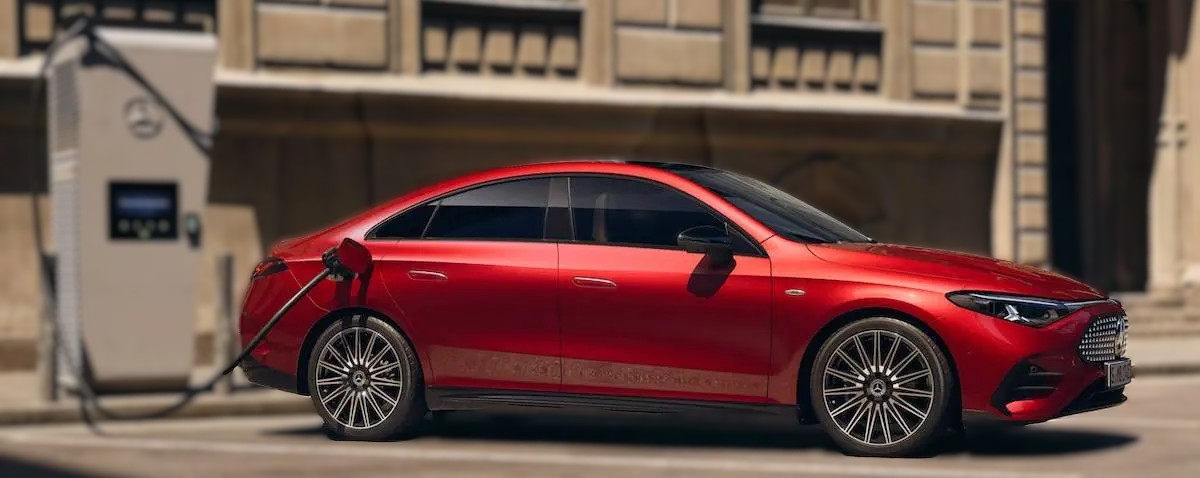
During the test week, the CLA 250+ with EQ technology was only charged once. This was an AC charge, which means that the 800V architecture did not play a decisive role in this case. AC charging is primarily intended for comfortable and battery-friendly charging over a longer period of time, for example at home or at work.
Below you will find the details of the charging session.
? Details of the AC charging session
Charging session | Charging type | Driving range start (km) | Driving range end (km) | SoC start (%) | SoC end (%) | Additional driving range (km) | Charged SoC (%) | Charged energy (kWh) |
|---|---|---|---|---|---|---|---|---|
Session 1 | AC | 157 | 554 | 24 | 100 | 397 | 76 | 69,46 |
? Derived core indicators (AC charging cycle)
Characteristic | Value | Interpretation |
|---|---|---|
Estimated usable battery capacity | ± 85 kWh | 69,46 kWh = 76% SoC |
Driving range per % SoC | ± 5,2 km / % | Based on GOM |
Driving range per kWh charged | ± 5,7 km / kWh | In line with test consumption |
Charging type | AC (alternating current) | Night/home charging |
This charging session resulted in an additional driving range of almost 400 kilometres, which underlines the high energy efficiency of the CLA 250+ in practice. The ratio between charged energy and SoC increase also confirms a usable battery capacity of approximately 85 kWh, fully in line with the technical specifications.
Drive and comfort
The CLA 250+ with EQ technology drives particularly pleasantly and immediately feels familiar. Even in Eco mode, it has enough power to move smoothly and relaxed in traffic. The suspension is not overly stiff, which means that comfort clearly takes precedence without completely losing its dynamic character.
Inside, too, a fine balance has been struck between modernity and tradition. The dashboard has not been reduced to a mere smartphone-like driver display with one large screen. The cockpit retains a clear structure and tranquillity, which benefits visibility and driving comfort. At the same time, choices have been made in favour of digitalisation: for example, the touchpad in the centre console has disappeared and all controls are now operated via the central screen.
On a practical level, the CLA offers extra convenience with a frunk of no less than 101 litres, ideal for charging cables or smaller items. The boot space at the rear is 405 litres, but the four-door coupé concept means that the possibilities for further increasing this loading space are rather limited. The same applies to the rear seats: getting into the back can be a little more difficult for taller people, mainly due to the sloping roofline.
All in all, the CLA confirms its character: a stylish, comfortable and efficient electric coupé, in which design and driving comfort clearly take precedence over maximum modularity — entirely in line with the philosophy of Mercedes-Benz.
Driver assistance systems (ADAS)
Safety is clearly part of Mercedes-Benz's DNA, and the CLA with EQ technology is no exception. The car is equipped as standard with the mandatory driver assistance systems in accordance with the applicable GSR regulations. In addition, the driver can choose from three equipment levels: the Advanced Plus package (standard), the Premium package and the Premium Plus package, each offering an increasing level of comfort and driver assistance.
CLA 250+ AMG Line met EQ-technologie - Uitrustingspakketten - Mercedes-Benz Car Configurator
In practice, the driver assistance systems are characterised by progressive and well-calibrated intervention. The coordination of steering, braking and speed assistance is refined, so that the ADAS functions provide clear support without feeling intrusive or corrective. However, speed recognition remains an area of concern: due to limitations in map data and camera interpretation, the displayed speed limit is not completely reliable in all situations. Active monitoring and driver responsibility therefore remain essential.
Driving range simulation (km) based on trip consumption (kWh/100 km), road type, trip length and trip lenght (km)
What does this simulation show?
The graph simulates the theoretical driving range (km) based on:
actual fuel consumption (kWh/100 km)
journey length (km)
usable battery capacity (constant factor in the calculation)
⚠️Important: this is not about measured driving range, but about a mathematical simulation based on actual consumption.
This simulation shows how closely the driving range is linked to actual energy consumption. Under efficient conditions, driving ranges above 600 km are realistically achievable, while cold temperatures and short city trips quickly reduce the range to around 450 km. Road type and trip length appear to be more important factors than the selected driving mode. The results confirm that an efficient driving style and appropriate usage profile are crucial to maximising the battery's potential.
? Summary based on the measurements
(usable battery ≈ 85 kWh – driving range = simulation based on driving consumption)
Measured dispersion
- Driving consumption: from 12.6 to 20.3 kWh/100 km
- Simulated driving range: from ±419 km to ±675 km
- Temperature range: 0.5 °C → 12.5 °C
Over 17 trips, the car demonstrates very broad efficiency potential, with a realistic driving range between ±420 and 670 km, depending on journey length, temperature and road type.
Short journeys and cold temperatures reduce efficiency, while Eco mode and a smooth driving style – especially outside the city and on motorways – clearly pay off.
This confirms once again that driving style and context are more decisive than driving mode alone.
Comparison WLTP/test results Drivolution
WLTP versus real-world driving
The WLTP homologation figure provides a reference framework for comparing electric vehicles, but does not automatically reflect the driving range achievable in everyday use. The WLTP test is conducted under standardised and ideal conditions, while practical measurements take place in real traffic, with varying temperatures, journey lengths, speeds and active use of comfort consumers.
The comparison below compares the theoretical WLTP driving range with the actual results achieved, simulated on the basis of measured energy consumption and a usable battery capacity of 85 kWh. This provides insight into the difference between laboratory values and realistic use and the factors that play a decisive role in this.
Characteristic | WLTP / CoC | Practical – Test course | Difference compared to WLTP | Practice – Full test period | Difference compared to WLTP |
|---|---|---|---|---|---|
Test environment | Roller bench (labo) | Real traffic | — | Real traffic | — |
Temperature | ± 23 °C | ± 9 °C | −14 °C | ± 8 °C | −15 °C |
Road type | Standardised cycle | Mix test track | — | Daily use | — |
Speed profile |
| Variable | — | Variable | — |
Heating / comfort appliances | Limited / off | Active (winter) | ↑ consumption | Active (winter) | ↑ consumption |
Average consumption (kWh/100 km) | 13,2 | 13,9 | +0,7 (+5%) | 15,0 | +1,8 (+14%) |
Driving range (km) | 742 (tot 868 stad) | 612 | −130 (−18%) | 567 | −175 (−24%) |
Battery (net) | — | 85 kWh | — | 85 kWh | — |
The driving range is a simulation based on actual real-world consumption and a usable battery capacity of 85 kWh. Differences from WLTP can be explained by winter temperatures, realistic speeds, short journeys and active use of comfort consumers.