Test review DrivOlution Mercedes-Benz GLB 250+ Electric AMG Line
Test report
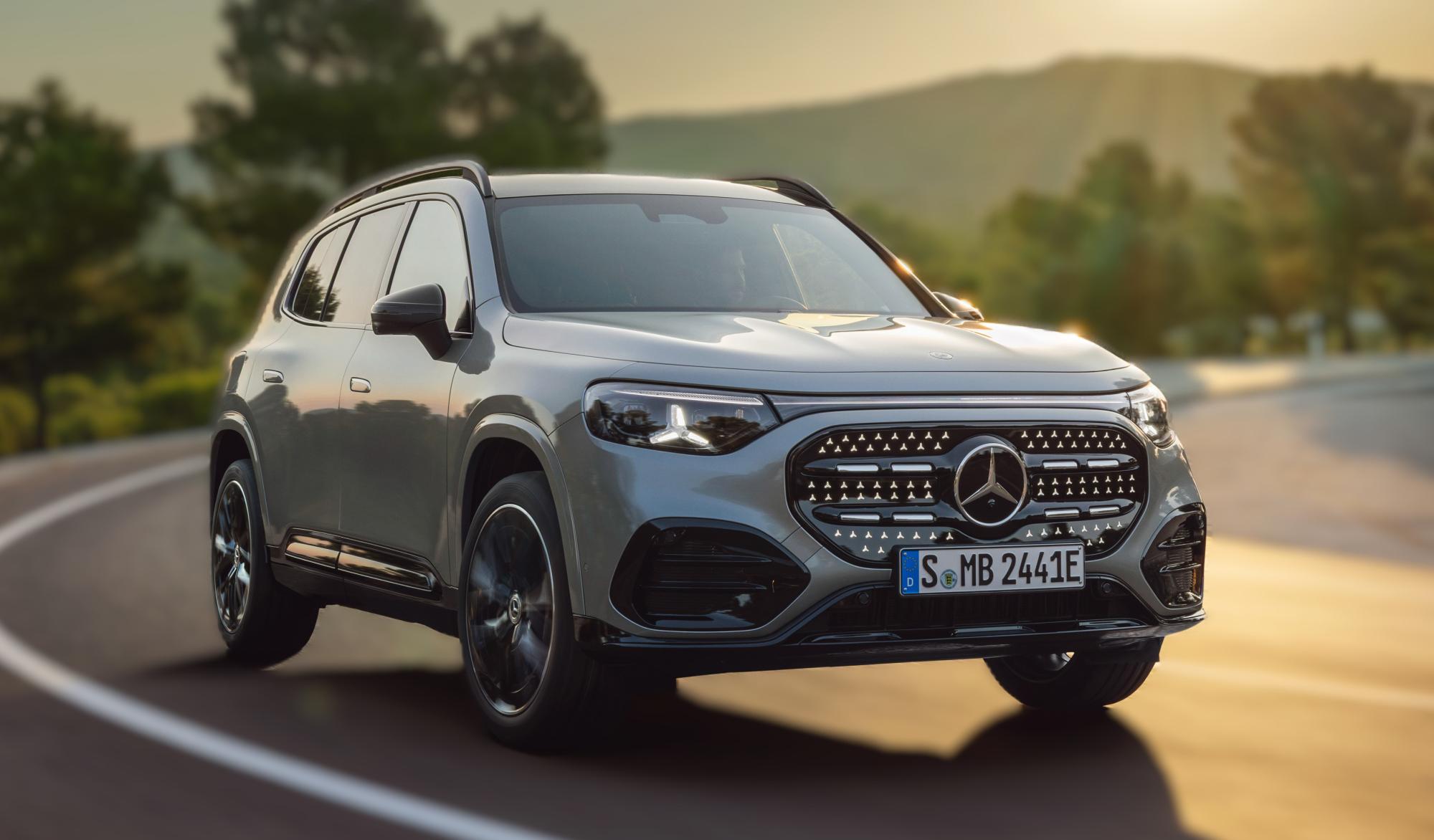
Mercedes-Benz GLB 250+: New Name, All-New Generation
With the introduction of the new Mercedes-Benz GLB, Mercedes-Benz opens a new chapter in its electric vehicle lineup. While the EQB name disappears, this is far more than a simple rebranding. Beneath the familiar SUV silhouette lies an entirely new generation of electric technology.
At first glance, the redesigned exterior immediately stands out. The GLB retains its robust, boxy SUV character but looks more modern and refined. The completely redesigned rear end is particularly eye-catching. Although there are still clear links to the former EQB, the new GLB has developed a distinct identity of its own. At the front, the new light signature and cleaner styling align perfectly with Mercedes-Benz's latest design language.
The biggest changes, however, are hidden beneath the bodywork. The GLB leaves the EQB platform behind and is built on the brand-new Mercedes Modular Architecture (MMA). This electric-first platform was developed from the ground up for battery-electric vehicles and introduces a host of technological innovations. Highlights include an 800-volt electrical architecture, a new generation of electric motors, more efficient battery technology and an innovative two-speed transmission. The result is greater driving range, faster charging and even lower energy consumption.
For this test, we drove the GLB 250+, arguably the most relevant version for fleet operators. Equipped with a 200 kW (272 hp) electric motor, an 85 kWh usable battery and a WLTP range of up to 628 km, it offers impressive technical credentials. At the same time, the GLB remains true to its practical nature, featuring a spacious interior and the option of seven seats—a rarity in the fully electric SUV segment.
As always at DrivOlution, however, we don't rely solely on the manufacturer's figures. Our real-world test focuses on how the GLB 250+ performs in everyday driving conditions. How efficient is the new powertrain in practice? What range can drivers realistically expect? And does the new GLB prove to be a worthy successor to the EQB for the fleet market?
Time to find out.
General information
- SUV
- Number of seats 5 or 7
- Mass in running order 2.200 kg
- LxWxH (mm) 4.739 x 1.861 x 1.689
- Price (test) vehicle (VTAi) starting at 57.959 , - euro (GLB 250+)
- Cargo volume 360 L / 1.231 L (max)
- Cargo volume frunk 72 L
- Tow bar possible (1.500 kg braked - 750 kg unbraked)
- Warranty : 8 jaar/160.000 km (distance)
Driveline
- BEV (Battery Electric Vehicle)
- Battery type Lithium-ion (NMC)
- 90 kWh battery capacity (85 kWh usable)
- Power 200 kW (272 hp)
- Torque 335 Nm
- RWD (rear wheel drive)
- Architecture 800 V
- EV-platform Mercedes-Benz MMA
- Heat pump standard
- V2L : no
Consumption/driving range (WLTP) (CoC)
- Combined consumption 16,8 kWh/100 km
- Combined driving range 597 km
- Driving range city 761 km
Charging information
- Internal onboard charger 11 kW
- Charging port rear right
- Charge Power AC 11 kW
- Charge Power DC 353 kW max.
- AC : 1 charge
- DC : 1 charge
Test track
- Non-urban (46 km) 11,5 kWh/100 km
- Motorway (40 km) 16,7 kWh/100 km
- City (21 km) 9,5 kWh/100 km
- Combined 12,6 kWh/100 km
Test results
- Non-urban 11,8 kWh/100 km
- Motorway 14,0 kWh/100 km
- City 9,55 kWh/100 km
- Combined 13,1 kWh/100 km
Test data
Test drivers
Johan Stevens
1106 Testkilometers
Drivetrain
The new electric GLB is much more than just an EQB with a different name. Mercedes has completely redesigned the technology. Thanks to the new MMA platform, the 800V architecture, rear-wheel drive, a more efficient electric motor and a two-speed transmission, the GLB represents a major step forward in terms of efficiency, charging performance and driving range. The GLB is therefore not the successor to the EQB, but a completely new generation of electric SUVs.
Two battery options
The electric Mercedes-Benz GLB is available with two battery options. The GLB 200 is fitted with a 58 kWh LFP (lithium iron phosphate) battery. This battery is known for its long service life, is less sensitive to frequent charging to 100 per cent and is also cheaper to manufacture. The downside is a lower energy density, which results in a more limited driving range.
The GLB 250+ is fitted with an 85 kWh NMC battery (nickel-manganese-cobalt). Thanks to its higher energy density, it offers a significantly greater driving range and supports very high DC charging capacities. This makes it particularly suitable for drivers who regularly cover longer distances. NMC batteries are, however, more expensive and perform best when they are not constantly charged to 100% for everyday use. Both battery variants utilise a modern 800V on-board electrical system, which enables short charging times.
Versions
Version | Power | Drive system | Usable battery capacity | WLTP range | WLTP consumption |
|---|---|---|---|---|---|
GLB 200 | 165 kW (224 hp) | Rear-wheel drive | 58 kWh | 428 km | 15,6 kWh/100 km |
GLB 250 | 200 kW (272 hp) | Achterwielaandrijving | 85 kWh | 524 km | 15,5 kWh/100 km |
GLB 250+ | 200 kW (272 hp) | Rear-wheel drive | 85 kWh | 628 km | 15,9 kWh/100 km |
GLB 350 4MATIC | 260 kW (354 hp) | Four-wheel drive | 85 kWh | 611 km | 16,0 kWh/100 km |
A full overview of the GLB Electric’s technical specifications can be found here Elektrische GLB | Prijzen & Specificaties | Mercedes-Benz
DYNAMIC SELECT driving modes
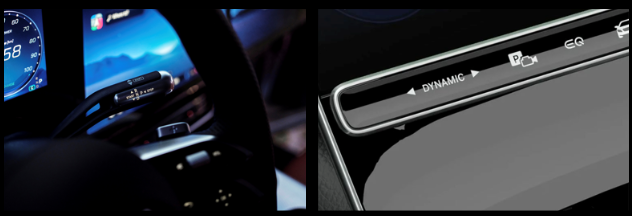
The Mercedes-Benz GLB Electric (MMA platform) is equipped with DYNAMIC SELECT. This allows the driver to adjust the car’s characteristics to suit the driving conditions or their personal preferences. Depending on the model, the following driving modes are available.
Driving mode | Features | Application |
|---|---|---|
Eco | Limits power output and optimises climate control and energy management to minimise consumption. | Ideal for maximising your range on everyday journeys or longer distances. |
Comfort | Offers a balanced combination of powertrain, steering and climate control settings. | The standard mode for everyday use, offering the best balance between comfort and efficiency. |
Sport | Faster throttle response, more direct steering response and maximum performance from the electric motor. | Suitable for a dynamic driving style or during powerful acceleration, such as when joining the motorway. |
Individual | The driver can combine various settings, such as the powertrain, steering feel and, where applicable, climate control, to suit their own preferences. | For those who want to tailor the car entirely to their personal driving style. |
It’s up to you, of course. Even in ECO mode, you won’t be the last to pull away at the traffic lights.
Brake energy recovery: 4 settings
Stand | Official name | How it works | Ideal for |
|---|---|---|---|
D AUTO | Intelligent recuperation | The car automatically determines the optimum level of braking energy recovery based on traffic conditions, navigation, bends, gradients and speed limits. | Everyday use and maximum efficiency without having to change the settings yourself. |
D+ | No recuperation | The car coasting almost freely when you take your foot off the accelerator. | Motorways and situations where you want to coast as far as possible. |
D | Normal recuperation | A slight regenerative braking effect when the accelerator pedal is released, similar to the engine braking in a car with a combustion engine. | Mixed traffic and everyday use. |
D− | Strong recuperation | Maximum braking energy recovery. Depending on the circumstances, the car can come to a complete stop (One-Pedal Driving) without using the brake pedal. | City traffic, traffic jams, roundabouts and junctions. |
One advantage: using the paddle shifters behind the steering wheel, you can switch between the different regenerative braking modes at any time. This allows you to easily adjust the level of regeneration to suit your driving style or the traffic conditions. The system is quick and intuitive, so ‘playing’ with the different modes soon becomes second nature. The D AUTO mode selects the right level of regeneration in most situations, meaning that, as the driver, you hardly need to intervene at all. However, if you prefer to be in control, you can switch to a different mode in an instant using the paddles. This makes the new GLB not only efficient, but also a real pleasure to drive.
Consumption
📊Overall efficiency
During the test with the GLB 250+, we covered 1,106 km with a weighted average consumption of 13.1 kWh/100 km. That is an exceptionally low energy consumption for a vehicle that was driven on the motorway for a large part of the test. The average simulated driving range comes to approximately 649 km, which indicates that the powertrain makes very efficient use of the available battery capacity.
Below is an overview by road type and driving mode:
🛣️Overview by road type
Road type | Number of trips (#) | Total distance (km) | Average consumption (kWh/100 km)* | Average simulation range (km) |
|---|---|---|---|---|
Motorway | 11 | 878 | 14,1 | 611 |
Non-urban | 5 | 207 | 12,5 | 728 |
City | 1 | 21 | 9,5 | 895 |
Total | 17 | 1.106 | 13,8 | 649 |
*Weighted average based on the distance travelled
📊Overview by driving mode
Driving mode | Number of trips | Total distance (km) | Average consumption (kWh/100 km) | Average simulation range (km) |
|---|---|---|---|---|
Eco | 13 | 849 | 13,9 | 639 |
Comfort | 4 | 252 | 13,4 | 639 |
Individual | 1 | 6 | 10,0 | 850 |
The Individual mode consists of just one short 6 km ride and is therefore not representative.
📊Key findings
- Total test distance: 1,106 km
- Average energy consumption: 13.1 kWh/100 km
- Average simulated driving range: 649 km
- Lowest fuel consumption: 9.5 kWh/100 km (urban driving)
- Highest consumption: 16.8 kWh/100 km (motorway)
- On the motorway, average energy consumption is 14.1 kWh/100 km, resulting in an average simulated range of 611 km.
- On country roads, energy consumption drops to 12.5 kWh/100 km, giving an average simulated range of 728 km.
- The city drive shows the lowest energy consumption at 9.5 kWh/100 km and the highest theoretical range (895 km), although this is based on just one drive.
1. Overall efficiency
During the test, the car covered 1,106 km with a weighted average energy consumption of 13.1 kWh/100 km. This is an exceptionally low energy consumption for a vehicle that was driven on the motorway for a large part of the test. The average simulated driving range works out at approximately 649 km, indicating that the powertrain makes highly efficient use of the available battery capacity.
2. Influence of road type
The type of road has a clear impact on the energy consumption of the Mercedes-Benz GLB 250+, although external factors such as temperature, wind, precipitation, traffic volume and speed also play an important role.
On the motorway, where no less than 79% of the test distance was covered, we recorded an average consumption of 14.1 kWh/100 km. Depending on the conditions, this varied between 12.7 and 16.8 kWh/100 km. Even under less favourable conditions, the GLB therefore remains exceptionally efficient for an electric SUV of this size.
Outside built-up areas, the GLB 250+ performed even better. Average consumption was 12.5 kWh/100 km, with a best result of 11.5 kWh/100 km. This confirms the high efficiency of the new MMA powertrain at constant speeds between 60 and 90 km/h.
For urban driving, we currently have one test run’s data. However, the measured consumption of 9.5 kWh/100 km is particularly promising and highlights the effective operation of the regenerative braking system and the high efficiency of the electric powertrain at low speeds. Although a larger sample size is needed to draw definitive conclusions, the initial results are certainly impressive.
3. Effect of driving mode
In practice, the impact of the selected driving mode on energy consumption appears to be rather limited. During our test week, we recorded an average consumption of 13.4 kWh/100 km in Comfort mode, compared with 13.9 kWh/100 km in Eco mode.
For most drivers, Comfort will therefore be the most logical choice. This driving mode offers the best balance between performance, comfort and energy consumption, whilst Eco is particularly useful when maximum range is the absolute priority. Comfort actually proves to be slightly more economical. This may seem surprising at first glance, but it makes sense when we take the test conditions into account. The driving mode primarily determines the accelerator response, the regenerative braking settings, the steering feel and the climate control.
Actual energy consumption is determined much more by speed, traffic conditions, temperature, changes in altitude and the driver’s driving style.
4. Simulated driving range of 611 to 895 km
That difference may seem huge, but it is entirely explainable. After all, the on-board computer bases its prediction on recent fuel consumption. Following a fuel-efficient city drive, the prediction rises sharply; after a long motorway journey, it drops immediately. The driving range is therefore not a fixed figure, but constantly adapts to current driving conditions.
✅During our test week, the Mercedes-Benz GLB 250+ demonstrated its exceptional efficiency. With an average energy consumption of just 13.1 kWh/100 km, despite a high proportion of motorway driving, it ranks among the most economical electric SUVs in its segment. The results also show that a proactive driving style and optimal use of coasting and regenerative braking have a greater impact on energy consumption than the selected driving mode.
Test track
🛣️General
A tradtional feature of every DrivOlution test week is our test track. This route covers 107 kilometres and comprises three representative driving conditions: outside built-up areas (46 km), motorway (40 km) and urban traffic (21 km). This enables us to assess the car’s efficiency under a variety of real-world conditions.
During the trips outside built-up areas (non-urban) and on the motorway, the air conditioning was switched on to simulate a realistic driving situation. During the city drive, the air conditioning remained switched off. The entire test was carried out at an average outside temperature of 28°C, allowing the battery to perform under favourable conditions.
During this test route, the on-board computer recorded a combined consumption of 12.6 kWh/100 km over the entire distance of 107 km. Based on the usable battery capacity, this corresponds to a theoretical driving range of approximately 675 km.
Eco driving mode was used for the entire route. As with all our electric vehicle tests, we aim to drive the car as efficiently as possible, without compromising on a realistic driving experience. To achieve this, we adopt a proactive driving style, coasting as much as possible when conditions allow and making maximum use of cruise control to maintain a constant speed.
The results of this test route therefore provide a good indication of the car’s efficiency potential in a variety of everyday driving conditions.
📉Overview of results by section of the test course
Road type | Distance (km) | Average speed (km/h) | Consumption (kWh/100 km) | Theoretical driving range (85 kWh usable) (km) |
|---|---|---|---|---|
Non-urban | 46 | 38 | 11,5 | 739 |
Motorway | 40 | 85 | 16,7 | 509 |
City | 21 | 25 | 9,5 | 895 |
Total / Average | 107 | 49 | 13,1 | 649 |
📉Changes in driving range (km) and SoC (%)
Traject | Distance (km) | SoC start | SoC finish | Δ SoC | Driving range start (km) | Driving range finish (km) | Δ Driving range |
|---|---|---|---|---|---|---|---|
Start | – | 80% | – | – | 418 km | – | – |
Non-urban | 46 | 80% | 74% | -6% | 418 km | 445 km | +27 km |
Motorway | 40 | 74% | 67% | -7% | 445 km | 408 km | -37 km |
City | 21 | 67% | 63% | -4% | 408 km | 409 km | +1 km |
The trend in the estimated driving range clearly illustrates how the on-board computer constantly adjusts its prediction based on recent energy consumption.
- Non-urban areas, the driving range increased from 418 to 445 km (+27 km), despite the battery level dropping from 80% to 74%. Thanks to the low energy consumption of 11.5 kWh/100 km, the on-board computer concluded that the car was driving more efficiently than before, resulting in an increase in the estimated driving range.
- On the motorway, the SoC fell by 7 percentage points and the driving range decreased by 37 km. The higher energy consumption of 16.7 kWh/100 km caused the on-board computer to revise the remaining driving range downwards.
- During the city drive, the battery level dropped by a further 4 percentage points, but the estimated range remained virtually stable (+1 km). The very low city consumption of 9.5 kWh/100 km largely offset the battery loss, leaving the predicted range virtually unchanged.
*The theoretical driving range shown is always calculated on the basis of the energy consumption measured during the journey and the vehicle’s usable battery capacity. This provides an indication of the potential driving range under the specific conditions in which the test was carried out.
It goes without saying that actual energy consumption and driving range in real-world conditions are influenced by various factors. These include outside temperature, weather conditions, speed, traffic conditions, tyre pressure, load, use of climate control and the driver’s driving style, all of which have a direct impact on the final range.
The values shown should therefore be regarded as a practical snapshot rather than a fixed figure applicable to all driving conditions. The theoretical driving range shown is always calculated on the basis of the energy consumption measured during the journey and the vehicle’s available battery capacity. This provides an indication of the potential driving range under the specific conditions in which the test was carried out.
Charging and driving range
Charging performance
During the test week, we carried out both an AC and a DC charging session. A third charging session was not included in the analysis, as it was not representative. Our focus is primarily on the performance of the DC charging session.
🔌The AC charge started at a State of Charge (SoC) of 56% and ended at 80%. A total of 22.47 kWh of energy was charged. The driving range calculated by the on-board computer increased from 354 km to 524 km, representing a gain of 170 km. Although the charging time (home charging) was not recorded, this session demonstrates that even a partial AC charge results in a significant increase in the available driving range.
🔌The DC charging test provides a good indication of the GLB 250+’s fast-charging capabilities. The battery was charged from 17% to 80% SoC in just 20 minutes and 20 seconds. During this charging session, 60.51 kWh was charged, resulting in an increase in the estimated driving range from 103 km to 481 km – an extra 380 kilometres of driving range.
With an average charging speed of 183 kW, the GLB 250+ performs exceptionally well. This is thanks to the 800V charging system, which enables the car to maintain a high charging power for much of the charging session. In practice, this means that a short charging stop is enough to restore a significant driving range.
As always, the driving ranges shown are indicative. They are based on the average energy consumption recorded by the on-board computer at that moment and may vary in practice depending on factors such as outside temperature, driving style, speed, traffic conditions and the use of the climate control system.
Conclusion: the combination of low real-world energy consumption and excellent DC charging performance makes the Mercedes-Benz GLB 250+ particularly well-suited to both everyday use and longer journeys, ensuring that charging time during a stopover is kept to a minimum and a long driving range is quickly restored.
Drive and comfort
Interior and practical usability
Inside too, the new Mercedes-Benz GLB 250+ represents a clear step forward. The interior looks modern, is finished to a high standard and exudes the premium feel we’ve come to expect from Mercedes-Benz. The two large displays combine to form a single, clear unit and run on the new MB.OS operating system. Operation is fast and intuitive, whilst the latest generation of MBUX offers a clear menu structure and smooth voice control. Nevertheless, we regret the disappearance of the touchpad on the centre console, as seen in the EQA and EQB. Not only is a touchscreen prone to fingerprints, but a physical touchpad also allows certain functions to be operated without touching the screen, which can be an ergonomic advantage whilst driving..
The number of physical buttons has been deliberately kept to a minimum, although the most important functions remain easily accessible. Behind the steering wheel are also the gearshift paddles, which allow the driver to switch easily between the different levels of brake energy recovery whilst driving. In combination with the DYNAMIC SELECT driving modes, the GLB can be fully tailored to the driver’s personal driving style.
The GLB also scores highly in practical terms. It remains one of the few fully electric SUVs available with five or seven seats, making it ideal for larger families. Rear passengers enjoy a spacious seating position and ample head and legroom.
An added bonus is the 72-litre frunk under the bonnet. This is ideal for storing charging cables, leaving the boot space entirely free for luggage. At the rear, the GLB offers a boot capacity of 360 litres, which can be expanded to 1,231 litres when the rear seats are folded down. Together with the practical interior layout, this makes the GLB a particularly versatile electric family car.
Driver assistance systems (ADAS)
The Mercedes-Benz GLB 250+ is equipped with most of the driver assistance systems that are now mandatory under the General Safety Regulation (GSR). During our test week, these systems made a positive impression. They assist the driver where necessary, without intervening excessively or disruptively. Mercedes has succeeded in ensuring that the systems work together seamlessly, thereby contributing to both safety and driving comfort.
During the test, we made use of, amongst other things, the Active Distance Assist DISTRONIC. This adaptive cruise control automatically maintains a safe distance from the vehicle ahead and smoothly adjusts the speed to suit the traffic. Particularly on longer motorway journeys, this not only enhances comfort but also helps to maintain a constant speed, which has a positive impact on fuel consumption.
The Active Lane Keeping Assist also performed reliably. The steering corrections are subtle and assist the driver when the car is in danger of unintentionally straying from its lane, without feeling intrusive. The Active Brake Assist, Blind Spot Assist and Attention Assist are also valuable additions and help to enhance safety without unnecessarily distracting the driver.
We have one minor comment regarding the Traffic Sign Assist. Although the system provides useful support and alerts the driver to the applicable speed limits, we noted during our test that the speed displayed did not always correspond to the actual road signs. The system should therefore be regarded as an additional aid and not as a substitute for the driver’s own observations. The driver remains responsible at all times for correctly interpreting and complying with the applicable traffic signs..
Overall, the GLB 250+’s driver assistance systems are among the car’s strong points. They operate discreetly, intervening only when necessary, and enhance both safety and driving comfort. This is exactly how a well-calibrated driver assistance system should function: providing support where needed, but without giving the driver the impression that control is being taken away from them.
Simulation driving range (km), based on trip consumption (kWh/100 km), road type, trip length (km) and usable battery capacity (kWh)
The results clearly show the relationship between energy consumption and driving range. The lower the consumption during a trip, the greater the theoretically achievable driving range. The figures given are calculated in each case on the basis of the measured journey consumption and the usable battery capacity of 85 kWh, and provide a realistic indication of the range achievable under comparable conditions.
As always, this is a theoretical simulation. Actual energy consumption and driving range depend on a number of factors, such as weather conditions, speed, traffic conditions, outside temperature, load and the driver’s driving style.
Comparison WLTP/test results DrivOlution
Parameters | WLTP (CoC) | DrivOlution test | Difference | Difference (%) |
|---|---|---|---|---|
Combined consumption (kWh/100km) | 16,8 | 13,1 | -3,7 | -22,0 |
Combined driving range (km) | 597 | 649 | +52 | +8,7 |
City driving range (km) | 761 | 895 | +134 | +17,6 |
Analysis:
During the DrivOlution test, the Mercedes-Benz GLB 250+ Electric achieved a significantly lower energy consumption than the WLTP reference value. At 13.1 kWh/100 km, the measured consumption was 22% lower than the official combined WLTP figure of 16.8 kWh/100 km. This translates directly into a greater theoretical driving range: 649 km combined, or 52 km (+8.7%) more than the stated WLTP figure.
In predominantly urban use, the difference becomes even greater. Due to the higher proportion of regenerative braking and lower speeds, the theoretically achievable range increased to 895 km, which is 134 km (+17.6%) above the WLTP urban figure.
It is clear that driving style is a decisive factor in determining the driving range. It goes without saying that these figures will look completely different in winter conditions.