Test review DrivOlution Mercedes C 400 4MATIC AMG Line Electric
Test report
General information
- Berline
- Number of seats 5
- Mass in running order 2.460 kg
- LxWxH (mm) 4.936 x 1.934 x 1.500
- Price test vehicle (VTAi) 78.329,35- euro
- Cargo volume 360 L / 1.231 L (max)
- Cargo volume frunk 101 L
- Tow bar possible (1.800 kg braked - 750 kg unbraked)
Driveline
- BEV (Battery Electric Vehicle)
- Battery type Lithium-ion (NMC)
- 100 kWh battery capacity (94 kWh usable)
- Power 360 kW (489 hp)
- Torque 800 Nm
- AWD
- Architecture 800 V
- EV-platform Mercedes-Benz EA-M
- Heat pump standard
Consumption/driving range (WLTP) (CoC)
- Combined consumption 15,2 kWh/100 km
- Combined driving range 721 km
- Driving range city 833 km
Charging information
- Internal onboard charger 11 kW
- Charging port rear right
- Charge Power AC 11 kW
- Charge Power DC 330 kW max.
- AC : 1 charge
- DC : 1 charge
- Battery preheating possible yes
Test track
- Non-urban (44 km) 14,4 kWh/100 km
- Motorway (40 km) 16,3 kWh/100 km
- City (21 km) 14,9 kWh/100 km
- Combined 15,2 kWh/100 km
Test results
- Non-urban 15,4 kWh/100 km
- Motorway 16,6 kWh/100 km
- City 14,9 kWh/100 km
- Combined 15,6 kWh/100 km
Test data
Test drivers
Johan Stevens
885 Testkilometers
Drivetrain
Mercedes-Benz MB.EA-M: new electric platform
With MB.EA-M (Mercedes-Benz Electric Architecture – Medium), Mercedes-Benz is introducing a completely new, modular EV platform for the mid-range segment. Among other things, it forms the technical basis for the electric C-Class and GLC.
The platform has been developed with particular emphasis on energy efficiency, driving range, charging performance and thermal management.
Key technical specifications
800V architecture: enables high DC charging power and helps to minimise electrical losses.
Two-speed transmission: optimises the efficiency of the rear electric motor at both low and high speeds.
Disconnect Unit (DCU): disconnects the front electric motor on the 4MATIC model when four-wheel drive is not required, thereby reducing drive losses.
Advanced thermal management: integrated heat pump for more efficient cabin heating and powertrain temperature control.
Brake energy recovery: up to 300 kW in the electric C-Class, depending on conditions.
MB.OS: a new operating system that integrates vehicle functions and energy management.
What does this mean for the C 400 4MATIC Electric?
The combination of the two-speed transmission, the disengageable front axle and the intelligent thermal management system is designed to ensure that the Mercedes utilises its available battery energy as efficiently as possible, despite its high power output and four-wheel drive.
Available versions
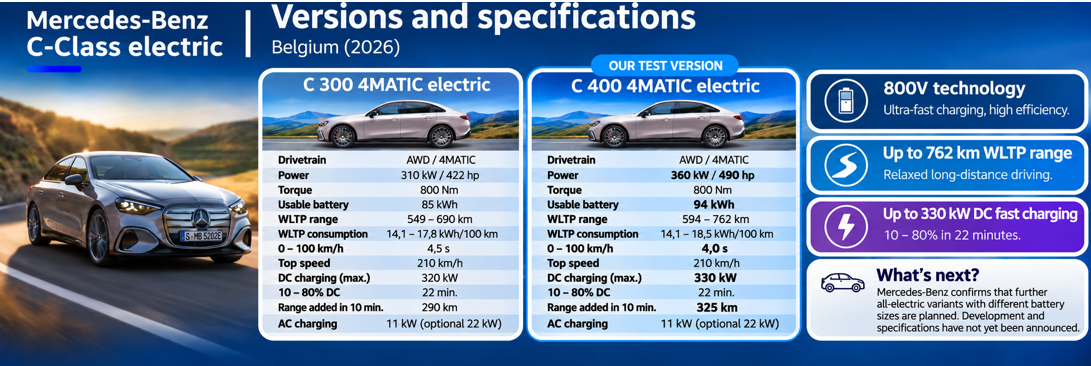
The new Mercedes-Benz C-Class electric is available in Belgium in two all-wheel-drive variants: the C 300 4MATIC electric and the more powerful C 400 4MATIC electric, which we put through its paces during our test week.
- The C 300 4MATIC is the entry-level model, although with 422 pk, a usable battery capacity of 85 kWh and a WLTP range of up to 690 km, this is a rather relative term. This model is aimed primarily at drivers who want to combine performance and efficiency.
- One step up is the C 400 4MATIC, with 490 pk, a usable battery capacity of 94 kWh and an official range of up to 762 km. Thanks to its 800V architecture and a maximum DC charging power of 330 kW, it also promises exceptionally short charging stops. Under ideal conditions, the charging time from 10 per cent to 80 per cent is approximately 22 minutes.
What does the future hold? Mercedes-Benz is also planning rear-wheel-drive variants and different battery sizes, which will further expand the range.
Four driving modes
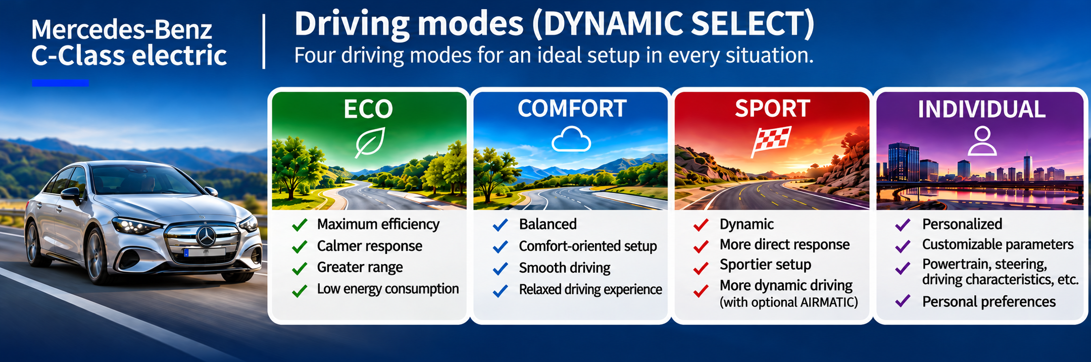
The Mercedes-Benz C 400 4MATIC electric offers four driving modes via DYNAMIC SELECT, each with its own distinct character.
- In ECO mode, the focus is on efficiency. The throttle response becomes smoother and the powertrain responds more gradually to the accelerator pedal, with the aim of reducing energy consumption and optimising driving range.
- Comfort offers a well-balanced set-up, with smooth power delivery and a pleasant, relaxed driving experience. A mode that is particularly well suited to everyday use and longer journeys.
- In Sport mode, the character changes noticeably. The throttle response becomes sharper and the C 400 responds much more directly to the driver’s commands. We only selected this mode briefly, but that was enough to experience the sporty potential of the powerful electric powertrain.
- Finally, Individual allows you to combine different vehicle settings to suit your personal preferences.
During our test week, we mainly drove in ECO and Comfort modes. Both are best aligned with the DrivOlution DNA, which focuses on anticipation, maximising coasting and efficient energy use. Sport mode is undoubtedly enjoyable, but during our fuel consumption tests, efficiency takes precedence over pure performance.
Brake energy recovery – four levels, maximum control
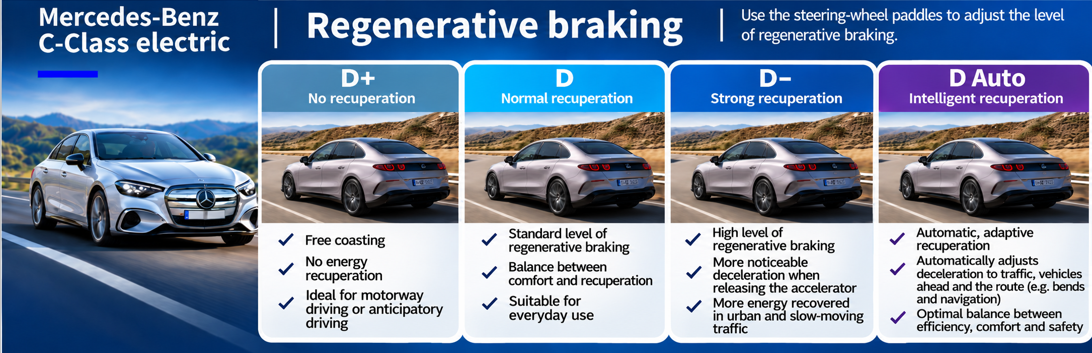
One of the things we particularly appreciate about the Mercedes-Benz C 400 4MATIC electric is the ability to control regenerative braking directly via the paddles behind the steering wheel. It’s simple, intuitive and, above all, extremely practical whilst driving.
Mercedes offers four levels of regenerative braking, each with its own distinct character.
- D Auto is the intelligent mode, in which the car itself determines how much energy recovery is required. Depending on the traffic situation, the system chooses between coasting and decelerating. It’s convenient, although we prefer to take control ourselves during our efficiency tests.
- We find this particularly in D+, our favourite setting when we want to coast or sail as much as possible. Regenerative braking is deactivated, allowing the C-Class to continue rolling along exceptionally smoothly when we take our foot off the accelerator. Exactly what we’re looking for with a proactive driving style.
- In D, gentle regenerative braking ensures a smooth, natural deceleration. A pleasant compromise for everyday use, without the car braking too sharply.
- If you want more deceleration, select D−. Regenerative braking becomes significantly stronger and the driving behaviour is similar to that of One Pedal Driving. This setting really comes into its own in city traffic, where you need to slow down frequently.
Our verdict? The ability to switch between the four levels with a single movement is a real bonus. During our test rides, we personally preferred D+, as maximising coasting fits perfectly with our driving philosophy. After all, the most efficient energy is still the energy you don’t have to use — or have to recover afterwards.
Consumption
Analyse testweek Mercedes-Benz C400 4MATIC Electric AMG Line
During our test week from 29 October to 4 November 2026, we covered a total of 885 kilometres in the Mercedes-Benz C400 4MATIC Electric AMG Line, spread over 16 journeys. With an average outside temperature of just 11°C, we recorded an average energy consumption of 16.4 kWh/100 km.
One journey, however, deserves special attention. During a short journey of barely 3 kilometres, with a cold battery and heavy traffic, energy consumption rose to around 28.4 kWh/100 km. This is not unusual: on such short journeys, the energy required to warm up the battery and the interior, combined with energy consumption at low speeds, has a relatively significant impact.
Although this fuel consumption reflects a realistic real-world scenario, this journey is less representative of the car’s overall efficiency.
If we exclude this short journey, the average consumption falls from 16.4 to 15.6 kWh/100 km. This paints a very different picture of the C400’s efficiency potential.
Our review
With 15.6 kWh/100 km over the remaining 15 trips, the Mercedes C400 4MATIC Electric has achieved a particularly impressive result, especially given the relatively low outside temperatures, the available power and the four-wheel drive.
For our DrivOlution analysis, we therefore retain both figures: 16.4 kWh/100 km as the recorded average across all journeys and 15.6 kWh/100 km as the adjusted average, excluding the short cold-start journey.
It is, however, important that both figures are calculated in the same way. For a fair comparison, a distance-weighted average – based on total energy consumption and the number of kilometres travelled – is preferable.
Conclusion: During our test week, the Mercedes C400 4MATIC Electric impressed us above all with its efficiency. The adjusted figure of 15.6 kWh/100 km underlines that potential, whilst we mustn’t lose sight of the impact of short journeys and cold starts.
Below is an overview of the breakdown of riders by road type and riding mode.
Test track
The Mercedes-Benz C 400 4MATIC Electric achieved an impressive result on our standard DrivOlution test route of 105.0 km. We recorded an average of 15.2 kWh/100 km, just 2.7 per cent above the official WLTP consumption figure.
During the three runs, the aim in each instance is to drive as efficiently as possible. We achieve this through an anticipatory driving style, by coasting as much as possible and avoiding unnecessary stops wherever possible. This makes the course particularly suitable for assessing the efficiency of the powertrain under controlled real-world conditions.
Furthermore, the test was not carried out under ideal conditions: 11.5 °C, the air conditioning was switched on and the battery was cold at the start.
Outside the city, we recorded 14.4 kWh/100 km, on the motorway 16.3 kWh/100 km and in the city 14.9 kWh/100 km. The narrow spread between the three segments is particularly striking.
Our impression: the C 400 4MATIC Electric combines its performance with exceptionally low energy consumption. The fact that we remained so close to the official WLTP figure despite a cold start and active climate control makes the result all the more impressive.
Charging and driving range
Analysis of the charging session and the additional driving range
The Mercedes-Benz C 400 4MATIC was charged twice: once via AC and once via DC. The focus was on the DC charging session. During this, 53.91 kWh was charged in 22 minutes and 44 seconds, taking the State of Charge (SoC) from 26% to 80%. According to our real-world measurements, this equates to an additional driving range of approximately 315 to 330 km. The on-board computer estimated this at 357 km, or 15.7 km per minute. Our measurements came to around 330 km during the test week and 315 km on the motorway.
Of the 53.91 kWh charged at the charging point, an estimated 50.8 kWh ended up in the battery. The difference of approximately 3.2 kWh corresponds to around 6 per cent charging loss and is accounted for, amongst other things, by heat, cooling and power consumption during charging.
Despite the 800V technology, the charging power remained at around 150 kW for approximately 11 minutes in practice. This is well below the charging point’s maximum of 400 kW and the peak of 330 kW specified by Mercedes. The flat curve suggests a limitation during this session, but does not clarify the cause. Possible factors include battery temperature, the absence of preconditioning, or power sharing with other charging points. A repeat test under controlled conditions should reveal the maximum charging power the car is capable of achieving.
The on-board computer estimated the driving range at 173 km at 26% SoC and 530 km at 80%. That works out at approximately 660 km on a full battery. During the test week, a range of 609 km was recorded.
Drive and comfort
Interior, comfort and ease of use
The C 400 4MATIC is remarkably quiet to drive. The sound insulation effectively keeps outside noise at bay, and the suspension is not set too stiffly. The suspension settings can also be adjusted to suit your preferences.
Inside, too, the familiar Mercedes-Benz style remains recognisable, despite the high level of digitalisation of the dashboard. Three LCD displays offer the driver and front passenger a wide range of display and control options. The central display and the passenger display each measure 14 inches and are touch-sensitive; the digital driver’s display measures 10.3 inches. The image quality is excellent. If desired, the speed can also be displayed in the familiar analogue style.
There’s no shortage of legroom: there’s more than enough in the back too. The boot offers 360 litres of load capacity. With the rear seats folded down, this increases to a maximum of 1,231 litres. At the front, there’s a 101-litre ‘frunk’, which you can easily open by pressing the Mercedes badge on the bonnet. The boot is deep, which means items at the bottom aren’t always easy to load or reach. Also, be careful when placing your foot under the car: this can cause the tailgate to close unexpectedly.
The trend towards digitalisation is also continuing in the area of controls: physical buttons are disappearing and more and more functions are being operated via the central screen. This brings together a wide range of options in one place, but it also has a downside. To find and operate functions, the driver must temporarily take their attention off the road. This creates a functional distraction, which is precisely what we want to minimise as much as possible.
What we missed during the test was a head-up display (HUD). Especially if you’re used to seeing information on the windscreen, you really notice its absence: you find yourself having to look at the driver’s display more often.
Driver assistance systems (ADAS)
Driver assistance systems: more than just the GSR basics
The Mercedes-Benz C 400 4MATIC Electric features a comprehensive range of driver assistance systems. Some of these are mandatory under the European General Safety Regulation (GSR); other functions offer additional comfort and support whilst driving.
Whilst driving, DISTRONIC and route-based speed adjustment help to regulate the speed and distance to the vehicle ahead. The car can take bends, roundabouts and junctions into account and automatically set off again in traffic jams. Lane Keeping Assist, Blind Spot Assist Plus and Traffic Sign Assist support the driver in staying in their lane, changing lanes and recognising speed limits. Warnings for stop signs and traffic lights, as well as Adaptive High-Beam Assist Plus with DIGITAL LIGHT, are also part of the equipment.
During our test, the systems’ warnings and interventions stood out for their subtle nature. They provide support without being intrusive. The traffic sign recognition and the speed limits displayed were generally accurate. However, the speeds indicated did not always correspond to the applicable speed limit. The driver must therefore remain alert and continue to assess the traffic signs and the road conditions themselves.
To ensure safety, the C 400 is equipped with COLLISION PREVENTION ASSIST, which includes brake assist, an emergency braking and evasive manoeuvre function, PRE-SAFE and an exit warning system. Tyre pressure monitoring and eCall round off this range of features. PARKTRONIC, the parking assistant, the reversing camera and the manoeuvring aid assist with parking and manoeuvring.
The GSR sets requirements for, amongst other things, intelligent speed assistance, automatic emergency braking, lane-keeping assistance, tyre pressure monitoring and rear traffic detection. The traffic sign assistant, brake assistant and lane-keeping assistant meet these requirements. The car also offers features that go beyond the legal minimum, such as DISTRONIC, blind-spot assist, PRE-SAFE and route-based speed adjustment. Mercedes lists DISTRONIC and parking assist as standard equipment for the electric C-Class; the availability of other features may depend on the configuration and selected equipment packages.
A clarification regarding the term emergency stop function: the GSR also requires an emergency stop signal that warns traffic approaching from behind in the event of heavy braking. This is not the same as a system that brings the car to a controlled stop itself. Functions such as fatigue and distraction warnings and the event data recorder are also part of the GSR requirements, but are not listed separately in this equipment list.
Driving range simulation (km) based on trip consumption (kWh/100 km), road type, trip length (km) and usable battery capacity (kWh)
The driving range shown is a theoretical simulation per journey. We calculated how far the car would travel if the full usable battery capacity of 94 kWh were consumed at the rate recorded by the on-board computer. The result is therefore not a prediction of the actual driving range, but an indication of what is achievable under comparable conditions. Consumption undeniably depends on a large number of factors, including speed, traffic density, outside temperature, climate control, driving style and journey length. Over 15 journeys totalling 883 km, the weighted average consumption was approximately 15.4 kWh/100 km, equating to a theoretical driving range of around 610 km. On motorway journeys at an average speed of 70 km/h or more, this figure was around 585 km. In practice, the battery is rarely used to its full capacity: if you charge between 80 per cent and 10 per cent, you can expect a range of approximately 410 km on the motorway between two charging stops. The consumption figures provided by the on-board computer do not take charging losses into account.
Comparison WLTP/test results Drivolution
WLTP versus real-world conditions
It is always interesting to compare the test results obtained with the official WLTP figures. This allows us to see how the driving range in practice compares with the standardised values.
According to the Certificate of Conformity (CoC), the combined WLTP range is 721 km. In urban driving, this rises to 833 km. During our test, the C 400 4MATIC AMG Line achieved an average of approximately 85% of the combined WLTP range. Given an average outside temperature of 11 °C and a significant proportion of motorway driving, this is a respectable real-world result.
The official WLTP consumption figure of 15.2 kWh/100 km was measured at the mains socket and includes charging losses. The consumption displayed on the on-board computer is measured whilst driving and is therefore not directly comparable. For a fair comparison, we therefore look at the driving range: the official WLTP figure versus the range we achieved in practice.