Test review DrivOlution NIO EL6 First Edition
Test report
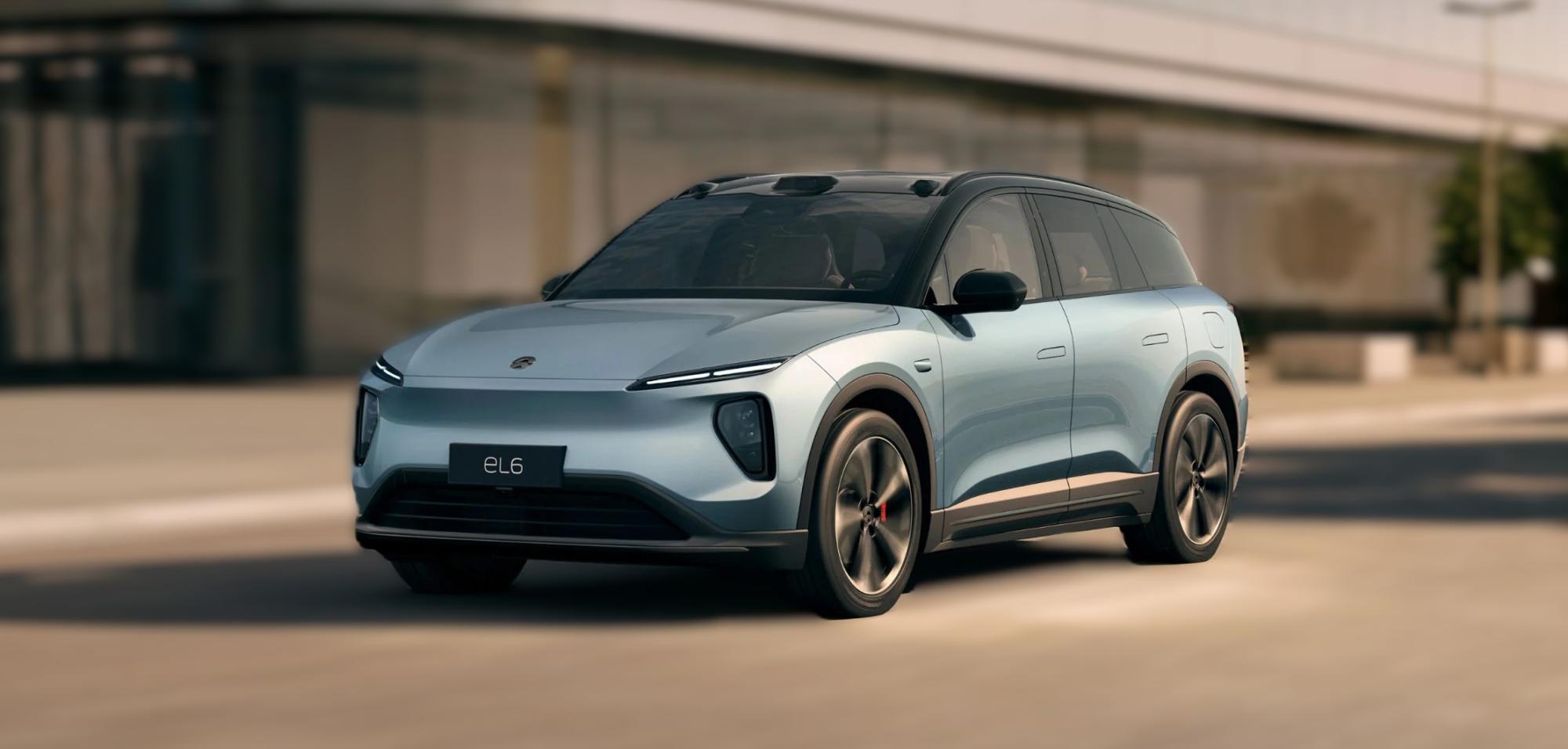
NIO is still an unknown name to most people in Belgium and Europe, but that makes discovering it all the more exciting. The brand is gradually building its European presence with a growing range: the ET5 saloon, the ET5 Touring, and the larger EL8 together form the backbone of the range. Right in the middle of this electric family is the NIO EL6 — a mid-size SUV that aims to combine comfort, efficiency and technological refinement. The NIO EL6 immediately attracts attention, not only because of its sleek and minimalist design, but above all because of the innovative brand story it carries with it. NIO is increasingly positioning itself in Europe as a premium EV player with a distinct focus on technology, ease of use and a seamless driving experience. The EL6 is right at the heart of the range: a mid-size SUV that combines comfort, efficiency and innovation in one package.
During our test week, we examine the EL6 as we always do at DrivOlution: through the eyes of the everyday driver and with an eye for realistic conditions. How does the car feel in everyday use? How intuitive is the interior? And how do the driver assistance systems perform in real traffic? We also take a close look at charging options, connectivity and user comfort.
The EL6 aims to offer a relaxing, modern and intelligent driving experience. Find out whether it succeeds in doing so in the full test report.
General information
- SUV
- Number of seats 5
- Mass in running order 2.398 kg
- LxWxH (mm) 4.854 x 1.995 x 1.703
- Price test vehicle (VTAi) 78.250,- euro
- Trunk volume 579 L/1.430 L (max)
- Cargo volume frunk 0 L
- Tow bar possible (1.200 kg braked - 750 kg unbraked)
- Warranty : 96 months or 160.000 km
Driveline
- BEV (Battery Electric Vehicle)
- Battery type Lithium-ion (NMC)
- 100 kWh battery capacity (90,0 kWh usable)
- Power 360 kW (489 hp)
- Torque 700 Nm
- AWD
- Architecture 400 V
- Ev-platform NIO NT2
- Heat pump standard
- V2L : no
Consumption/driving range (WLTP) (CoC)
- Combined consumption 21,1 kWh/100 km
- Combined driving range 512 km
- Driving range city 581 km
Charging information
- Internal onboard charger 11 kW
- Charging port rear left
- Charge Power AC 11 kW
- Charge Power DC 180 kW max.
- AC : 0 charge
- DC : 1 charge
Test track
- Non-urban (42,2 km) 16,6 kWh/100 km
- Motorway (39,0 km) 20,8 kWh/100 km
- City (20,5 km) 14,6 kWh/100 km
- Combined 17,3 kWh/100 km
Test results
- Non-urban 18,5 kWh/100 km
- Motorway 19,9 kWh/100km
- City 12,9 kWh/100 km
- Mix 23,3 kWh/100 km
- Combined 19,1 kWh/100 km
Test data
Test drivers
Johan Stevens
548 Testkilometers
Driveline
EV-platform - NT2 of N2.0
The NIO EL6 is based on the NT2 platform, NIO's modern EV architecture that rests on three pillars: an efficient electric powertrain, a modular battery concept and a powerful digital safety architecture.
The electric powertrain consists of two electric motors – one on the front axle and one on the rear axle – delivering a total power output of 360 kW and 700 Nm. The front induction motor (150 kW) kicks in when extra power or traction is needed, while the rear permanent magnet motor (210 kW) acts as the main motor, ensuring an optimal balance between performance and efficiency.
The modular battery concept supports both 75 kWh and 100 kWh batteries and is fully compatible with NIO's battery swap stations. The platform is also prepared for future battery sizes, such as the announced 150 kWh semi-solid-state battery.
However, NIO's BaaS (Battery as a Service) formula — whereby the battery is rented and you can make use of battery exchanges — is only available in countries where battery rental is actively offered. This service is not yet available in Belgium.
The digital architecture comprises four NVIDIA Orin-X chips and 33 sensors, including LiDAR, which forms the basis for the advanced ADAS features and extensive OTA updates.
The NT2 platform forms the basis for all recent NIO models, including the EL6, ET5, ET5 Touring, ET7, EL7/ES7 and the latest ES8.
Battery packs: Standard Range and Long Range
You can choose between two battery packs: Standard Range and Long Range.
- standard range
- long range
Version | Battery capacity (gross/usable) | WLTP Driving range | WLTP consumption |
|---|---|---|---|
Standard Range (75 kWh) | ca. 75 kWh (ca. 70 kWh usable) | ~ 406 km | ~ 17.3 kWh/100 km (TEL value) Also specified: 20.4-22.3 kWh/100 km |
Long Range (100 kWh) | ca. 100 kWh (ca. 90 kWh usable) | ~ 529 km | Approximately ~ 20.7 kWh/100km specified for this version |
Driving modes
The NIO EL6 has 9 driving modes, tailored to efficiency, comfort, performance or terrain conditions. 5 basic modes and 4 modes for specific situations.
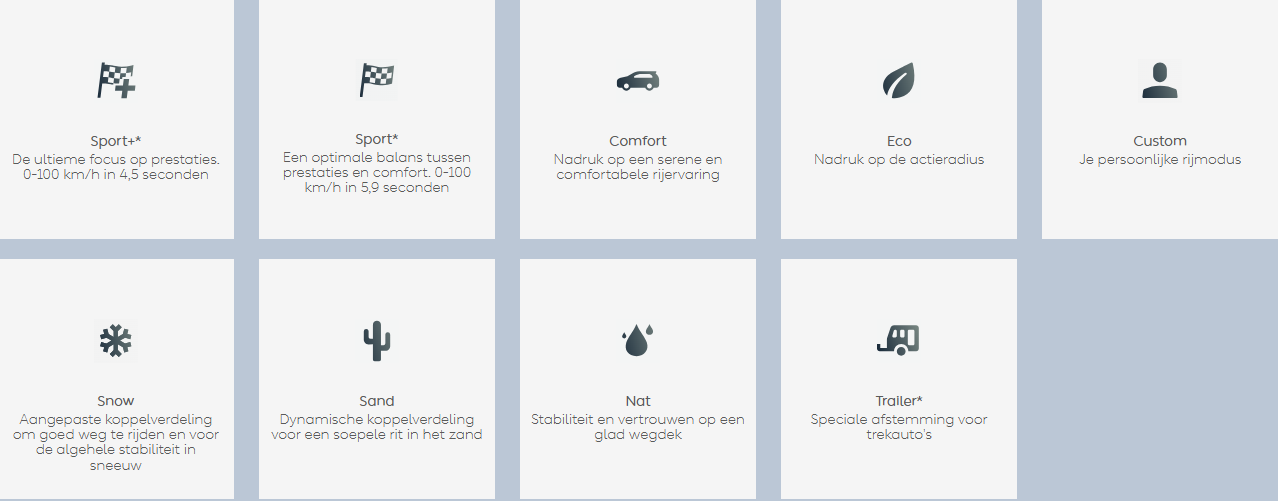
More information about the models can be found here: NIO EL6 - Prices and models | Hedin
Driving mode | Brief explanation |
|---|---|
Eco | Maximum energy efficiency; limited power, more efficient climate control. |
Comfort | Standard mode with a balance between performance and comfort. |
Sport | Faster throttle response and a more dynamic driving experience. |
Sport+ | Maximum system output (360 kW); most sporty settings. |
Snow | Optimised traction for driving on slippery or snowy roads. |
Sand | Adjusted wheel spin and traction for driving through loose sand. |
Wet | Greater slip tolerance for pulling through muddy conditions. |
Trailer | Special adjustment for towing a trailer |
Custom / Individual | Driver sets driving, steering and regeneration settings themselves. |
Brake energy recovery
The NIO EL6 offers three levels of brake energy recovery and a One-Pedal-Drive function that must be activated manually. In this mode, the car slows down sharply on the electric motors and can be driven without the brake pedal in many situations, which increases efficiency, especially in city traffic.
Stand | Description |
|---|---|
Low | Slight delay, ideal for motorway driving and coasting. |
Standard | Comfortable everyday driving setting. |
High | Strong recovery, suitable for city driving and traffic jams. |
One-Pedal-Drive (geactiveerd) | Maximum recuperation — vehicle slows to near standstill without brake pedal. |
The recovery level cannot be changed using paddles on the steering wheel, but only via the central screen. This makes it less practical to 'play' with the different levels while driving, which means that drivers often stick to the default setting in practice.
Consumption
General
After 548 test kilometres on board the NIO EL6, we arrived at a combined consumption of 19.1 kWh/100 km, spread over 14 journeys. Taking into account a usable battery capacity of 90 kWh, this results in a theoretical driving range of 471 kilometres. During the test week, the average outside temperature was 11 °C..
Overview of consumption and theoretical driving range per road type
Road type | Number of trips | Share (%) | Consumption (kWh/100 km) | Theoretical driving range (km) |
|---|---|---|---|---|
Non-urban | 5 | 36% | 18,5 | 485 km |
Motorway | 7 | 50% | 19,9 | 452 km |
City | 1 | 7% | 12,9 | 698 km |
Mix | 1 | 7% | 23,2 | 388 km |
Total | 14 trips | 100% | — | — |
Distance travelled | — | — | — | 548 km total |
Overview of consumption and theoretical driving range per driving mode
Driving mode | Number of trips | Share (%) | Consumption (kWh/100 km) | Theoretical driving range (km) |
|---|---|---|---|---|
Eco | 8 | 57% | 17,7 | 508 km |
Comfort | 4 | 29% | 20,8 | 433 km |
Sport | 2 | 14% | 21,4 | 421 km |
Total | 14 trips | 100% | — | — |
The analysis clearly shows that both road type and driving mode have a noticeable impact on the energy consumption of the NIO EL6. Eco mode and journeys in urban areas deliver the best efficiency, while motorway kilometres and more dynamic driving modes logically push consumption up. Despite this variation, the combined driving range of 471 km remains a realistic value within the conditions of our test week, especially given the average outside temperature of 11 °C, which is not entirely favourable for an electric powertrain.
The NIO EL6 thus confirms its capabilities as an efficient and comfortable electric SUV that remains close to its theoretical potential in real-world conditions.
Test track
? How does the NIO EL6 First Edition perform on our classic test track?
During our test week, we subject each electric car to the same classic DrivOlution test route, consisting of outside built-up areas, motorways and urban routes. Based on the actual energy consumption per trip, we calculate the consumption per 100 km and a theoretical driving range based on the usable battery capacity. For the NIO EL6 Long Range, we calculate with a usable capacity of 90 kWh. For the NIO EL6 Long Range, we calculate with a usable capacity of 90 kWh. Combining the three components, we arrive at a combined consumption of 17.3 kWh/100 km. Based on the usable battery capacity, this results in a theoretical driving range of approximately 520 km. The average outside temperature was 15°C. All journeys were made in Eco driving mode. Taking the outside temperature into account, we switched off the climate control.
Let's look at this component by component:
Road type | Trip length (km) | Average speed (km/h) | Actual consumption (kWh) | Consumption (kWh/100 km) | Theoretical driving range (km) |
|---|---|---|---|---|---|
Non-urban | 42,2 | 39,6 | 7,0 | 16,6 | ≈ 542 km |
Motorway | 39,0 | 80,7 | 8,1 | 20,8 | ≈ 433 km |
City | 20,5 | 23,2 | 3,0 | 14,6 | ≈ 616 km |
Average | – | – | – | 17,3 kWh/100 km | ≈ 520 km combined |
Overview 1 — Driving range + Efficiency + Totals
Road type | Trip length (km) | Driving range start (km) | Driving range end (km) | Decrease in driving range (km) | Efficiency (kilometres driven per kilometre of range loss) |
|---|---|---|---|---|---|
Non-urban | 42,2 | 346 | 326 | 20 | 2,11 : 1 |
Motorway | 39,0 | 326 | 272 | 54 | 0,72 : 1 |
City | 20,5 | 272 | 267 | 5 | 4,10 : 1 |
Total | 101,7 km | – | – | 79 km lost | 1,29 : 1 on average |
Average consumption | – | – | – | – | 17,3 kWh/100 km |
Overview 2 — SoC + Efficiency + Totals
Road type | Trip length (km) | SoC start (%) | SoC end (%) | Decrease SoC (%) | Efficiency (km per 1% SoC) |
|---|---|---|---|---|---|
Non-urban | 42,2 | 76 | 68 | 8 | 5,28 km/% |
Motorway | 39,0 | 68 | 60 | 8 | 4,88 km/% |
City | 20,5 | 60 | 57 | 3 | 6,83 km/% |
Total | 101,7 km | – | – | 19% total | 5,35 km/% on average |
Average consumption | – | – | – | – | 17,3 kWh/100 km |
The NIO EL6 Long Range performs very consistently on our test track.:
City delivers the best efficiency picture, as with most EVs..
Non-urban, consumption remains well under control, with no surprises..
Motorway shows a logically higher consumption, but remains neatly positioned within its class..
These results confirm that the EL6 focuses not only on comfort and technology, but also on real, reliable efficiency — an important asset for both private users and professional drivers.
*The specified driving range is a theoretical calculation based on the usable battery capacity. This is always a snapshot. All kinds of factors such as weather conditions, use of climate control, topography, traffic congestion and your own driving style can influence this.
We strive to drive as efficiently as possible by making maximum use of cruise control (constant speed) and by anticipating traffic situations as much as possible. The speed on motorways is 110 km/h. Energy consumers (such as air conditioning) are switched off if weather conditions permit. In addition, we select the most efficient driving mode (Eco), if available.
Charging and driving range
BaaS - Battery as a Service
NIO BaaS (Battery as a Service) is a revolutionary concept in which the car is completely disconnected from the battery. This system utilises rechargeable, interchangeable and upgradeable battery technologies. NIO BaaS users can choose from different battery capacities depending on their needs and upgrade or downgrade later without technical intervention. A key advantage is access to NIO's Power Swap technology, which allows an empty battery to be replaced with a full one in minutes. This maximises vehicle availability and virtually eliminates charging time.
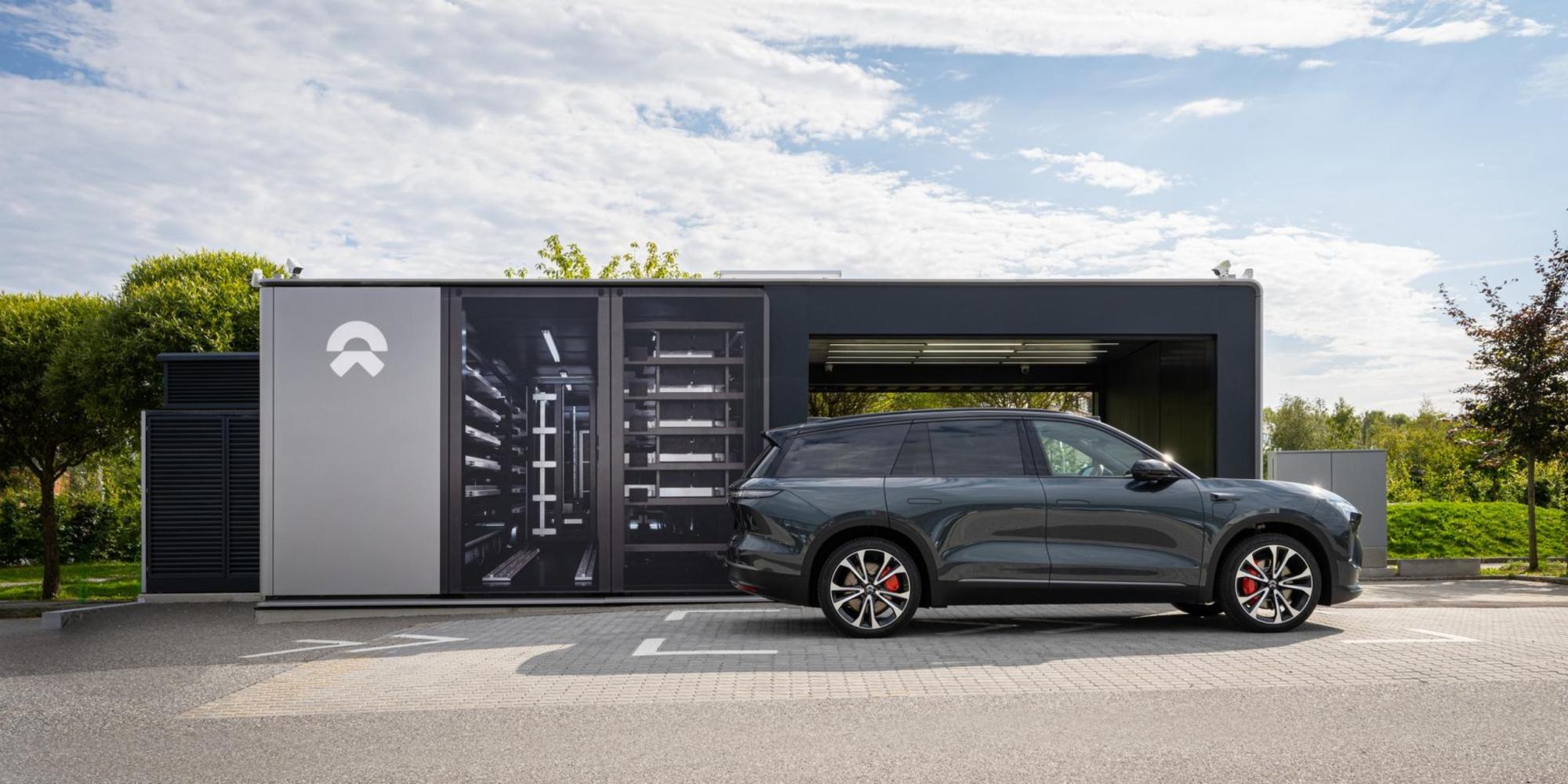
Currently, there is only one Power Swap Station in Belgium, namely NIO Power Swap Station | BE Edegem, Kattenbroek 1, 2650 Edegem, Belgium. However, you must have a subscription to use this service.
Situation in Belgium
Currently, BaaS is not available in Belgium, which means we have to rely on traditional charging methods: AC and DC. Naturally, the EL6 remains fully compatible with both charging methods.
AC charging is done at a maximum of 11 kW, ideal for home or public charging points.
DC fast charging is possible up to 180 kW, ensuring competitive charging times within the premium EV segment.
This means that even without access to battery exchange stations, the EL6 remains perfectly usable in Belgium, with mature charging speeds and a flexible charging process.
⚡Charging NIO EL6
During our test week with the NIO EL6, we were able to record one full DC charge. We started with a driving range of 196 km and a State of Charge (SoC) of 45%, ending up with 365 km driving range and 80% SoC after 29 minutes of charging. A total of 35.33 kWh was charged, representing a real driving range gain of 169 km. This corresponds to an average charging power of approximately 73 kW, which is fully in line with expectations for the charging range between 40 and 80% SoC. This session provides a clear picture of the practical DC charging performance of the EL6 in realistic conditions.
Charging session | Type | Driving range start (km) | Driving range end (km) | SoC start (%) | SoC end (%) | Charged kWh | Charged driving range(km) | Duration (hh:mm) |
|---|---|---|---|---|---|---|---|---|
Session 1 | DC | 196 | 365 | 45 | 80 | 35,33 | 169 | 0:29 |
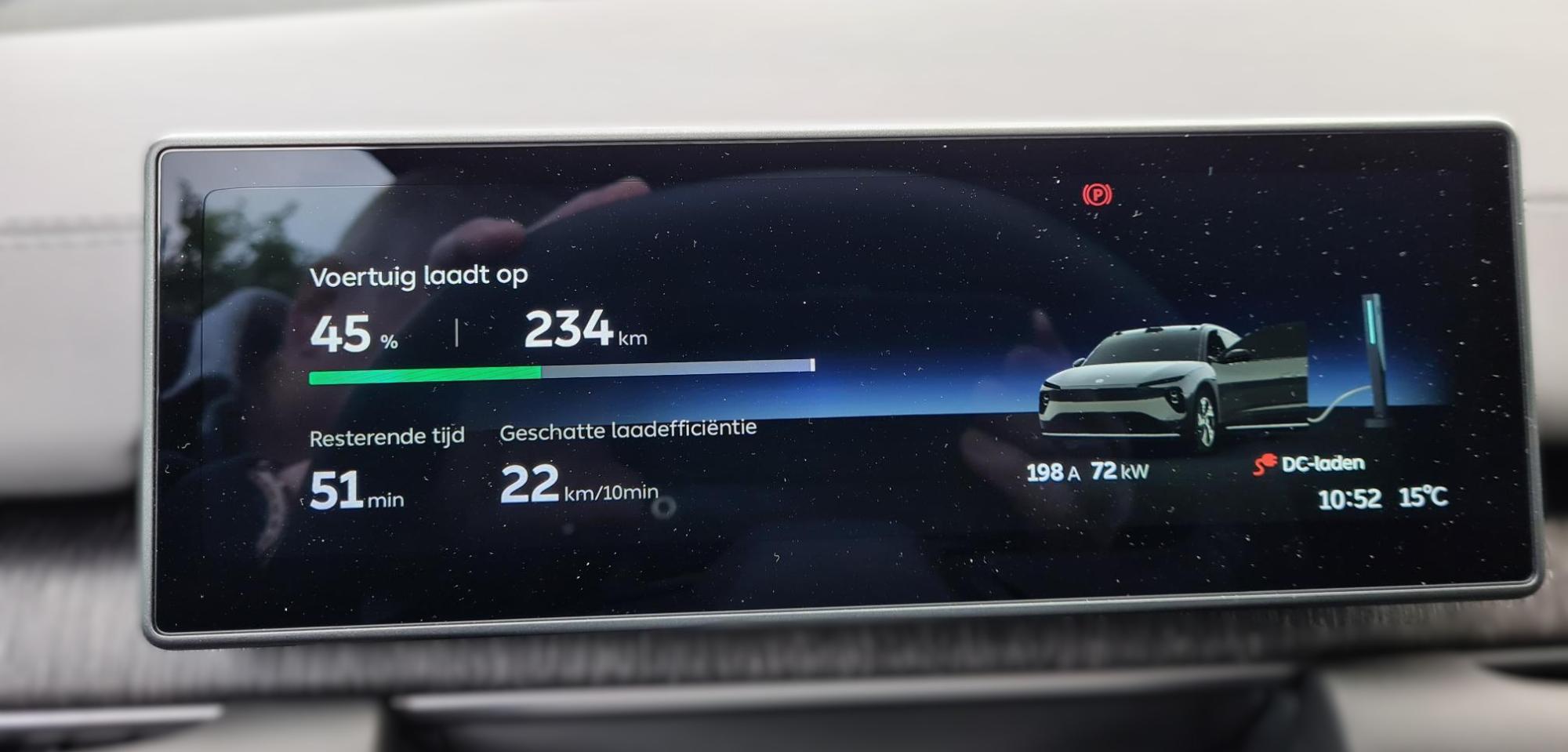
⚡Display during the charging process
During DC charging, the NIO EL6 displays a clear and fairly comprehensive set of charging data on the central display. You get real-time insight into:
SoC (State of Charge, in %) – the current battery percentage, which increases continuously during the session.
Driving range (km) – the remaining distance calculated by the car based on the current SoC and recent consumption.
Remaining charging time – an estimate of the time until the selected charge level (e.g. 80% or 100%) is reached.
Estimated charging efficiency – an indication of how efficiently energy is converted into usable driving range.
Current (Amps) – the actual charging current supplied by the charging station.
Charging speed (kW) – the current charging power, displayed dynamically because the charging curve depends on SoC, temperature and charging station capacity.
Drive and comfort
Driving the NIO EL6
Driving the NIO EL6 is particularly relaxing. There are no distracting noises, the suspension is soft and filters out bumps nicely. During our test week, we traditionally focus on everyday use — commuting, shopping, short trips and the occasional motorway journey — and that is exactly where the EL6 feels completely at home. It drives in a relaxed, predictable and comfortable manner, exactly as you would expect from a modern electric SUV.
The most commonly used driving mode is Eco, a setting that focuses primarily on efficiency and the lowest possible fuel consumption. However, even in this mode, you will not experience any lack of power. The EL6 responds quickly, continues to accelerate smoothly and always gives you enough reserves to keep up with traffic. You notice that the powertrain is designed to perform convincingly even in its most economical mode, without giving you the feeling that anything is being held back.
Exterior of the NIO EL6
The NIO EL6 undoubtedly has a beautiful and well-thought-out design. It is an SUV that immediately attracts attention without being flashy. The lines are sleek and clear, with a clear focus on aerodynamics and visual calm — a style that fits perfectly within the modern NIO DNA.
The slim light signature at the front is striking, with the daytime running lights positioned high and slim, while the main lights are subtly integrated into the bumper area. The overall effect is premium and high-tech, without being excessive. The closed grille immediately emphasises that this is an electric SUV, but in an elegant way.
From the side, the EL6 has beautifully proportioned dimensions: a long wheelbase, short overhangs and a gently sloping roofline that gives the silhouette a dynamic look without compromising on space. The recessed door handles and clean sides reinforce the minimalist character. The large wheels fill the wheel arches well and give the SUV a powerful stance.
At the rear, we find a sleekly designed rear end with a continuous light bar, a design choice that emphasises both width and modernity. Everything feels coherent: no superfluous lines or busy details, but a calm and confident design that exudes confidence.
This makes the EL6 one of those models that you find even more attractive in real life than in photographs — the proportions are just right, the finish looks premium, and the minimalist style perfectly matches NIO's vision as a modern electrification player.
Interior of the NIO EL6
We have noticed that different generations of drivers each have their own preferences when it comes to car interiors. While older generations – such as Gen X – grew up with wide dashboards and lots of physical buttons, Millennials attach more importance to digital screens and intuitive controls. The youngest drivers, Gen Z, expect a sleek, minimalist and fully digital interior with smart assistants and the cleanest possible layout.
The automotive world is clearly adapting to this evolution. We see this reflected in the NIO EL6: a modern, well-organised and digitally oriented interior that meets the expectations of this new generation of users, without losing sight of the more traditional driver..
The NIO EL6 offers an interior that exudes tranquillity and space, constructed from high-quality materials and featuring a minimalist design. The infotainment system is centrally controlled via the large vertical 12.8-inch centre screen, while the compact 10.2-inch digital instrument panel clearly displays the most important driving data. Nomi, the smart AI assistant, also plays a prominent role in the user experience with its simple and intuitive operation.
The number of physical buttons has been deliberately kept to a minimum. There are two central control buttons on the steering wheel: on the left for activating and setting ACC or Smart Pilot, and on the right for controlling the radio and audio functions. Although the concept is logical, it takes some getting used to in order to really master the functions of both buttons, as there are no additional visual or textual indications. And I must admit: as someone who belongs to the Gen-X generation and therefore grew up with clearly labelled physical buttons, this does require a mental adjustment. Once you get used to it, however, the whole thing works logically and intuitively.
The front seats are comfortable and fully adjustable, with options such as heating, ventilation and massage. Rear passengers benefit from generous legroom thanks to the long wheelbase and a completely flat floor, which improves seating comfort for three people. The cabin also remains remarkably quiet thanks to good sound insulation and the quiet electric drive..
The EL6 is also impressive in practical terms: the boot offers a load volume of 579 litres, which expands to 1,430 litres when the rear seats are folded down. There is no frunk, but the space available in the rear is more than sufficient for everyday tasks and longer journeys.
Driver assistance systems (ADAS)
NIO NAD architecture
The NIO EL6 features one of the most comprehensive and advanced ADAS packages in its class. Thanks to LiDAR, powerful sensor fusion and four NVIDIA Orin-X chips, the EL6 offers highly precise and comfortable driver assistance systems, ranging from traffic jam and motorway assistance to automatic emergency braking, 360° cameras and autonomous parking.
The NIO EL6 features one of the most advanced ADAS systems in its segment. This is thanks to the powerful NIO NAD architecture, built around 33 sensors, including:
1 LiDAR (for accurate 3D detection)
7 8MP cameras
4 radars
12 ultrasonic sensors
2 blind spot cameras
1 Driver Monitoring System (DMS)
Environmental sensors such as rain/light
This whole system is powered by four NVIDIA Orin-X chips, which together deliver 1,016 TOPS, enabling the EL6 to continuously build up a detailed picture of its surroundings.
During the test week, we found that most driver assistance systems are not overly intrusive. The warnings are clear but limited to a short acoustic signal, which is very pleasant. However, we would like to emphasise – and NIO is certainly no exception in this respect – that the recognition and display of the maximum permitted speed is not always correct. So it is still important to remain alert and check for yourself.
Euro NCAP - five stars
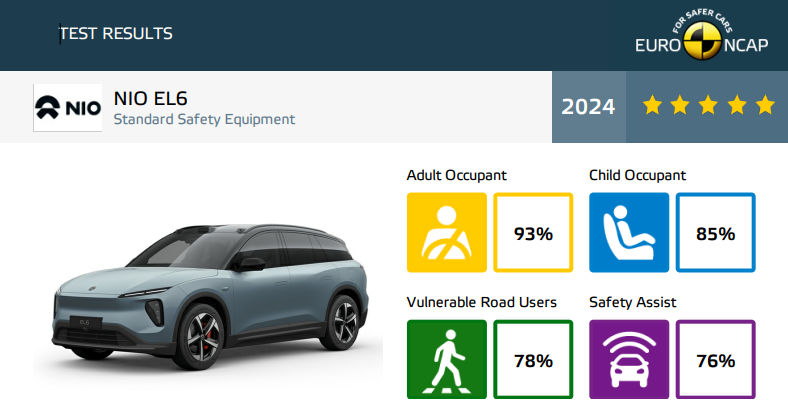
The NIO EL6 achieved a full five-star rating from Euro NCAP, confirming that the NT2 platform is not only technologically advanced but also offers a high level of safety. Protection for adult occupants was rated at 93% , while child safety scored a strong 85% . Safety for vulnerable road users such as pedestrians and cyclists also scored solid results with 78% . NIO EL6
In terms of driver assistance systems – the Safety Assist category – the EL6 achieved a score of 76%, confirming once again that the assistance systems fitted are both well designed and effective in everyday driving conditions.
These results make the EL6 one of the safest electric SUVs in its class, both passively and actively.
Simulation driving range (km), based on trip consumption (kWh/100 km), road type, trip length (km) and usable battery capacity (kWh)
The graph shows the simulated driving range based on the measured fuel consumption during our test week. For the most efficient journeys — such as city driving in Eco mode — consumption drops to 12.9 kWh/100 km, resulting in a theoretical range of up to 696 km.
Journeys at higher speeds or in less efficient driving modes increase consumption to 23 kWh/100 km, which can reduce the range to approximately 390 km.
It remains important to emphasise that these values are snapshots. Factors such as outside temperature, traffic congestion, driving style, altitude differences and wind all have a direct influence on both consumption and driving range.
Comparison WLTP/test results DrivOlution
During our test week, the NIO EL6 performed noticeably more efficiently than the official WLTP figures indicate. On the DrivOlution test track, we recorded a combined consumption of 17.3 kWh/100 km, significantly lower than the WLTP value of 21.1 kWh/100 km, resulting in a calculated driving range of 543 km compared to 512 km WLTP. During the entire test period (548 km), we achieved an average consumption of 19.1 kWh/100 km and a realistic range of 492 km.
It is always interesting to compare the results achieved with the official WLTP values. These are ideal test cycle values, measured under controlled conditions (mild temperatures, low speeds, no accessories, steady acceleration). In that light, the EL6 confirms that it is particularly energy-efficient in real-world conditions, and in many situations even outperforms the official standard.