Test review DrivOlution NIO Firefly
Test report

A new ray of hope within NIO
With Firefly, NIO is taking the next striking step in its European story. Whereas NIO has been known until now for its premium electric models and advanced battery swap technology, the new sub-brand is focusing on a completely different goal: compact, affordable and surprisingly accessible electric driving. Firefly aims to become the brand that brings electric mobility closer to the general public, without compromising on quality or driving experience.
The name Firefly is no coincidence. A firefly is small, agile and, above all, a point of light that illuminates its surroundings. That is exactly what the brand wants to convey: compact, smart and efficient EVs that send a clear, positive signal in busy urban traffic. A Firefly doesn't have to be the biggest to stand out—it's its simplicity, its efficiency and its ability to shine brightly even in the darkness.
The range starts with a fully electric hatchback in the B segment, designed with efficiency, range and usability in mind. This will be followed by a B-segment crossover and a compact C-segment SUV, both based on the same advanced architecture and equipped with modern LFP battery technology. NIO is thus expanding its offering to a segment where smart mobility is key, but where expectations in terms of quality and technology must never be compromised.
Firefly is more than just a new model. It is a new chapter within NIO, a brand that starts with light—literally and figuratively—but has the potential to really light up the compact EV market.
And that is precisely what makes our test week, with our traditional DrivOlution test track, so exciting: we are curious to see whether this 'little' Firefly lives up to expectations.
General
- Hatchback 5D
- Number of seats 5
- Mass in running order 1.542 kg
- LxWxH (mm) 4.003 x 1.781 x 1.557
- Price test vehicle (BTWi) 57.480, - euro
- Trunk loading capacity 404 L / 1.253 L (max)
- Front boot capacity (frunk) 92 L
- Tow bar possible no
- Warranty : 8 jaar/160.000 km (battery)
Driveline
- BEV (Battery Electric Vehicle)
- Battery type Lithium-ion (LFP)
- 42,1 kWh battery capacity (41,2 kWh usable)
- Power 105 kW (143 pk)
- Torque 200 Nm
- RWD (rear wheel drive)
- Architecture 400 V
- EV-platform NIO FT1
- Heat pump no
Consumption/driving range (WLTP) (CoC)
- Combined consumption 14,5 kWh/100 km
- Combined driving range 330 km
- Driving range city 471 km
- LxBxH (mm) 4.830 x 1.925 x 1.620
Charging information
- Internal onboard charger 11 kW
- Charging port rear right
- Charge Power AC 11 kW
- Charge Power DC 100 kW max.
- AC : 3 charges
- DC : 1 charge
- Battery preheating possible yes
Test track
- Non-urban (43,4 km) 14,8 kWh/100 km
- Motorway (40,0 km) 18,2 kWh/100 km
- City (21,1 km) 12,5 kWh/100 km
- Combined 15,2 kWh/100 km
Test results
- Non-urban 16,0 kWh/100 km
- Motorway 15,5 kWh/100 km
- City 12,5 kWh/100 km
- Combined 15,5 kWh/100 km
Test data
Test drivers
Johan Stevens
601 Testkilometers
Driveline
Rear-wheel drive with a focus on efficiency
The Firefly is built around a compact EV platform (FT1) developed specifically for this model within the NIO group, with a focus on efficiency, low weight and optimal space utilisation. A notable feature is the choice of rear-wheel drive, with an electric motor driving the rear axle. This configuration ensures balanced weight distribution and natural, stable handling without compromising efficiency targets.
The powertrain consists of a 105 kW (143 hp) electric motor, coupled with a 41.2 kWh LFP battery. Firefly has deliberately opted for a clear and well-thought-out configuration, tailored to urban and regional use. The performance is more than adequate for everyday traffic, with the direct and linear power delivery you would expect from a modern EV.
The choice of LFP (Lithium Iron Phosphate) battery technology fits perfectly with the philosophy of the model. This battery is known for its thermal stability, long life and limited degradation during frequent charging. This makes the Firefly particularly suitable for intensive use and short, repeated journeys — a typical profile for this segment. In addition, the compact and robust battery construction contributes to a low centre of gravity and predictable handling.
Driving mode - Eco, Comfort and Sport

The Firefly offers the driver a choice of three driving modes: Eco, Comfort and Sport. In Eco mode, the emphasis is on maximum efficiency. The available power is subtly limited, the throttle response is softened and the climate control operates in an energy-efficient manner. This is the ideal mode for city driving and for those who want to get the most mileage out of the battery.
Comfort is the most neutral setting and offers a natural balance between fuel consumption, performance and driving comfort. The powertrain responds smoothly, without the sharpness of Sport or the restraint of Eco. This is the most versatile mode for everyday use.
In Sport mode, the Firefly responds noticeably more directly. The accelerator response becomes livelier and the electric motor responds more quickly, making the compact EV feel surprisingly alert. Although the absolute power remains limited to the motor's 105 kW, this mode provides a more dynamic driving experience, especially during short bursts of acceleration.
Together, these three settings enable the driver to easily adjust the Firefly to suit the conditions — from economical city driving to a more enthusiastic driving style.
Brake energy recovery
The Firefly does not have separate, manually adjustable settings for brake energy recovery (such as low/medium/high via paddles), but automatically links recovery to the selected driving mode. This fits in with its simple, city-oriented philosophy.
Energy recovery – available statuses
Driving mode | Nature of the recovery | Practical impact |
|---|---|---|
Eco | Strong | .Maximum energy recovery during gas discharge. Ideal for city traffic and traffic jams, with clear deceleration and higher efficiency potential. |
Comfort | Average / balanced | Natural driving feel, comparable to braking on the engine in a combustion engine car. Best all-round setting. |
Sport | Milder | Less pronounced recuperation to keep the driving feel smoother and more dynamic during acceleration and speed changes. |
There is no one-pedal driving in the strict sense, nor is there separate control via sliders or paddles for brake energy recovery. Instead, the system is controlled logically and automatically, resulting in a natural and predictable driving experience, especially in city traffic.
Consumption
General
After 601.4 test kilometres on board the Firefly, we recorded a combined consumption of 15.5 kWh/100 km, good for a theoretical driving range of 266 kilometres based on the usable 41.2 kWh battery. The test week took place at an outside temperature of 3°C, which visibly affected the efficiency of the battery and the energy consumption for heating. Together with the mix of motorway and out-of-town driving, this results in a realistic and winter-proof picture of practical performance.
? Overview of consumption by road type
Road type | Number of trips (#) | Proportion (%) | Average consumption (kWh/100 km) |
|---|---|---|---|
Non-urban | 6 | 40% | 16,0 |
Motorway | 8 | 53% | 15,5 |
City | 1 | 7% | 12,5 |
? Overview of consumption per driving mode
Driving mode | Number of trips (#) | Proportion (%) | Average consumption (kWh/100 km) |
|---|---|---|---|
Eco | 8 | 53% | 15,0 |
Comfort | 6 | 40% | 16,2 |
Sport | 1 | 7% | 15,3 |
? Theoretical driving range per road type
Road type | Consumption (kWh/100 km) | Theoretical driving range (km) |
|---|---|---|
Non-urban | 16,0 | 258 km |
Motorway | 15,5 | 266 km |
City | 12,5 | 330 km |
The test results show that the Firefly delivers a consistent energy efficiency profile across all road types and driving modes. The lowest consumption is measured in the city (12.5 kWh/100 km), while motorway figures also remain remarkably favourable at 15.5 kWh/100 km. Outside built-up areas, consumption rises slightly to 16.0 kWh/100 km, but remains within a stable range—an indication of a well-balanced powertrain and efficient aerodynamic design.
The consumption pattern remains consistent across the driving modes. Eco delivers the best efficiency at 15.0 kWh/100 km, followed by Sport (15.3 kWh/100 km) and Comfort (16.2 kWh/100 km). The limited spread shows that the Firefly maintains its efficiency even when more power is required.
Together, these results confirm that the Firefly offers a predictable, stable and energy-efficient consumption profile in a variety of conditions, with theoretical driving ranges that are close to each other and make optimal use of the available battery capacity. The chosen driving style remains a determining factor in the final energy consumption.
Test track
Algemeen
As always, we subjected the Firefly to our classic DrivOlution test track. After 104.5 kilometres, the on-board computer recorded a combined test consumption of 15.2 kWh/100 km. The average speed was 52.5 km/h, with an outside temperature of 0°C.
The selected driving mode was Eco. During the three journeys, we used both the seat heating and the steering wheel heating, which undoubtedly had an impact on energy consumption.
Below you will find a detailed overview
?️Fuel consumption per road type
Road type | Trip length(km) | Average speed (km/h) | Trip consumption (kWh/100 km) |
|---|---|---|---|
Non-urban | 43,4 | 42,1 | 14,8 |
Motorway | 40,0 | 89,3 | 18,2 |
City | 21,1 | 26,2 | 12,5 |
Total / Average | 104,5 | 52,5 | 15,2 |
?Evolution of Driving Range & SoC
Roadtype | Driving range start (km) | Driving range end (km) | Decrease in driving range (km) | SoC start (%) | SoC end (%) | Decrease SoC (%) |
|---|---|---|---|---|---|---|
Non-urban | 179 | 137 | 42 | 72 | 55 | 17 |
Motorway | 137 | 83 | 54 | 55 | 36 | 19 |
City | 83 | 68 | 15 | 36 | 29 | 7 |
Total / Sum | — | — | 111 | — | — | 43 |
?Efficiency in kilometres per kWh
Road type | Trip consumption (kWh/100 km) | Efficiency(km per kWh) | Specific consumption (Wh/km) |
|---|---|---|---|
Non-urban | 14,8 | 6,76 km/kWh | 148 Wh/km |
Motorway | 18,2 | 5,49 km/kWh | 182 Wh/km |
City | 12,5 | 8,00 km/kWh | 125 Wh/km |
Combined | 15,2 | 6,58 km/kWh | 152 Wh/km |
?Efficiency in kilometres per % SoC
Road type | Trip length (km) | Decrease in SoC (%) | Efficiency (km per % SoC) |
|---|---|---|---|
Non-urban | 43,4 | 17 | 2,55 km/% |
Motorway | 40,0 | 19 | 2,11 km/% |
City | 21,1 | 7 | 3,01 km/% |
Total | 104,5 | 43 | 2,43 km/% |
⚡Theoretical driving range (usable battery 41.2 kWh)
Road type | Trip consumption (kWh/100 km) | Theoretical driving range (km) |
|---|---|---|
Non-urban | 14,8 | 278 km |
Motorway | 18,2 | 226 km |
City | 12,5 | 330 km |
Combined | 15,2 | 271 km |
The results clearly show that this Firefly excels particularly in urban environments. Its low energy consumption in the city — aided by frequent recuperation when slowing down and stopping — demonstrates that this model performs best in variable conditions and at lower speeds.
Combined with its compact size, efficient powertrain and intuitive Eco driving mode, this makes the Firefly particularly suitable for everyday city driving, commuting and journeys where manoeuvrability and efficiency are paramount.
Although the out-of-town and motorway sections are also finished to a high standard, it is in the city that the Firefly really comes into its own: quiet, efficient and pleasant to use — even at low temperatures and with comfort features such as seat and steering wheel heating switched on.
Charging and driving range
Battery and cold
The smaller battery capacity of 41.2 kWh net combined with the low winter temperatures (0–3°C) meant that we had to recharge regularly during the test week. This is not unexpected: in cold weather, the efficiency of the battery pack decreases and energy consumption increases, making anticipatory charging essential to optimise the driving range.
In total, we carried out four charging sessions, including one DC fast charge and three AC charges. These sessions provide a clear picture of how the Firefly handles energy absorption, charging speed and driving range build-up at different State of Charge levels in practice. It is striking that the charging performance remains very stable and predictable: per per cent of SoC charged, we gained an average of 2.5 to 2.7 kilometres of driving range, regardless of the charging type.
The DC charging session provided a quick recharge of 118 km between 33% and 80% SoC, which is an efficient stop along the way. The AC charging sessions – each charged to 100% – provided an additional 137 to 196 km of driving range each time, which once again places the Firefly on the favourable side of the segment in terms of charging dynamics in winter conditions.
Below you will find a detailed overview of all charging sessions.
Charging session | Type of charging | Driving range start (km) | Driving range end (km) | SoC start (%) | SoC end (%) | Loaded range (km) | Loaded SoC (%) |
|---|---|---|---|---|---|---|---|
Session 1 | DC | 83 | 201 | 33% | 80% | 118 km | 47% |
Session 2 | AC | 59 | 254 | 25% | 100% | 195 km | 75% |
Session 3 | AC | 125 | 262 | 50% | 100% | 137 km | 50% |
Session 4 | AC | 67 | 263 | 27% | 100% | 196 km | 73% |
While charging, the Firefly displays all essential information in a single, clear screen. You can see the SoC increase, the recharged driving range, the current charging power (kW) and the current (A). In addition, the car displays the remaining charging time until the set charging target and clearly indicates whether AC or DC charging is taking place. Thanks to this transparent charging display, you can accurately monitor the charging process and easily estimate when further charging is still efficient.

Drive and comfort
Design, Interior & Space – A compact EV with a mature look
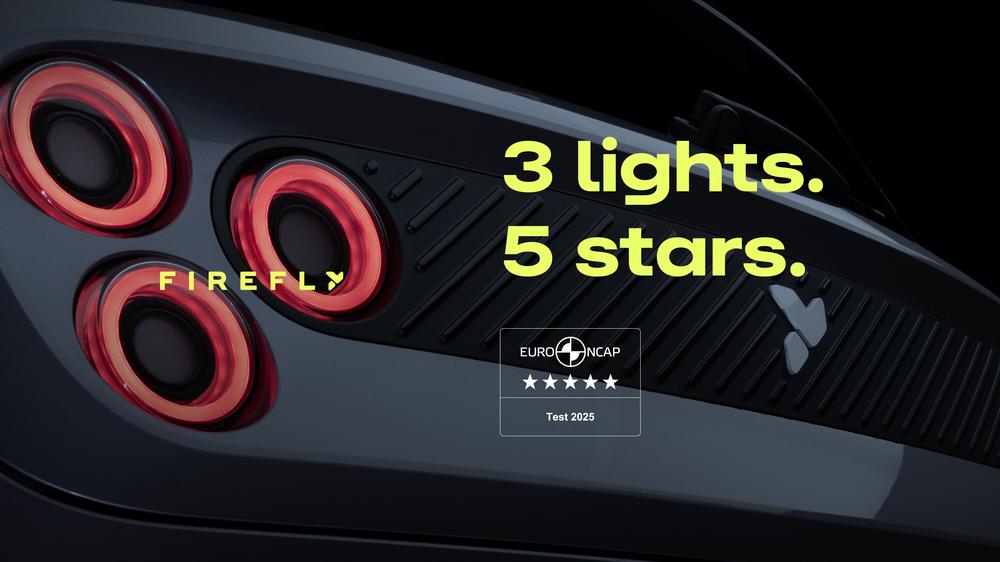
The Firefly does not need extreme lines to stand out. Its design is based on simplicity, efficiency and functionality, yet it still has a distinct identity. The most eye-catching element is the characteristic three-part light structure. This recognisable signature, both at the front and rear, gives the Firefly an immediate brand identity and emphasises the broad, confident appearance of the compact bodywork. Even in the dark, it is instantly recognisable.
The proportions are typical of a modern city EV: short overhangs, a relatively long wheelbase and a sleek, aerodynamically optimised surface structure. This combination makes the Firefly appear larger and more mature than its external dimensions suggest. The rounded volumes create a friendly and contemporary look, while the whole is clearly designed to support efficiency and low consumption values.
Interior – Minimalistic, modern and surprisingly refined
Inside, the Firefly combines its compact dimensions with a particularly well-designed, modern and almost premium-feeling interior. In front of the driver is a 6-inch digital instrument panel, deliberately kept small to display only essential information and thus create peace of mind in the field of vision. The central element of the cockpit is the 13.2-inch touchscreen, which serves as the heart of the infotainment system. The screen is razor sharp, responds quickly and uses a clear interface that deliberately omits unnecessary visual elements.
As with many modern EVs, a large part of the vehicle settings are controlled via this central display — from climate control to driving modes and lighting. Fortunately, Firefly provides a series of practical shortcuts, keeping frequently used functions available at the touch of a button. This keeps the controls intuitive and prevents the driver from having to delve deep into menus.
Despite its compact footprint, the cockpit feels open, light and surprisingly refined. The low dashboard line, minimalist design language and clever layout all contribute to a mature and inviting atmosphere, allowing the Firefly to aim higher than its segment would suggest.
Space & Functionality – Small on the outside, big on possibilities
Despite its compact exterior dimensions, the Firefly surprises with an impressive sense of space and versatility. It offers 404 litres of luggage space in the rear, which can be expanded to 1,253 litres when the rear seats are folded down. This makes it one of the most spacious models in its class.
In addition, there is a 92-litre frunk, ideal for charging cables or loose items that you want to store separately. Inside, Firefly once again demonstrates its smart approach: there is a hidden storage compartment under the front passenger seat, and another 29-litre storage box under the wide part of the rear seat. These smart solutions make the car particularly practical for everyday use.
In total, the Firefly has 525 to 1,374 litres of usable storage space — a remarkable achievement for a vehicle in this compact city segment. This is where Firefly lives up to its reputation: small on the outside, big on functionality.
Driver assistance systems (ADAS)
The Firefly is making great strides in terms of safety and support, especially within its compact segment. The model achieved a Euro NCAP score of 5 stars, demonstrating that both its passive and active safety structures are of a high standard..
Key safety advantages:
- 5-star Euro NCAP rating – excellent protection for occupants and vulnerable road users.
- Uitgebreid ADAS-pakket – inclusief Adaptive Cruise Control, Lane Keeping Assist, Automatic Emergency Braking, Blind Spot Monitoring en Rear Cross Traffic Alert.
- Powerful braking and detection systems – recognise not only vehicles, but also cyclists and pedestrians.
- 360° camera or rear view camera – depending on model, for better visibility when manoeuvring.
- Smart parking sensors all around – providing support in tight urban situations.
Point of attention:
- The Driver Attention Monitoring system can sometimes be overly sensitive, causing warnings to appear more frequently than necessary and potentially causing distraction..
Conclusion:
The Firefly combines an impressive safety base with a wide range of driver assistance systems. This makes it one of the best-equipped compact EVs on the market, with only one system requiring further refinement.
Simulation driving range (km), based on trip consumption (kWh/100 km), road type, trip length (km) and usable battery capacity (kWh)
Simulation based on journey consumption (3°C)
The results below are simulations of the theoretical driving range, calculated based on the measured fuel consumption during our test week. We take into account an average outside temperature of only 3°C, a circumstance that clearly influences actual consumption. The values are therefore not taken directly from the on-board computer but are calculated by linking the fuel consumption to the usable battery capacity.
Since each trip is a snapshot (traffic, temperature, elevation profile, use of heating, etc.), the simulations mainly provide insight into the efficiency per road type and driving mode. City driving shows the highest efficiency, with simulations of up to 330 kilometres, while motorway driving logically results in a lower theoretical driving range (approximately 226–303 kilometres, depending on driving mode). Driving outside built-up areas ranges between 233 and 278 kilometres, with Eco mode consistently delivering the best results.
Despite the low outside temperature, this simulation provides a clear picture of the relative efficiency of each journey and is a valuable addition to the overall consumption analysis.
Comparison WLTP/test results Drivolution
Analysis of DrivOlution vs. WLTP (winter conditions)
Consumption
Compared to the WLTP value of 14.5 kWh/100 km, we recorded 15.2 kWh/100 km during the test route and 15.5 kWh/100 km over the entire test period. Despite the low outside temperatures of 0 to 3°C, the deviation is only 5 to 7%, which is remarkably favourable for winter conditions in which batteries are less efficient and comfort consumers are switched on more often.
Driving range
The official WLTP driving range is 330 km, but based on our test consumption and net battery capacity, we arrive at a practical range of 266 to 271 km. This represents a loss of approximately 19%, which is entirely in line with what we can expect in the winter months. A realistic loss for electric vehicles is usually between 15 and 30%, depending on temperature, driving style, speed and use of heating. This puts the Firefly at the favourable end of that spectrum..
Urban range WLTP
Compared to the highly optimistic WLTP city range of 471 km, the practical value is almost 43% lower, which is logical given that these city values are measured under warm, ideal conditions at low speeds and without thermal losses..
Efficiency
Despite the winter cold, the Firefly remains an efficient EV, with a petrol equivalent consumption of 1.7 to 1.8 l/100 km. The limited deviation from WLTP confirms that the vehicle has good control over its energy management and achieves a stable and predictable winter range of around 270 kilometres in real-world conditions.