Test review DrivOlution Polestar 3 long Range Single Motor
Test report
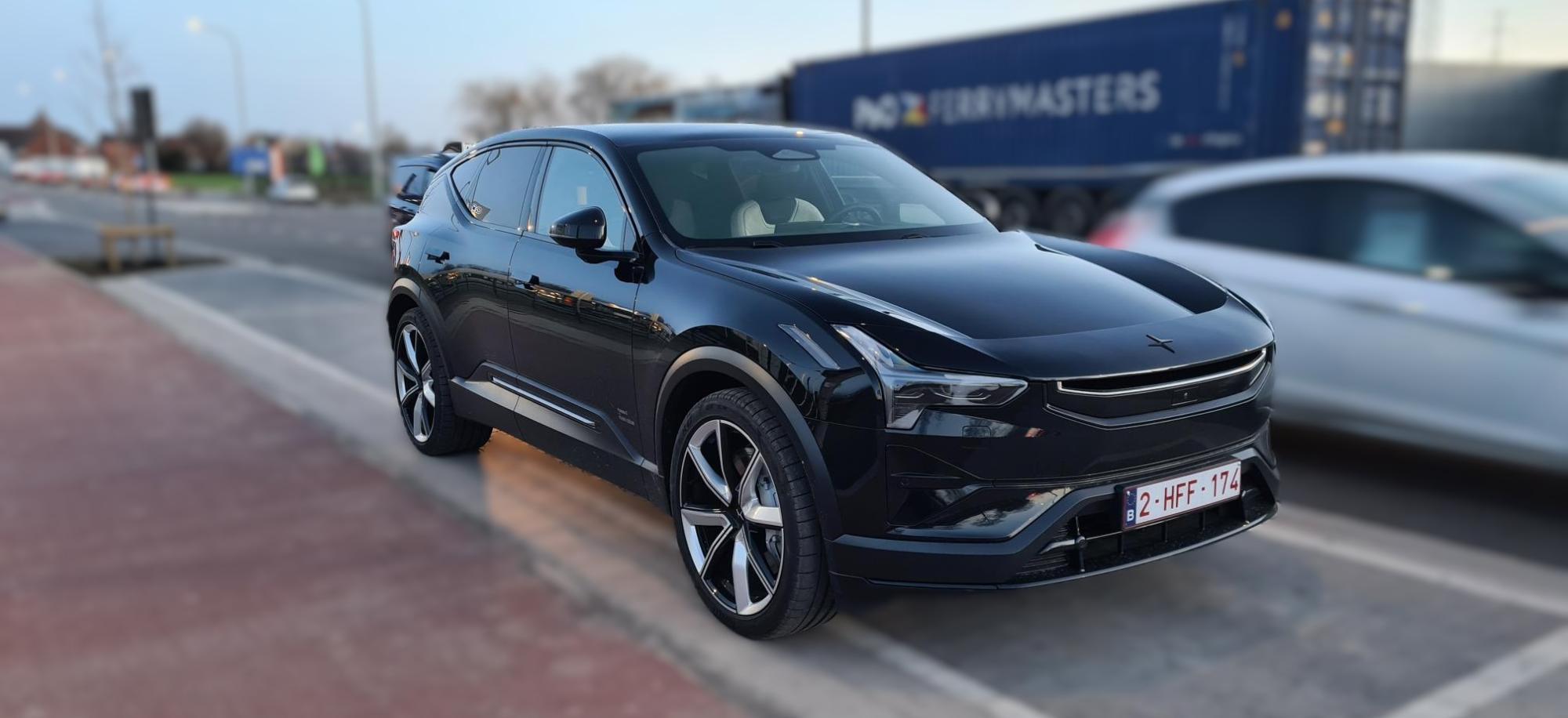
A while ago, we took a look at the Polestar 3 Long Range Dual Motor. This version is clearly positioned in the premium segment: two motors, all-wheel drive and a decidedly dynamic focus.
This week, we’re taking a look at the Polestar 3 Long Range Single Motor. Less focused on raw power, it prioritises efficiency and range. A single motor, rear-wheel drive and a clear aim: to maximise range from a given battery capacity.
Whilst the Dual Motor version focuses primarily on driving pleasure and performance, this model appears to prioritise strategic energy management and everyday practicality.
But does it really live up to that promise?
As is our tradition, we are also putting this test vehicle through our renowned DrivOlution test route, which includes fixed sections outside built-up areas, on the motorway and in urban traffic. This is the only way for us to carry out objective comparisons and assessments.
Will this model be the most fuel-efficient in the Polestar range? That’s what we’ll find out during this week’s test drive.
General information
- SUV
- Number of seats 5
- Mass in running order 2.480 kg
- LxWxH (mm) 4.900 x 1.968 x 1.614
- Price test vehicle (VATi) 100.700 , - euro
- Boot capacity 597 L / 1.411 L (max)
- Cargo volume frunk 32 L
- Tow bar possible (1.500 kg braked - 750 kg unbraked)
- Warranty : 8 jaar/160.000 km (battery)
Drivetrain
- BEV (Battery Electric Vehicle)
- Battery type Lithium-ion (NMC)
- 111 kWh battery capacity (107 kWh usable)
- Power 220 kW (299 hp)
- Torque 490 Nm
- Rear wheel drive (RWD)
- Architecture 400 V
- Ev-platform VOLVO SPA2
Consumption/driving range (WLTP) (CoC)
- Combined consumption 19,3 kWh/100 km
- Combined driving range 645 km
- Driving range city 857 km
Charging
- Internal onboard charger 11 kW
- Charging port rear left
- Charge Power AC 11 kW
- Charge Power DC 250 kW max.
- AC : 1 charge
- DC : 1 charge
- Battery preheating available: yes
Test track
- Non-urban (42,7 km) 19,6 kWh/100 km
- Motorway (39,5 km) 25,4 kWh/100 km
- City (20,8 km) 20,3 kWh/100 km
- Combined 21,8 kWh/100 km
Test results
- Non-urban 21,5 kWh/100 km
- Motorway 21,8 kWh/100km
- City 20,3 kWh/100 km
- Combined 21,6 kWh/100 km
Test data
Test drivers
Johan Stevens
545 Testkilometers
Drivetrain
Polestar 3 variants
Type | Single Motor | Dual Motor | Dual Motor Performance |
|---|---|---|---|
Drive | RWD | AWD | AWD |
Number of engines | 1 | 2 | 2 |
Net battery | ±107 kWh | ±107 kWh | ±107 kWh |
WLTP consumption | ±19,3 kWh/100 km | ±20–21 kWh/100 km | ±22 kWh/100 km |
WLTP combined range | 645 km | ca. 610–630 km | ca. 560–590 km |
WLTP city | 857 km | lower than SM | lower than DM |
Fast-charging capability | ±250 kW | ±250 kW | ±250 kW |
Driving modes
Brake energy recovery
The Polestar 3 Long Range Single Motor is equipped with regenerative braking, which recovers energy released during deceleration and stores it back in the battery. Using the One Pedal Drive system, the driver can adjust the level of regeneration, allowing them to tailor the driving experience to their preferences for comfort and efficiency.
Steering paddles to quickly adjust brake energy regeneration whilst driving are missing. Adjustments are made via the central display, which is less intuitive during dynamic driving.
Consumption
During this test week, we covered a total of 545 kilometres in the Polestar 3 Long Range Single Motor,
spread across 16 recorded journeys.
The test took place at an average outside temperature of 5°C, i.e. in distinctly wintery conditions. As expected, this had a clear impact on energy consumption and the actual driving range, meaning that the results provide a realistic picture of use in a Belgian winter context.
The table below provides an overview of the breakdown of journeys by road type, including their proportion and the corresponding average fuel consumption.
Overview of consumption by road type
Road type | Number of trips (#) | Share (%) | Average consumption (kWh/100 km) |
|---|---|---|---|
Non-urban | 4 | 25,0% | 21,2 |
Motorway | 11 | 68,8% | 21,8 |
City | 1 | 6,2% | 20,3 |
Total | 16 | 100% | 21,6 |
Due to the lack of specific driving modes, we are unable to provide an overview here.
Based on the usable battery capacity of 107 kWh, this would result in a theoretical range of approximately 495 km in mixed driving conditions. Depending on the driving profile, this varies between 491 km on the motorway and 527 km in urban conditions, with 505 km for journeys outside built-up areas.
These figures clearly show that the driving range is not fixed, but depends heavily on usage and driving conditions.
Road type | Number of trips (#) | Share (%) | Consumption (kWh/100 km) | Range simulation (km) |
|---|---|---|---|---|
Non-urban | 4 | 25,0% | 21,2 | 505 km |
Motorway | 11 | 68,8% | 21,8 | 491 km |
City | 1 | 6,2% | 20,3 | 527 km |
Average | 16 | 100% | 21,6 | 495 km |
Test track
During the 103 km test route, carried out at an outside temperature of 2°C, the route was divided into three road types: open country, motorway and urban. The average test consumption came to 21.8 kWh/100 km, which is a solid and realistic result for winter conditions. Taking into account the available battery capacity of 107 kWh, this would equate to a theoretical driving range of 491 km.
The lowest energy consumption was recorded on the open road (42.7 km): 19.6 kWh/100 km. This section combines a moderate average speed (41 km/h) with low aerodynamic drag and ample opportunities for regenerative braking, resulting in the best efficiency of the test. The driving range here fell from 240 km to 210 km, indicating stable energy delivery.
On the motorway (39.5 km), we see the highest energy consumption: 25.4 kWh/100 km at an average speed of 86 km/h. The higher constant speed increases aerodynamic drag exponentially, causing energy consumption to rise significantly. This also results in the greatest reduction in the calculated driving range (from 210 km to 160 km).
In the city (20.8 km), consumption of 20.3 kWh/100 km was recorded. Although city driving is normally the most efficient for an electric car, the low outside temperature plays a role here. Cold battery conditions and the constant demand from comfort features (such as seat and steering wheel heating) mean that consumption is not at its lowest.
Overall, the test shows that the vehicle performs very consistently across different road types. The variations in fuel consumption are mainly attributable to speed (aerodynamic drag), temperature and driving conditions. In these winter conditions, a realistic theoretical driving range of around 490 km remains achievable based on the measured combined figure.
Verbruik (kWh/100 km) per wegonderdeel
Road section | Distance (km) | Average speed (km/h) | Start range (km) | End range (km) | Consumption (kWh/100 km) |
|---|---|---|---|---|---|
Non-urban | 42,7 | 41 | 240 | 210 | 19,6 |
Motorway | 39,5 | 86 | 210 | 160 | 25,4 |
City | 20,8 | 25 | 160 | 140 | 20,3 |
Combined | 103 | — | — | — | 21,8 |
?Changes in driving range (km) and state of charge (%)
Road section | Distance (km) | Driving range start (km) | Driving range end (km) | ? Decrease in driving range (km) | Start SoC (%) | End SoC (%) | ? Decrease SoC (%) |
|---|---|---|---|---|---|---|---|
Non-urban | 42,7 | 240 | 210 | -30 km | 53% | 45% | -8% |
Motorway | 39,5 | 210 | 160 | -50 km | 45% | 35% | -10% |
City | 20,8 | 160 | 140 | -20 km | 35% | 30% | -5% |
It is clear that the biggest drop is on the motorway.
Charging and driving range
General information
The Polestar 3 is equipped with an on-board charger rated at 11 kW for AC charging (alternating current). For fast charging, the vehicle supports DC charging up to 250 kW, allowing the battery to be recharged quickly under ideal conditions.
The charging port is located at the rear left and is opened via the central touchscreen, which ensures a seamless integration into the design, but may be less intuitive in everyday use.
? Charging sessions
During the test period, two charging sessions were carried out, each with a different charging type and range. In one case, an AC charge was used to a high state of charge, whilst in the other, a DC charge was used within the standard fast-charging window.
This combination makes it possible to assess the vehicle’s performance both during near-full charging and in practical everyday use. Based on the increase in State of Charge (SoC) and the corresponding driving range, a representative picture emerges of the vehicle’s charging characteristics and its suitability for use in various scenarios.
Below is an overview of the charging sessions
Charging session | Charging type | SoC start (%) | SoC end (%) | Initial range (km) | Range remaining (km) | Charged energy (kWh) | Efficiency (km/kWh) | km per % SoC |
|---|---|---|---|---|---|---|---|---|
Charging session 1 | AC | 29 | 99 | 140 | 440 | 83,77 | 3,58 | 4,29 |
Charging session 2 | DC | 40 | 80 | 190 | 380 | 31,83 | 5,97 | 4,75 |
? Information during the charging process
Whilst charging, the driver is clearly informed of the progress via the central display in the vehicle. The information shown is clearly laid out and allows the charging process to be monitored closely.
This gives the manager an insight into:
- the estimated charging time (hours:minutes)
- the current load capacity (kW)
- the additional driving range during charging (km)
- the current charge level (SoC – State of Charge)
- the set charge level (target SoC)
This information helps the driver to plan charging sessions and contributes to the efficient use of the vehicle in practice.
❄️ Preconditioning
The Polestar 3 features battery preconditioning. This means that the battery can be brought up to the desired temperature in advance, for example whilst navigating to a fast-charging point or via pre-set departure times.
By bringing the battery to the ideal temperature, charging capacity can be optimised and charging efficiency improved. In addition, preconditioning also enhances driving comfort, as it allows the interior to be brought to the desired temperature before setting off.
?Adjustable charge percentage
Polestar recommends limiting the charge level to 90% to improve battery health. This is a common practice for electric vehicles to extend battery life.
?️Navigate smartly with Google Maps
The Polestar 3 comes as standard with an integrated version of Google Maps that works seamlessly with the vehicle’s electronics. This allows the system to monitor the battery level in real time and automatically calculate the most efficient route based on this information. Suitable charging stations are suggested along the way, ensuring you always arrive at your destination stress-free and well-prepared.
Drive and comfort
✨ A stylish statement with subtle variations in character
The Polestar 3 is clearly positioned in the premium segment — in both the Single Motor and Dual Motor versions. The difference, however, lies less in the design or finish, and more in its character.
Whilst the Dual Motor focuses on performance and dynamism, the Long Range Single Motor is explicitly designed for tranquillity, efficiency and driving range. The interior, materials and finish remain identical, but the driving experience is clearly more relaxed and focused on comfort.
? Space and functionality: no difference
In terms of space and practicality, there are no differences between the Single and Dual Motor. Both versions offer:
- up to 597 litres of load volume (roof height)
- 1,411 litres with the rear seats folded down
- a 32-litre frunk
? The choice between the two powertrains therefore has no impact on practicality or boot capacity.
? Rear-seat comfort: an identical experience
There are also no differences between the two variants in the rear. Passengers can enjoy:
- spacious seats for adults
- a high level of comfort
- an integrated second touchscreen for climate control and media
?Both the Single and Dual Motor models offer the same premium experience here.
?Interior experience: same design, different focus
The minimalist and soothing interior has the same layout, but fits perfectly with the character of the Single Motor.
? Whereas the Dual Motor version offers a sporty take on this interior, the Single Motor version primarily enhances the sense of calm and efficiency.
?️ Infotainment and connectivity: exactly the same
There are also no differences in terms of technology:
- 14,5 inch touchscreen
- Android Automotive (Google Maps, Assistant, Spotify)
- Over-the-air updates
- Wireless Apple CarPlay
- 4G connectivity and app integration
?Both versions offer exactly the same digital experience.
? Key difference summarised
The differences between the Single and Dual Motor models lie not in space, technology or finish, but entirely in the driving character.
Driver assistance systems (ADAS)
The Polestar 3 uses an extensive network of sensors to continuously monitor the vehicle’s surroundings. These sensors form the basis for the operation of the various advanced driver-assistance systems (ADAS) and ensure that GSR requirements are effectively supported in practice.
The Polestar 3 features, among other things:
Intelligent Speed Assist (ISA), which detects speed limits and alerts the driver.It remains important to keep an eye on your surroundings yourself and not to rely blindly on the technology.
Driver Monitoring System, which monitors the driver’s attention and alertness
Autonomous Emergency Braking (AEB), which intervenes in the event of an imminent collision
Lane Keeping Aid, which helps keep the car in its lane
Event Data Recorder (EDR), which records relevant data in the event of an incident
Reversing camera and parking sensors, which improve safety when manoeuvring
Thanks to the combination of cameras, radars and sensors, these systems are constantly fed with information about their surroundings, enabling them to respond quickly and accurately.
SmartZone
A striking feature of the Polestar 3 is the so-called SmartZone at the front of the vehicle. Where a grille would traditionally be found, there is an integrated module that includes:
front-facing camera
radar sensors
heated elements to keep the sensors free of dirt or ice
? This ensures that the systems operate more effectively, even in bad weather.
Pilot Assist
assists the driver by actively keeping the car within the lane. The system detects the car’s position relative to the lane markings and, if necessary, makes slight steering corrections to keep the car centred in the lane.
This assistance is available up to speeds of approximately 150 km/h (where legally permitted) and works in conjunction with adaptive cruise control.
? Pilot Assist enhances driving comfort, particularly on longer journeys, but remains a driver assistance system: the driver must always keep their hands on the steering wheel and remain alert.
?️Euro NCAP – additional information
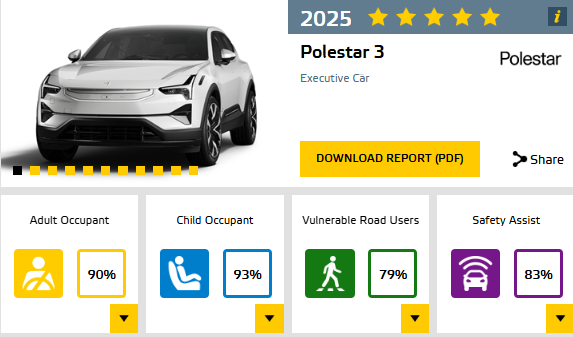
It is worth noting that the Polestar 3 was named the safest Executive Car of 2025 by Euro NCAP. In addition to the maximum five-star rating, the model also achieved an exceptionally high score of 93% for child protection.
This strong performance is down to a combination of advanced structural safety and a comprehensive suite of advanced driver-assistance systems (ADAS), which together contribute to a high overall level of safety.
Driving range simulation (km) based on trip consumption (kWh/100 km), road type, trip length (km) and usable battery capacity (kWh)
As is our custom, we have carried out a simulation of the driving range based on previous journeys, measured energy consumption and journey length. In doing so, we have taken into account an average outside temperature of 5°C, which is representative of realistic winter conditions. Based on the usable battery capacity of 107 kWh, this gives the overview below.
This simulation provides a clear picture of the expected driving range in real-world conditions and allows for an accurate assessment of the impact of driving style and road type. As always, this serves as an indication of what is possible. In practice, the actual driving range may vary depending on various factors, such as driving style, speed, traffic conditions, weather conditions and load.
Comparison WLTP/test results Drivolution
? Comparison of WLTP vs real-world figures (fuel consumption and range)
During the test period, average energy consumption was measured at 21.6 kWh/100 km, compared with a WLTP figure of 19.3 kWh/100 km. This results in additional consumption of approximately +2.3 kWh/100 km or around +11.9%.
Based on this measured consumption, we arrive at a combined range of approximately 495 km, whilst the WLTP range is 645 km combined. This represents a difference of -150 km or -23.3%.
These variations can be attributed to realistic conditions such as the lower outside temperature (±5°C), driving style, traffic conditions and the use of comfort systems.
Parameter | WLTP | DrivOlution (test) | Difference (abs.) | Difference (%) |
|---|---|---|---|---|
Consumption (kWh/100 km) | 19,3 | 21,6 | +2,3 | +11,9% |
Combined range (km) | 645 | 495 | -150 | -23,3% |
City driving range (km) | 857 | — | — | — |
The WLTP figures provide a theoretical reference, whereas the DrivOlution test gives a more realistic picture of actual fuel consumption and driving range in everyday conditions.