Test review DrivOlution Volvo EX60 P10 AWD Ultra Launch Edition
Test report
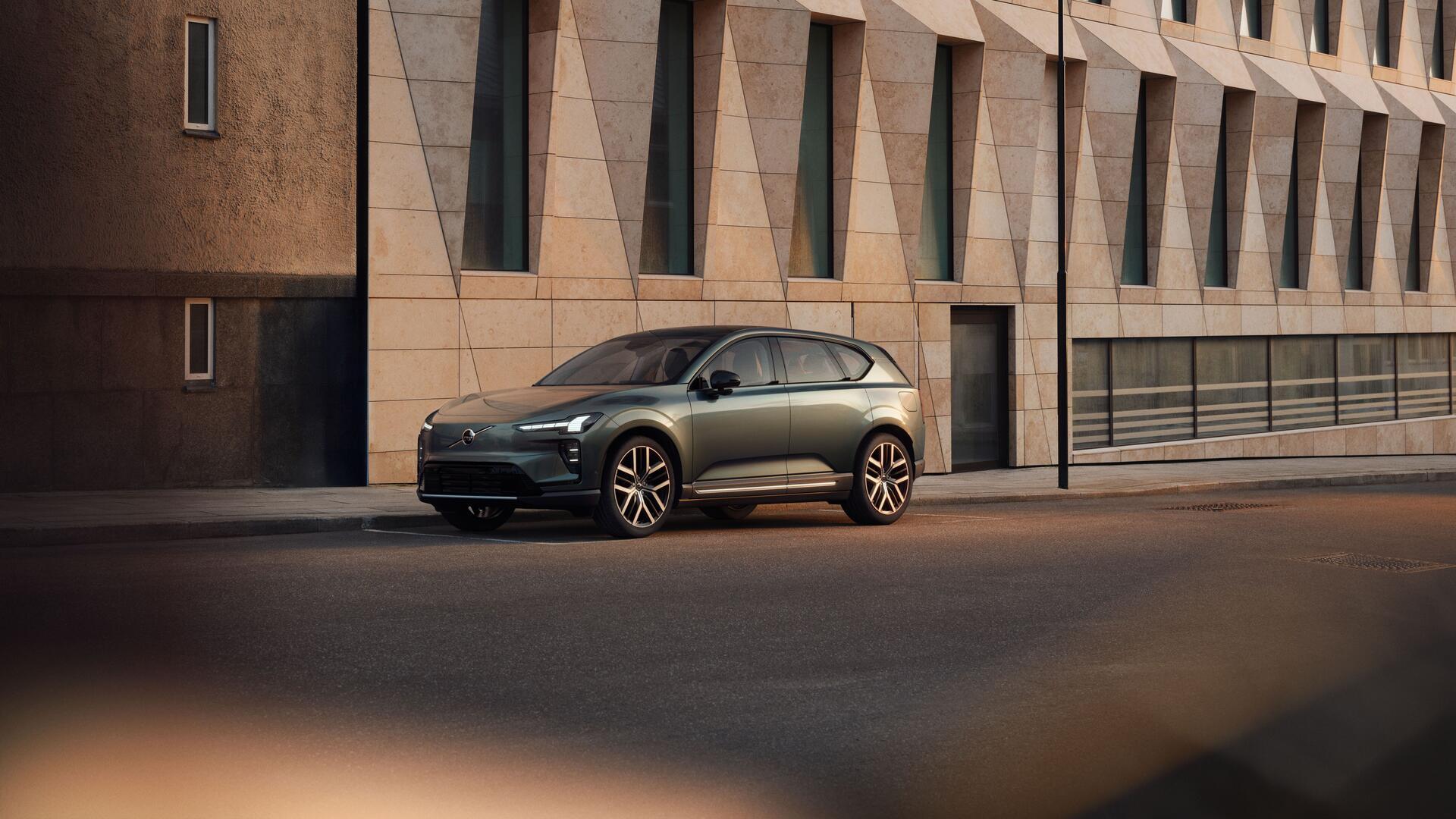
The XC60 has been a mainstay of the Volvo range for years. It is comfortable, spacious, safe and quintessentially Volvo. With the EX60, this tried-and-tested formula is now available in a fully electric version.
We set off at the wheel of the Volvo EX60 P10 AWD Ultra Launch Edition, a version that immediately demonstrates just how important this model is to Volvo. Expectations are therefore high. Not only because the EX60 succeeds the particularly popular XC60, but also because it must demonstrate how Volvo combines its traditional strengths with a new electric architecture, advanced digitalisation and a fresh approach to controls and user-friendliness.
During our test drive, we don’t just look at the figures on paper. How does the EX60 feel in everyday traffic? Is it really comfortable and spacious? Are the driver-assistance systems and digital controls up to scratch? And how does it perform on long journeys and on our usual DrivOlution test track?
In summary: Is the EX60 simply an electric version of the XC60, or is Volvo truly setting a new benchmark for its next generation of SUVs?
General information
- SUV
- Number of seats 5
- Mass in running order 2.350 kg
- LxWxH (mm) 4.803 x 1.908 x 1.635
- Price test vehicle (VTAi) 77.360,- euro
- Cargo volume 634 L / 1.647 L (max)
- Cargo volume frunk 58 L
- Tow bar possible (2.400 kg braked - 750 kg unbraked)
- Warranty : 10 years/240,000 km battery life (battery check every 2 years or every 40,000 km)
Driveline
- BEV (Battery Electric Vehicle)
- Battery type Lithium-ion (NMC)
- 95 kWh battery capacity (91 kWh usable)
- Power output 375 kW (510 hp)
- Torque 710 Nm
- AWD
- Architecture 800 V
- EV-platform VOLVO SPA3
- Heat pump standard
Consumption/driving range (WLTP) (CoC)
- Combined consumption 17,4 kWh/100 km
- Combined driving range 617 km
- Driving range city 765 km
Charging information
- Internal onboard charger 22 kW
- Charging port rear left
- Charge Power AC 22 kW
- Charge Power DC 370 kW max.
- AC : 1 charge
- DC : 1 charge
- Battery preheating possible yes
Test track
- Non-urban (43,5 km) 12,3 kWh/100 km
- Motorway (39,6 km) 17,0 kWh/100 km
- City (21 km) 11,4 kWh/100 km
- Combined 14,2 kWh/100 km
Test results
- Non-urban 12,6 kWh/100 km
- Motorway 16,2 kWh/100 km
- City 11,4 kWh/100 km
- Combined 15,0 kWh/100 km
Test data
Test drivers
Johan Stevens
675 Testkilometers
Drivetrain
SPA3-platform
The EX60 introduces Volvo’s new SPA3 platform, a vehicle architecture developed entirely for electric propulsion. Thanks to features such as an 800V electrical system, cell-to-body battery technology, megacasting and new electric motors, SPA3 is designed to reduce weight and production costs whilst improving efficiency, driving range and charging speed. The EX60 is the first Volvo model to utilise this architecture. It is significantly more scalable than SPA2 and is expected to be suitable for both smaller and larger Volvo models in the future.
Performances
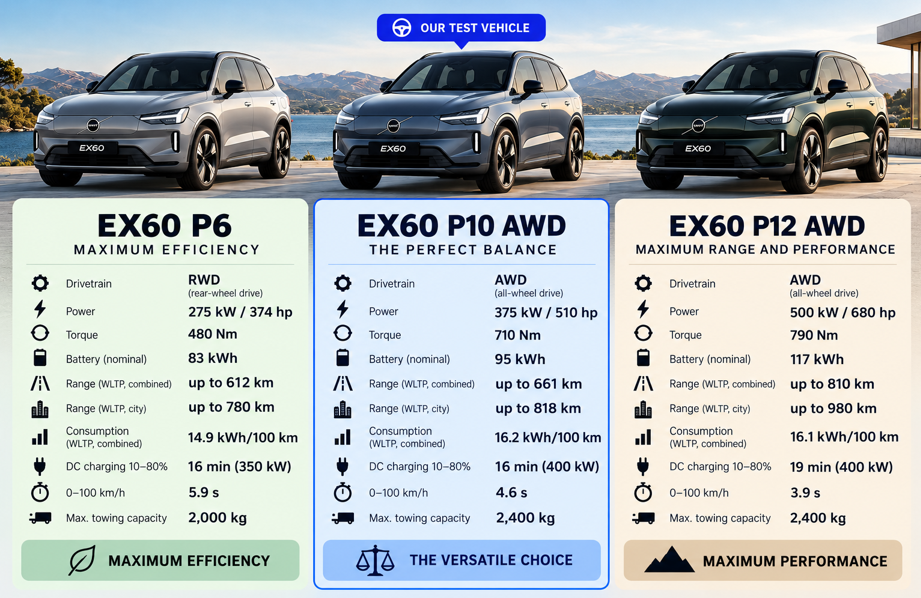
Volvo is launching the new EX60 with three powertrain options, each with its own distinct character.
The P6 is the most efficient model in the range. With rear-wheel drive, an 83 kWh battery, an official energy consumption of 14.9 kWh/100 km and a WLTP range of over 600 km, it is firmly focused on efficiency.
Our test car, the EX60 P10 AWD Ultra Launch Edition, strikes the perfect balance. It combines 510 pk, all-wheel drive and a 95 kWh battery with a WLTP range of 661 km. Fast charging from 10 per cent to 80 per cent in around 16 minutes makes the overall package even more appealing.
At the top of the range is the P12 AWD. With a battery capacity of 117 kWh and a maximum 810 km WLTP range, it is designed for long-distance travel and performance. Weighing in at around 2,405 kg, it is also the heaviest of the three.
In a nutshell: P6 for efficiency, P10 AWD for balance, and P12 AWD for maximum driving range and performance.
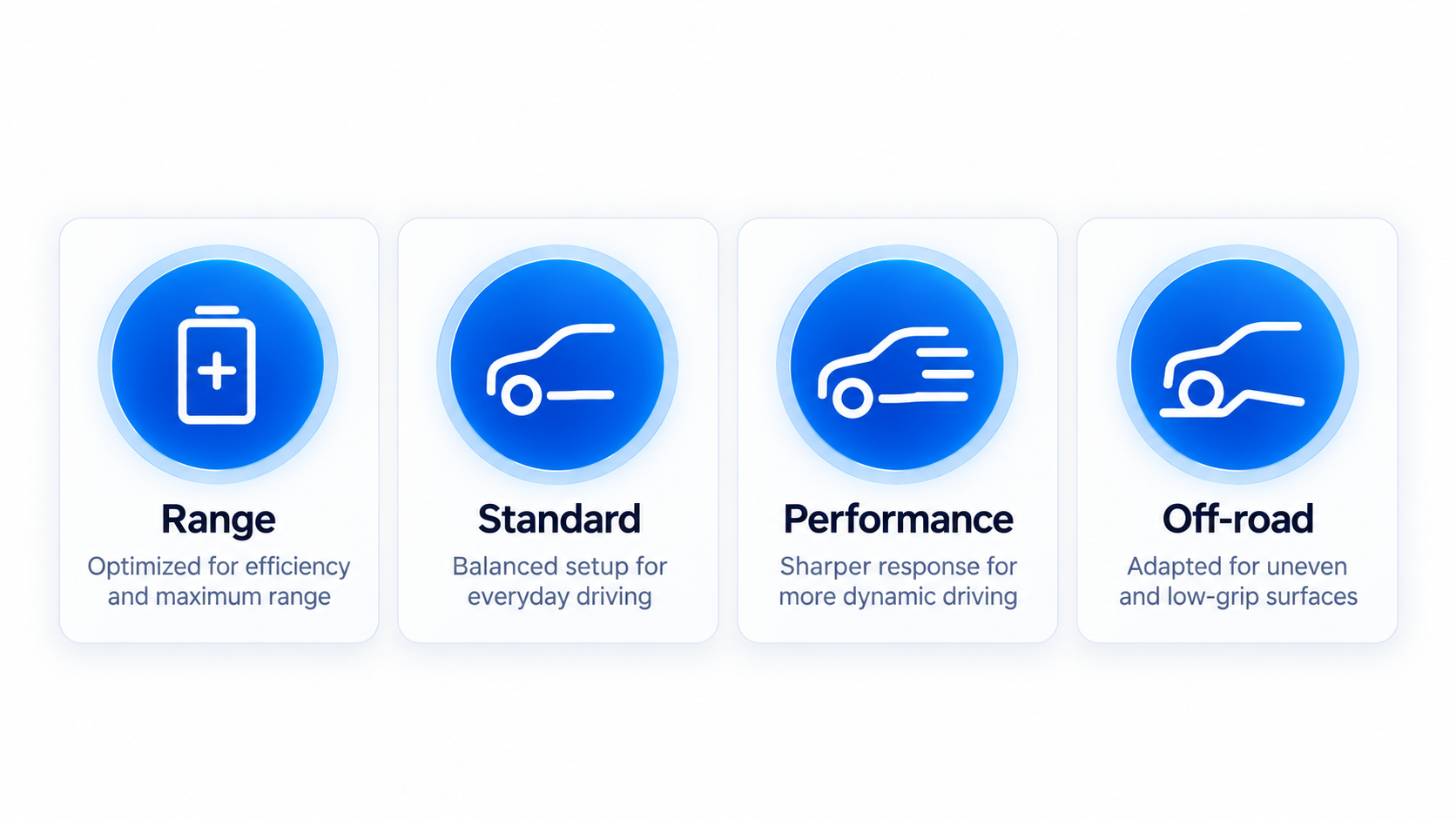
Four driving modes
For most of our test, the EX60 was set to Range. This was a deliberate choice, as this driving mode is most closely aligned with DrivOlution’s DNA: driving as efficiently as possible without losing sight of driving pleasure. The powertrain and climate control are optimised to minimise energy consumption and get the most kilometres out of the battery.
Anyone who fears that this might compromise the EX60 needn’t worry too much. Even with the emphasis on efficiency, the P10 AWD has more than enough power. Merging, overtaking or accelerating vigorously is effortless. During normal day-to-day use, we rarely felt the need for more.
Even so, we couldn’t completely ignore Performance mode. We selected it once during a short drive, and the P10 immediately showed what it’s still capable of. The throttle response becomes sharper and the acceleration is nothing short of impressive. Impressive, exceptionally fast and fun to experience for a moment, but at the same time, the question arises as to how often you actually need that sort of performance on public roads.
For us, therefore, the EX60’s added value does not lie in constantly utilising its full power, but in the way it manages to combine strong performance with efficiency. And that is precisely where the P10 AWD felt most at home during our test.
Brake energy recovery: 4 levels
One Pedal Drive
The EX60 allows the driver to choose from four levels of regenerative braking: Off, Low, High and Automatic. Conveniently, you can switch between these four modes directly from the home screen of the central display. This keeps the controls relatively straightforward, although making any changes whilst driving still requires a glance at the screen. As there are no paddles on the steering wheel, it is less intuitive than systems where you can adjust the regeneration with your fingers.
Just when you switch One Pedal Drive off completely, one of the EX60’s most pleasant features comes to the fore. As soon as you release the accelerator pedal, the car coasts exceptionally well and continues to roll along smoothly for a remarkably long time. This suits an anticipatory and efficient driving style perfectly, whilst also contributing to the car’s character. The combination of the quiet interior, the smooth coasting and the absence of abrupt deceleration gives the EX60 a particularly soothing and relaxed driving experience. It’s the sort of feature you come to appreciate more and more on longer journeys.

Consumption
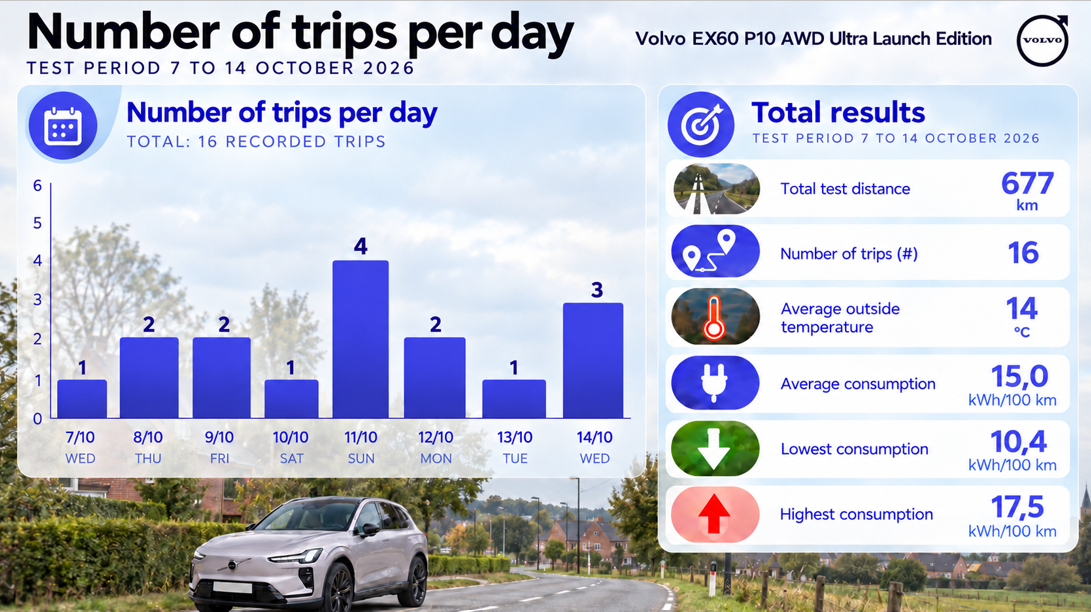
During our test week with the Volvo EX60 P10 AWD Ultra Launch Edition, we covered a total of 677 kilometres, spread over 16 journeys. The average outside temperature was 14 °C, conditions that were fairly typical of a Belgian autumn day.
Over the entire test period, we recorded an average consumption of 15.0 kWh/100 km. The individual journeys ranged from 10.4 to 17.5 kWh/100 km, which once again illustrates how much energy consumption can vary depending on road type, speed, traffic, temperature and driving style.
As always, this is just a snapshot. The figures mainly provide a good indication of what proved possible with the EX60 under real-world conditions during our test week.
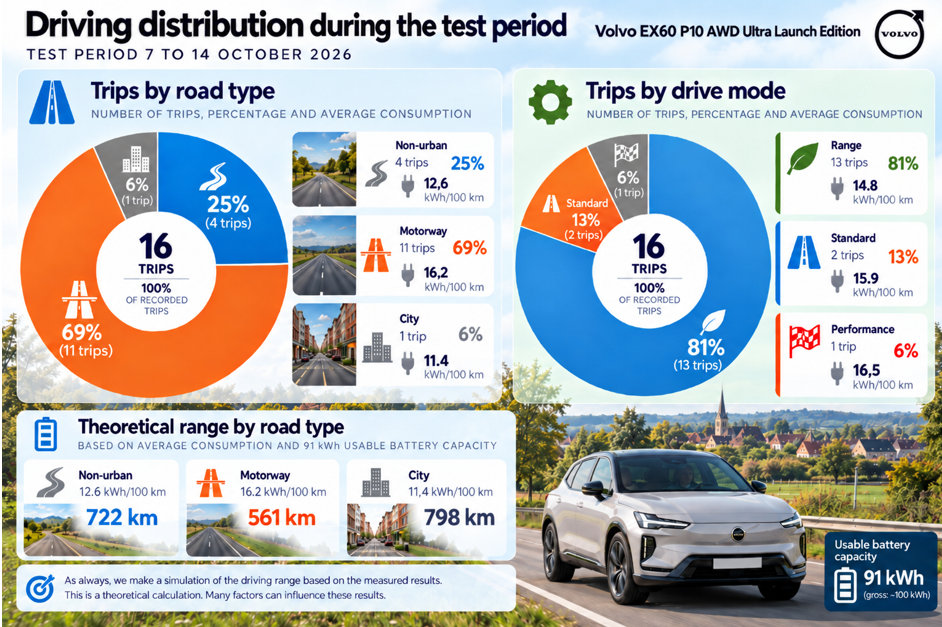
During the test week with the Volvo EX60 P10 AWD Ultra Launch Edition, we completed a total of 16 journeys. Below is an overview of how these journeys were broken down across the various road types and driving modes, with the measured energy consumption and the resulting theoretical driving range shown for each.
With 11 trips accounting for 69 per cent of the total, motorway driving was by far the most common usage scenario. There, we recorded an average consumption of 16.2 kWh/100 km. Outside the city, this figure was significantly lower at 12.6 kWh/100 km, whilst a single city journey averaged 11.4 kWh/100 km.
The choice of driving mode also says a lot about the nature of this test. In 13 of the 16 trips or 81 per cent, we opted for Range. This mode best aligns with our focus on efficient driving and resulted in an average consumption of 14.8 kWh/100 km across these journeys. Standard was used twice and averaged 15.9 kWh/100 km. We selected Performance mode just once, during a short trip, during which consumption rose to 16.5 kWh/100 km.
When we relate the measured consumption figures to the 91 kWh usable battery capacity, an interesting theoretical comparison emerges. Based on average consumption, the EX60 could travel approximately 722 km outside the city, around 561 km on the motorway and as much as 798 km in city traffic.
As always, this is a theoretical simulation and a snapshot. Temperature, traffic, speed, weather conditions and driving style can all influence the final result. Nevertheless, the figures clearly show that the EX60 makes particularly efficient use of its available energy, especially at lower speeds.
Test track
As always, we put every test car through our traditional DrivOlution test track. This enables us to assess the various models under comparable conditions in terms of fuel consumption, efficiency and driving range.
During the 3 journeys, the aim on each occasion is to drive as efficiently as possible. We do this by adopting a proactive driving style, coasting as much as possible and avoiding unnecessary stops wherever possible.
We covered 104.1 km in the Volvo EX60 P10 AWD Ultra Launch Edition, travelling on country roads, motorways and in city traffic. We drove in Range mode, with the air conditioning switched off and at temperatures between 14 and 15 °C.
Over the entire journey, we recorded an average consumption of 14.2 kWh/100 km, compared with an official WLTP figure of 17.4 kWh/100 km. Outside the city, we recorded 12.3 kWh/100 km, on the motorway 17.0 kWh/100 km and in the city 12.7 kWh/100 km. With a usable battery capacity of 91 kWh, this equates to a theoretical driving range of approximately 642 km.
The change in driving range was also noticeable. The SoC fell from 78% to 61%, whilst the predicted driving range dropped from 430 km to 350 km. Whilst driving, we clearly noticed that the EX60 constantly adjusts its prediction based on recent energy consumption and driving conditions.
Important: this remains a snapshot. Temperature, traffic, speed, driving style, route profile, use of the heating, ventilation and air-conditioning (HVAC) system, and load can all influence the results. We therefore regard these figures primarily as a realistic real-world measurement of this specific test drive.
Charging and driving range
Two charging sessions
During our week-long test drive of the Volvo EX60 P10 AWD Ultra Launch Edition, we were able to put both AC and DC charging through their paces.
During AC charging, the battery charge rose from 34% to 80%, representing 44.92 kWh of energy charged and an additional 190 km of indicated range.
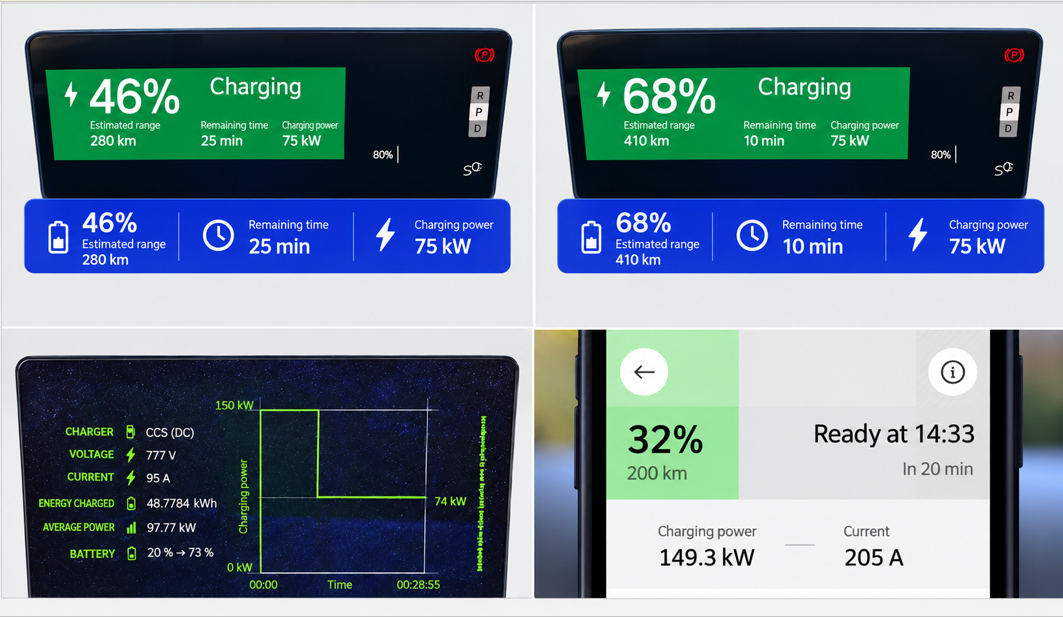
During the DC charging session, we went from 20 to 80 per cent in 34 minutes and 33 seconds. During this time, 55.1 kWh was charged and the indicated range increased from 110 to 480 km, a gain of 370 km. The peak power was 150 kW, compared to the 370 kW maximum specified by Volvo. The average charging power over the entire session was 95.7 kW.
That difference calls for a more nuanced view. The battery was not preconditioned, the outside temperature was 18 °C and the charging power temporarily dropped to 74 kW because a second vehicle was using the same charging point. It subsequently rose again to approximately 149 kW.
The choice of charging point is also important. After all, a car can never charge any faster than the charging point and the installation are capable of delivering at that moment. So, if you want to make the most of the EX60’s maximum charging potential, it’s best to choose a sufficiently powerful DC fast charger that supports the 800V architecture.
The measured peak power of 150 kW should therefore not simply be regarded as a limitation of the EX60. To properly assess the theoretical maximum of 370 kW, a test is required using a low SoC, a pre-warmed battery and a very powerful charging point, without power sharing.
One practical drawback is the loading tailgate on the left-hand side. This is not usually a problem in car parks, but when loading on the public highway, the driver may have to move closer to passing traffic. From the point of view of safety and ease of use, we would have preferred the loading point to be on the pavement side.
As always, these are instantaneous practical measurements. Temperature, SoC, preconditioning, charging point capacity and power sharing all influence the final result.
As always, these are instantaneous real-world measurements. Battery temperature, outside temperature, preconditioning, SoC, the charging point’s capacity and any power sharing within the charging system all influence the final charging result.
During the charging process, the EX60 keeps the driver clearly informed. The top two photos show the driver display at two different stages during charging. This displays, amongst other things, the SoC (%), the remaining range (km), the remaining charging time, the current charging power (kW) and the set target battery level of 80%.
The photo at the bottom left shows the information available directly on the screen of the DC charging point, such as the charging power, voltage, current, energy charged, average charging power and the change in SoC.
The photo at the bottom right shows the information displayed in the Volvo Cars app. The app allows the driver to monitor the charging process remotely, including the current SoC, remaining charging time, charging power and the set target battery level.
Drive and comfort
Ride comfort and interior
In terms of ride comfort, the Volvo EX60 P10 AWD Ultra Launch Edition makes a strong first impression. Our test car drove remarkably smoothly and quietly, with very little road, wind or engine noise penetrating the cabin. This gives the EX60 a particularly soothing character, especially on longer journeys. Road imperfections are also neatly filtered out, without the car feeling soft or detached.
Inside, the overriding impression is one of space and tranquillity. The seating position up front is comfortable, and the seats offer a good balance between comfort and support. Passengers in the back have little cause for complaint either: there is plenty of legroom and headroom, and comfort remains high there too.
The interior itself clearly follows the current minimalist trend. In front of the driver is a compact digital display, whilst the large touchscreen takes centre stage. This screen is used not only to control infotainment and navigation, but also a large proportion of the vehicle and climate settings. The result looks sleek and modern, but we’re less convinced when it comes to functionality. Even for simple tasks, you often find yourself having to navigate through menus, whilst physical buttons would simply be quicker and less distracting in some cases.
Another striking feature is the steering wheel, which is not the classic round shape but rather oval in shape. This is not merely a stylistic detail: the steering wheel is deliberately positioned below the driver’s display, ensuring that the information on that screen remains clearly visible. In practice, this works quite well, although the shape of the steering wheel takes a little getting used to over the first few kilometres.
You’ll also notice this when adjusting the seat position and the mirrors, which is also done via the central screen. Of course, you don’t need to readjust those mirrors every time you drive, but we would still have preferred a more traditional solution for the seat. Furthermore, in our test car, we couldn’t find a traditional memory function for the seat position. That might seem like a minor detail, until, for example, you recline the seat slightly for a quick power nap. Finding your exact familiar driving position again afterwards is then less straightforward than with a traditional memory button.
A head-up display would also have been welcome, in our view. Particularly in a car where so much information and so many functions are displayed on screens, a HUD would help to keep essential driving information closer to the driver’s field of vision.
Volvo does allow you to create multiple user profiles. That’s a plus, as it means personal preferences and settings can be saved for each driver. In your own car, this can make day-to-day use noticeably more pleasant. However, in a test vehicle, which is used by different drivers and frequently switches between profiles, the system does not always work as intuitively as one might expect in practice.
Access to the car is also distinctly modern. There is no traditional key; instead, it is replaced by a card. As you approach, the EX60 unlocks automatically and the strikingly designed door handles extend outwards. When you leave, the car locks again automatically. In practice, this works well, but anyone who still prefers to hold a key in their hand will need a little time to get used to it.
Another detail that takes a bit of searching for is the storage compartment in the centre console. It’s located beneath the wireless charger, in a place you wouldn’t immediately expect. Once you know where it is, it’s obviously useful, but the placement isn’t exactly intuitive.
Fortunately, the EX60 continues to impress in practical terms. The boot offers 634 litres of space, which increases to 1,647 litres when the rear seats are folded down. There’s also a 58-litre frunk at the front, which is handy for charging cables and smaller items.
The conclusion is therefore quite clear: the EX60 impresses above all with its smooth, quiet and relaxed ride, its spacious interior and its excellent seating comfort. At the same time, with its highly digitalised interior, Volvo also highlights the downside of modern minimalism: whilst it looks exceptionally well-designed, some functions are not necessarily made any simpler as a result.
Driver assistance systems (ADAS)
Driver assistance systems: plenty of technology, but thankfully not constantly intrusive
The Volvo EX60 features an extensive range of driver-assistance systems, with Pilot Assist being one of the key functions. The system combines adaptive cruise control with steering assistance and can also assist the driver when changing lanes. Other features include traffic sign recognition, lane-keeping assist, collision warnings and various active safety systems that can intervene if necessary.
It should be noted, however, that some of this technology is no longer considered exceptional. Various driver-assistance systems have now become mandatory under the European General Safety Regulation (GSR). As a result, the distinction between brands lies less and less in the presence of the systems themselves, and more in how well they are calibrated and how smoothly they operate in practice.
And that’s precisely where the EX60 scores particularly well. The Driver Monitoring system effectively monitors the driver’s attention, but does so without constantly intruding. That’s worth noting, because in many other recent models, warnings about attention, line of sight or perceived distractions can become rather irritating quite quickly. In the Volvo, the system remains active, but usually without giving the impression that you’re constantly being told off.
The assistance provided during a lane change is also impressive. In particular, the way in which the EX60 moves sideways stands out positively. The movement is gradual, controlled and without any abrupt steering input. As a result, the manoeuvre feels much more natural than with systems that seem to almost drag the car from one lane to another. This makes it easier for the driver to trust what the car is doing.
Pilot Assist itself also operates smoothly and predictably. The system monitors speed and the distance to the vehicle ahead and, if desired, can also assist with lane positioning. Furthermore, the steering assistance can be switched off separately, allowing the speed and distance control to remain active without the car constantly steering along with you.
That does not mean that everything is perfect. As with virtually any modern car, it remains important to understand when a system is active, what it responds to, and when it might intervene unexpectedly. However advanced the technology becomes, it remains dependent on cameras, sensors, road markings and traffic conditions. A properly functioning driver assistance system can take some of the strain off the driver, but should never lead to blind trust.
And that is precisely where the key message remains: ADAS is a driver assistance system, not an autopilot. The EX60 supports its driver in a pleasant and generally unobtrusive way, but the responsibility always lies with the person behind the steering wheel.
Simulation driving range (km), based on trip consumption (kWh/100 km), road type, trip length (km) and usable battery capacity (kWh)
During the test week, we recorded 16 journeys of varying lengths, road types and driving modes. Based on the measured fuel consumption and the usable battery capacity of 91 kWh, we calculated the theoretical driving range for each journey.
The results clearly show how much fuel consumption – and therefore the potential driving range – varies depending on the conditions. Across the recorded journeys, average consumption was 15.7 kWh/100 km, with values ranging from 10.4 to 17.5 kWh/100 km. Based on the type of road, this results in an average simulated driving range of approximately 560 km on the motorway, 708 km outside the city and 798 km in city traffic.
The graph covers 672 km of individually recorded journeys. However, over the entire test period, we covered 677 km with the EX60. The small difference of 5 km is due to short journeys that were not included in the analysis as separate test journeys.
As always, these are instantaneous simulations based on our own real-world measurements. Temperature, speed, driving style, traffic, climate control and other conditions may affect the actual driving range.
Comparison WLTP/test results Drivolution
Even when compared to the official WLTP figures, the Volvo EX60 P10 AWD Ultra Launch Edition performed exceptionally well during our test. The official combined WLTP consumption of our test car is 17.4 kWh/100 km, whilst over 677 km and 16 journeys we achieved an average of just 15.0 kWh/100 km. That is approximately 13.8 per cent lower than the official figure.
On our standard DrivOlution test route, the difference became even greater. Over 104.1 km, we recorded an average of 14.2 kWh/100 km, which is more than 18 per cent less than the WLTP reference figure. The EX60 proved particularly efficient, especially on the open road (12.3 kWh/100 km) and in town (12.7 kWh/100 km). On the motorway, consumption rose to 16.9 kWh/100 km, but even that remained below the official combined WLTP figure.
If we take the 91 kWh usable battery capacity as our basis, the average for our entire test week would theoretically correspond to a driving range of approximately 607 km. That is surprisingly close to the official 617 km WLTP. The test route itself, at 14.2 kWh/100 km, would even yield a theoretical range of approximately 641 km.